


Wadi El Natrun sits roughly halfway between Cairo and Alexandria, a shallow desert depression that has been a heartland of Coptic monasticism since the 4th century. For today’s traveler, it is an easy but rewarding excursion from Cairo, with four living monasteries, quiet courtyards scented with incense, and monks who still welcome visitors. This guide focuses on the practical side of planning a Wadi El Natrun visit from Cairo, comparing private tours, hiring a driver and self-drive, and explaining what is realistically possible in one day.
Understanding Wadi El Natrun and its Monasteries
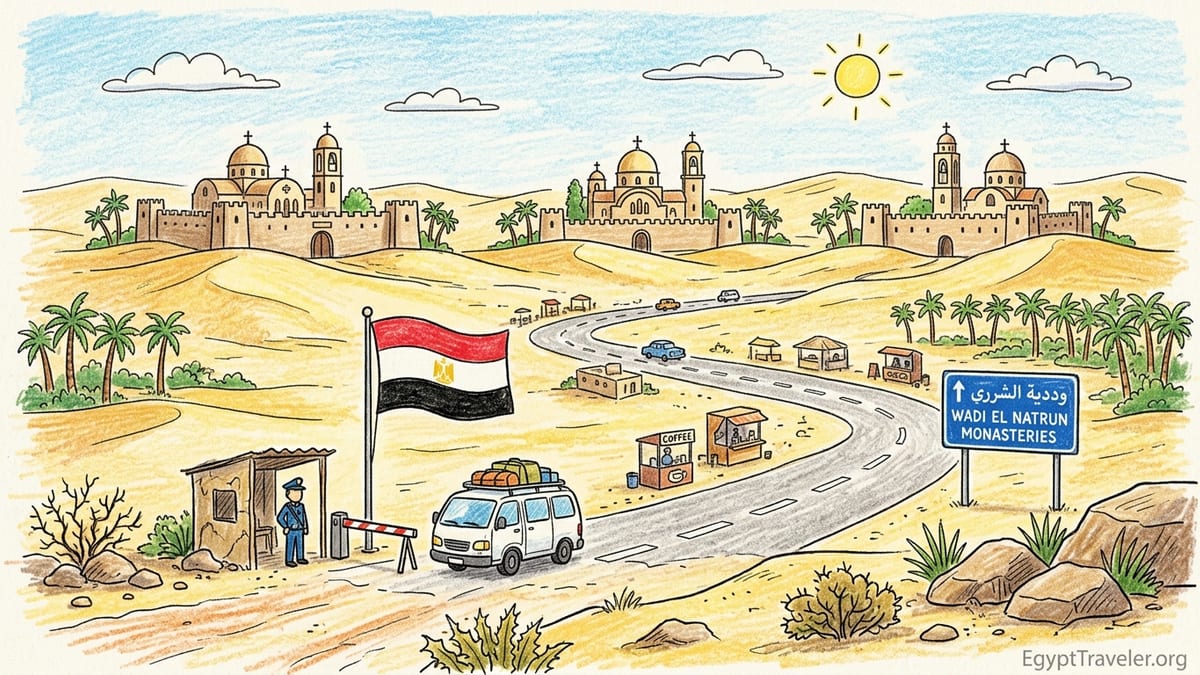
Wadi El Natrun is a desert valley in Egypt’s western Nile Delta region, about 100 to 110 kilometers northwest of central Cairo on the Cairo–Alexandria Desert Road. The area’s dry climate and isolation made it an early center of Christian monasticism; at its peak in late antiquity it hosted dozens of monasteries. Today, four active Coptic Orthodox monasteries remain open to visitors: Deir Anba Bishoy (Monastery of Saint Bishoy), Deir El Baramous (Paromeos Monastery), Deir El Suryan (Syrian Monastery), and the Monastery of Saint Macarius the Great. Most travelers manage to visit two or three of these in a day, occasionally four if starting early and moving efficiently.
All four monasteries function first as religious communities, not tourist sites. There are no formal ticket booths or turnstiles. Visitors are generally welcomed, but movement tends to follow monastic rhythms more than tourist schedules. That means chapels or relic shrines may close at short notice for prayers, and some spaces are accessible only with a resident monk. The experience is less about ticking off “sights” and more about walking through fortified walls, peering into ancient churches, and observing a living tradition.
The monasteries sit off the main highway on small access roads that are paved but narrow and occasionally potholed. Deir Anba Bishoy and Deir El Suryan lie close together and are often combined. Deir El Baramous is slightly more secluded and feels quieter. The Monastery of Saint Macarius is the southernmost and is usually visited either first or last, depending on how your driver or guide plans the loop. Driving distances between monasteries are short, generally 5 to 25 minutes, but traffic at the highway exits and occasional police checkpoints can add a bit of delay.
Getting There from Cairo: Routes, Driving Time and Police Checks
Most day trips to Wadi El Natrun from Cairo start from downtown, Zamalek, or Giza hotel areas. Under typical traffic conditions, expect a drive of about 1.5 to 2 hours one way, depending on how quickly you escape Cairo’s ring road. Vehicles head northwest along the Cairo–Alexandria Desert Road, then exit toward Wadi El Natrun at one of several signed turnoffs, from which side roads lead to the monasteries. Total round-trip driving distance is roughly 220 to 240 kilometers.
Traffic leaving Cairo in the morning can be heavy, particularly between 7:30 and 9:30 a.m. Many private tours schedule departure around 7:30 a.m. from central hotels, reaching the first monastery between 9:30 and 10:00 a.m. Independent travelers who want quieter roads sometimes leave earlier, around 6:30 a.m., which can shorten the journey to around 90 minutes. In the afternoon, returning toward Cairo, there can be delays approaching the metropolitan area, especially on Thursdays and Sundays when weekend or work traffic peaks.
Police checkpoints along the highway are routine, and cars carrying tourists may be asked to show passports or ID, hotel details, and a rough outline of their day. Drivers and guides who regularly run this route are used to these procedures and usually handle the questions. Independent self-drivers should be prepared with printed or digital copies of hotel bookings and a clear explanation that they are visiting Wadi El Natrun monasteries for the day and returning to Cairo or continuing to Alexandria. These checks are typically polite and brief but can add several minutes each time.
The roads themselves are paved, with service stations, roadside coffee kiosks, and simple restaurants scattered along the way. Larger fuel stations near the Cairo ring road and on the Desert Road often have recognizable international fuel brands, small supermarkets, basic restrooms, and sometimes a fast-food outlet. Many drivers choose to refuel and pick up water and snacks just after leaving Cairo to avoid delays later in the day.
Private Tour, Private Driver or Self-Drive: Which Works Best?
Most travelers visit Wadi El Natrun on an organized private tour from Cairo, typically marketed as a 9 to 10 hour excursion that includes hotel pick-up, air-conditioned transport, and either an Egyptologist guide or a driver-guide. In late 2026, sample rates from Cairo-based operators for two people in a private car commonly fall in the approximate range of 80 to 160 US dollars total, depending on vehicle type, group size and guiding level. These tours usually visit three monasteries, provide bottled water, and include time for a simple lunch stop either on the road or at a roadside restaurant near the valley.
Hiring a private driver without an official guide is slightly cheaper and can work well for travelers comfortable receiving explanations at the monasteries from monks themselves. A Cairo-based driver with an air-conditioned sedan or small van might charge an approximate day rate in the range of 60 to 110 US dollars for a full-day round trip, sometimes quoted in Egyptian pounds and paid in cash. In this setup you manage your own time at each monastery and rely on any informal guidance offered by resident monks or translated signage. This option offers flexibility but requires more personal initiative in asking for short tours inside the monasteries.
Self-driving is possible, especially for those already renting a car in Egypt or continuing north to Alexandria. The highway is straightforward and GPS mapping apps show the monastery access roads clearly. The challenges are mainly practical: dealing with Cairo traffic, navigating police checkpoints without a local Arabic-speaking driver, and finding correct entrances at each monastery compound, which can be confusing on first arrival. For experienced drivers who have already driven in Egypt, self-drive can provide maximum freedom and make Wadi El Natrun a natural stop on a longer road trip. For first-time visitors unused to local driving habits, a driver or tour minimizes stress.
When comparing the options, consider how much interpretation and cultural context you want. An Egyptologist or specialist Coptic guide can connect what you see in the monasteries to broader Egyptian and Christian history. A simple driver will know the logistics but not necessarily the detailed stories. Self-driving offers independence but leaves you reliant on whatever English-speaking monk or visitor you encounter. For many travelers, a compromise is booking a private driver through a Cairo hotel or reputable operator, then asking for short tours from monks at each monastery.
How Monastery Rhythms Shape Your Day
The monasteries of Wadi El Natrun do not operate on fixed “tourist attraction” hours in the way that museums or historic sites in central Cairo might. In practice, visitor access tends to cluster between mid-morning and late afternoon, loosely around 9:00 a.m. to 4:00 or 5:00 p.m. Outside this window, gates may be officially closed or practically inaccessible to casual visitors, especially in the early morning or after sunset. On major Coptic feast days and during Holy Week, visiting patterns can shift significantly, and monasteries may be crowded with pilgrims or may limit access to certain spaces.
Residential areas are off-limits, but churches, refectories, and courtyards are usually open, subject to prayer times. Liturgies and prayers often take place at dawn or in the early morning, and parts of the churches may close briefly at other times for community worship. This affects how much you can see at a given moment. For example, a chapel with revered relics might close while monks pray, then reopen half an hour later. On a typical day trip, a flexible attitude helps: if a particular relic room is closed when you arrive, your guide or a monk might suggest visiting the main church first and returning later.
Monks frequently offer short guided walk-throughs of key spaces, often in Arabic, sometimes in English or French if someone is available. These tours can range from ten minutes to nearly an hour, depending on interest and the monk’s schedule. On a busy weekend, your group might be combined with Egyptian pilgrims; on a quiet weekday, you may find yourself almost alone. Because the monasteries are active religious centers, photography rules and access can change without formal notice. Expect a more fluid experience than at a standard archaeological site and plan your day with generous buffer time at each stop rather than a rigid minute-by-minute schedule.
Many visitors find that the monastic rhythm, with its alternation of silence, bells, and small groups of worshippers, is central to the experience. Loud behavior, speakerphones, and large group photos in doorways are discouraged. On Fridays and Sundays, when Egyptian families and church groups are more likely to visit, the atmosphere can be livelier but still devotional. Travelers seeking more quiet should consider scheduling their day trip on a midweek day outside major religious holidays.
Which Monasteries to Visit on a Day Trip
Across a standard full-day trip from Cairo, most itineraries focus on three monasteries, occasionally four for fast-moving groups. A common route begins with the Monastery of Saint Macarius the Great, then continues to Deir Anba Bishoy and Deir El Suryan, which are near each other on the same approach road. Those with extra time may add Deir El Baramous, which lies slightly more secluded and can feel quieter and more contemplative.
The Monastery of Saint Macarius stands out for its significance to early monasticism and its relatively large complex. Visitors typically walk through a walled compound with a historic church, refectory, and some modern structures. Deir Anba Bishoy is well known among Egyptian pilgrims for the relics of Saint Bishoy, considered a beloved “desert father.” Deir El Suryan is notable for its rich iconography and its historical connection with Syriac Christian monks, while Deir El Baramous is often perceived as the most tranquil, with a sense of isolation that recalls the valley’s earlier austerity.
In practical terms, a realistic schedule for most private tours from Cairo might look like: departure around 7:30 a.m., arrival at the first monastery between 9:30 and 10:00 a.m., about 60 to 75 minutes on site, then a 10 to 20 minute drive to the next monastery. A brief midday stop for a simple lunch or snacks, then one more monastery in the afternoon, leaving the valley around 3:30 or 4:00 p.m. and arriving back in Cairo between 5:00 and 6:00 p.m. Ambitious visitors might squeeze in a fourth monastery by shortening each stop, but that often means less conversation with monks and fewer moments of quiet observation.
Travelers deeply interested in early Christian history or Coptic art may feel that even one full day is not enough. In that case, some choose to overnight in nearby basic accommodation or to split their monastery visits across two days while en route between Cairo and Alexandria. For most first-time visitors, however, three well-paced monastery visits in one day, with time for questions and reflection, provides a satisfying introduction without feeling rushed.
Meals, What to Wear and How to Show Respect
There are no mainstream tourist restaurants inside the monastery walls. Most private tours include a stop at a roadside restaurant or service area along the Cairo–Alexandria Desert Road, offering grilled meats, rice, salads, and simple Egyptian dishes, or a quick meal at a casual eatery near the highway exits. Another common pattern is to have a substantial hotel breakfast in Cairo, then rely on bottled water and light snacks during monastery visits, taking a late lunch on the drive back. Travelers with dietary restrictions should carry some backup food, as vegetarian or gluten-free options at roadside stops can be limited.
Dress expectations align with visiting an active church rather than a museum. For both men and women, shoulders and knees should be covered. Lightweight long trousers or skirts and breathable shirts or blouses work well in the desert climate. Scarves for women are not always mandatory, but many female visitors choose to carry one to cover their hair inside church spaces, particularly when services or prayers are underway. Closed shoes or sturdy sandals are recommended; surfaces can include stone floors, uneven paving and sandy courtyards.
Behavioral norms emphasize quiet respect. Conversations should be kept low, especially inside churches and near prayer areas. When a monk speaks, it is polite to give full attention, refrain from interrupting, and ask questions at natural pauses. Photography rules vary by monastery and sometimes by room; when in doubt, ask “photo ok?” or wait for clear signals. Flash is often discouraged, particularly around icons and painted surfaces. It is customary, though not obligatory, to leave a small donation when a monk has given you a personal tour or spent time answering questions.
Alcohol should not be brought into monastery grounds, and smoking is generally restricted to specific outdoor areas, if permitted at all. Public displays of affection, loud laughter, and climbing on walls or rooftops for photographs are inappropriate. Visitors traveling with children should prepare them in advance about quiet behavior and the importance of not touching relics, icons, or liturgical objects unless expressly invited.
Wadi El Natrun as a Cairo Day Trip vs. a Stop to Alexandria
Most current tour offerings sell Wadi El Natrun as a full-day private excursion from Cairo, returning to the city by evening. This format is convenient for those based entirely in Cairo or those with limited days in Egypt. You can sleep in the same hotel, avoid luggage logistics, and focus solely on the monasteries without needing to coordinate onward travel. For travelers whose main priorities are the Giza Pyramids, the Egyptian Museum, and perhaps Islamic Cairo, adding a one-day Wadi El Natrun trip rounds out the experience with a deep look at Christian Egypt.
Geographically, Wadi El Natrun sits close to the main route between Cairo and Alexandria, which makes it attractive as a stop on a one-way road journey. In this scenario, you check out of your Cairo hotel in the morning, drive to Wadi El Natrun, spend several hours visiting two or three monasteries, then continue north to Alexandria to arrive by evening. This can be efficient and avoids backtracking. Many private operators are willing to quote a one-way transfer tour that starts in Cairo, includes monastery visits, and ends at an Alexandria hotel, generally priced somewhat higher than a standard round-trip day tour because of the empty return drive for the vehicle.
The main trade-off when using Wadi El Natrun as a transit stop is the added complexity of managing luggage and timing. Your bags stay in the vehicle while you explore. This is usually fine with reputable drivers, but some travelers prefer the simplicity of leaving belongings in a Cairo hotel room. Additionally, one-way trips must account for later arrival in Alexandria. Traffic into Alexandria in the late afternoon and early evening can be dense, so it is wise not to schedule tightly timed evening plans.
If your broader itinerary already includes overnight stays in both Cairo and Alexandria, building Wadi El Natrun into the road segment between the two cities is logical. If you are short on time and based only in Cairo, a classic out-and-back day trip is simpler. In both cases, a full day is still appropriate; much less than six to seven hours door-to-door would feel rushed and would likely reduce monastery time to quick photo stops rather than meaningful visits.
Guides, Language and Booking Practicalities
When booking a private tour from Cairo, pay attention to whether you are getting a licensed Egyptologist guide, a general tour escort, or a driver only. Egyptologist-led tours tend to cost more but provide deeper historical and theological context, explaining the significance of figures like Saint Macarius or Saint Bishoy and the role of the Nitrian Desert in early Christian monastic life. A driver or escort may briefly introduce each monastery but will often rely on local monks to provide most on-site explanation.
Arabic is the main language at the monasteries, but you will often find monks or lay helpers who can converse in basic English or French. On weekends and around religious holidays, there may be Egyptian visitors who can interpret informally. Still, if you are seeking detailed understanding and do not speak Arabic, booking a bilingual guide from Cairo can significantly enrich your experience. Many established Cairo-based operators list Wadi El Natrun monastery tours among their religious or cultural excursions and can arrange hotel pick-up across central neighborhoods and Giza.
Payment is typically taken in cash in Egyptian pounds or, for international operators, by card in advance. Prices vary with fuel costs, season, and demand. To get a realistic figure, compare at least two or three quotes from different operators or directly through hotels. Ask specifically what is included: door-to-door transport, museum or site fees if any are applicable, bottled water, lunch stops, and guiding. Because monasteries do not charge formal entry fees in the same manner as major archaeological sites, many tours have no additional on-site ticket costs beyond voluntary donations.
For independent travelers, it is possible to hire a taxi or private car for the day even at short notice, but booking at least a day in advance is advisable, especially during high seasons such as Christmas and Easter periods for the Coptic Church. Rental cars can be arranged through international brands present in Cairo or local agencies; if you intend to self-drive, double-check that your rental contract allows highway travel outside Greater Cairo and that you have all required paperwork for police checkpoints.
The Takeaway
Wadi El Natrun is close enough to Cairo to be logistically simple yet distant enough in atmosphere to feel truly separate from the city. The roughly 100 to 110 kilometer drive along the desert highway leads not to a single monument but to a cluster of active monasteries where prayer, study and community life continue much as they have for centuries. For many travelers, that living continuity is the main reason to visit.
In practical terms, a full-day private excursion from Cairo remains the most straightforward way to experience the valley, with three monastery visits forming a comfortable and meaningful itinerary. Those who value flexibility and already understand Egyptian driving conditions may opt for a private driver or self-drive and perhaps build Wadi El Natrun into a one-way journey toward Alexandria. Whatever the format, respecting monastic rhythms, dressing modestly, and approaching the visit with patience and curiosity will make the day more rewarding.
Travelers who arrive expecting a polished museum may be surprised by the informality of the experience: sand on the paths, unmarked doorways, and sudden encounters with chanting or bells. Those who come prepared for a slower, more contemplative day, however, often find that Wadi El Natrun becomes a highlight of their time in Egypt, a quiet counterpoint to the bustle of Cairo and the crowds of the pyramids.
FAQ
Q1. How long does the drive from Cairo to Wadi El Natrun really take? For most travelers, the one-way drive takes around 1.5 to 2 hours from central Cairo or Giza, depending on traffic leaving the city and brief stops for fuel or checkpoints. Leaving early in the morning usually shortens the journey.
Q2. How many monasteries can I realistically visit in one day? A comfortable day trip from Cairo typically allows time for three monasteries, usually a combination of Saint Macarius, Anba Bishoy, the Syrian Monastery and sometimes Baramous. Four is possible but often feels rushed.
Q3. Is it better to book a private tour or arrange my own driver? A private tour is easiest for most visitors, bundling transport, logistics, and often a guide into one package. Hiring your own driver can be slightly cheaper and more flexible but requires more initiative on your part.
Q4. Can I rent a car and drive myself to Wadi El Natrun? Yes, experienced drivers comfortable with Egyptian traffic can self-drive using the Cairo–Alexandria Desert Road and GPS directions. You will need to handle police checkpoints and navigation without local-language support, which some first-time visitors find stressful.
Q5. Are there fixed opening hours for the monasteries? The monasteries generally welcome visitors between mid-morning and late afternoon, roughly 9:00 a.m. to 4:00 or 5:00 p.m., but they do not have rigid tourist hours. Access to specific chapels or relic rooms may change based on prayer times and monastic needs.
Q6. What should I wear when visiting the Wadi El Natrun monasteries? Dress as you would for a church visit. Both men and women should cover shoulders and knees, and women may wish to carry a light scarf to cover their hair inside churches if asked. Closed shoes or sturdy sandals are recommended.
Q7. Is Wadi El Natrun suitable as a stop between Cairo and Alexandria? Yes, the valley lies close to the main highway linking the two cities. Many travelers choose to stop for several hours en route, visiting two or three monasteries before continuing to an overnight in Alexandria.
Q8. Are meals included on Wadi El Natrun day trips? Some private tours include a simple lunch at a roadside restaurant, while others plan only for bottled water and snacks, leaving you to purchase your own meals along the highway. Always confirm in advance what your tour price covers.
Q9. Do I need a specialist religious guide to appreciate the visit? A specialist guide is not essential but can greatly deepen your understanding of the history, saints and traditions linked to each monastery. Without one, you can still learn a lot from monks on site, though explanations may be more limited or offered only in Arabic.
Q10. Is photography allowed inside the monasteries? Photography is generally allowed in outdoor areas and some interior spaces, but rules vary between monasteries and specific rooms. It is best to ask permission before photographing inside churches or near relics, and to avoid flash when icons or paintings are present.