


Rosetta, officially Rashid, is one of the Nile Delta’s most evocative small cities, a place where Ottoman brickwork, quiet mosques and the ghost of the Rosetta Stone sit beside broad river views. It works best as a dedicated full-day excursion from Cairo, and with a bit of planning you can see its Rashid National Museum houses, Qaitbay Citadel and the Nile’s meeting with the Mediterranean without feeling rushed. This guide walks through road time, private-driver and guided-tour options, an efficient sightseeing order and whether it is realistic to tag on Alexandria or another Delta stop in a single day.
Understanding Rosetta and the Shape of a Day Trip
Rosetta (Rashid) sits in the western Nile Delta about 65 kilometers east of Alexandria and roughly 220 to 250 kilometers by road from central Cairo, depending on your starting point and route. In practical terms that translates to around 2.5 to 3 hours of driving one way in light to moderate traffic, and slightly longer if you are leaving Cairo after the morning rush. Most commercial Rosetta excursions from Cairo advertise total durations of 8 to 10 hours, which aligns with a realistic there-and-back travel day including sightseeing, lunch and short breaks.
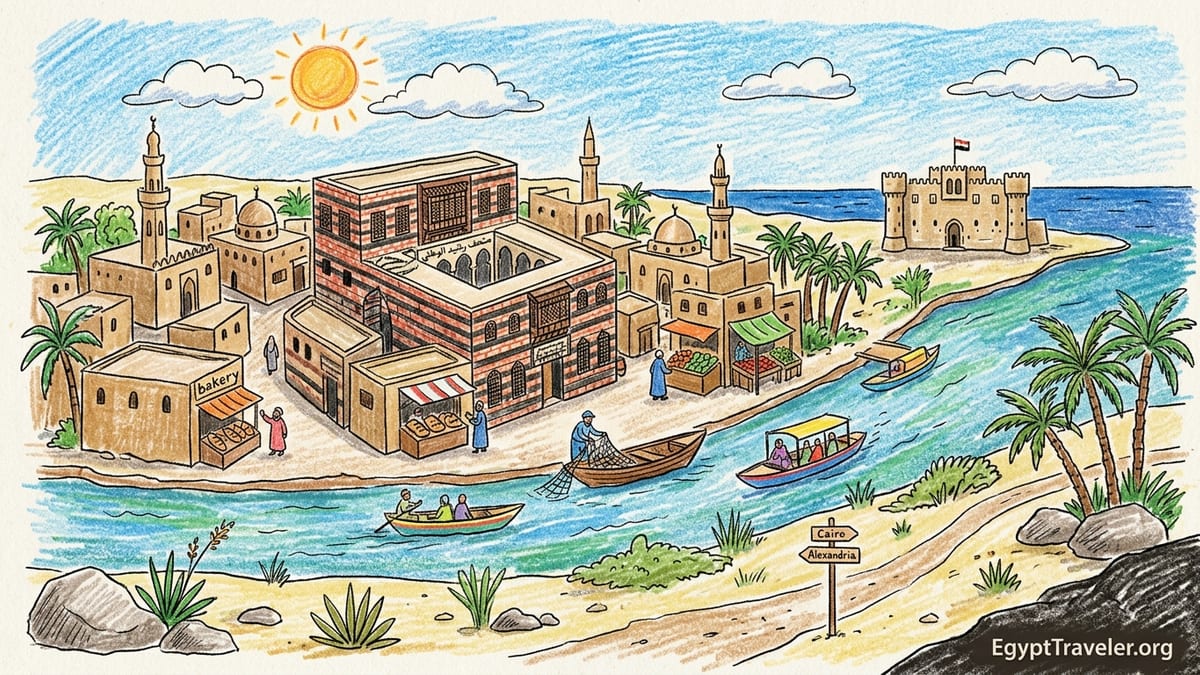
The city’s charm lies in its compact historic core. Within a small radius you can visit the Rashid National Museum complex in an Ottoman merchant house, walk between several other preserved houses and mosques, and then continue by car out to Qaitbay Citadel (Fort Julien) near the northern tip of the Nile before it reaches the Mediterranean. Many tours add a short local boat ride on the Nile branch or out toward the river mouth, which can be a highlight in late afternoon light.
Rosetta is significantly less visited than Alexandria, which means a quieter experience but also fewer services aimed at international tourists. You will not find big-name hotel chains or a dense strip of English-language restaurants, but you will encounter working bakeries, produce markets and fishermen repairing nets on the riverbanks. This low-key character is part of the appeal, especially for travelers who have already seen Giza and the Egyptian Museum and want a different, more everyday side of Egypt.
Because of the distance from Cairo and the number of included stops, Rosetta works as a single-focus day: depart early, concentrate your time in and immediately around the town, and return to Cairo in the early evening. Trying to split the same day between Rosetta and Alexandria or another Delta destination dramatically increases driving time and cuts into the slower walking and café pauses that make the town rewarding.
Getting From Cairo to Rosetta: Transport Choices and Realistic Timings
Most travelers reach Rosetta from Cairo either with a private driver (often organized through a local agency or hotel) or on a fully guided private tour. There are shared public options via bus or train plus minibus, but they involve changes in Tanta or Alexandria and are not practical for a same-day round trip unless you speak Arabic and are very comfortable with informal transport. For a first-time visitor and a tightly timed excursion, a car and driver is the sensible baseline.
In traffic conditions typical for Greater Cairo, the drive north toward the Delta usually begins on the Desert Road or Agricultural Road toward Alexandria before branching west toward Rosetta. If you depart around 7:00 am from a central Cairo hotel, expect to arrive in Rosetta between 9:30 and 10:00 am, allowing for a brief service-station coffee stop. Some tour operators list the road segment as “about 2.5 hours,” while others build in three hours to avoid pressure on the schedule. For planning, it is wise to think in terms of three hours each way and treat anything quicker as a bonus.
A private Rosetta day-tour package from Cairo that includes an air-conditioned vehicle, fuel, a licensed guide, entrance fees and lunch typically sits in the rough range of 80 to 140 US dollars per person for two people traveling together, based on current offerings advertised by mid-market Cairo and Alexandria operators. Prices trend lower for groups of three or more and higher if you want a dedicated Egyptologist or an included boat ride. Hiring only a driver through your hotel or an independent car service can be cheaper overall, but you will then pay small entry fees in cash on arrival at each site and handle navigation and language yourself.
Self-driving is an option for confident drivers who are used to Egyptian road conditions, toll booths and informal local driving styles. However, traffic around Cairo and through the Delta can be dense and sometimes aggressive, and road signage near smaller junctions is not always clear in English. Most visitors find they get better value in both time and stress reduction by booking a driver, with or without a guide, and using the travel hours to rest, read or watch the landscape change from city blocks to irrigated fields and date palms.
Independent Driver vs Guided Tour: What Works Best in Rosetta
Choosing between arranging a driver independently and booking a guided tour comes down to how much you value context, logistics support and fixed pricing versus flexibility and a slightly lower total cost. In Rosetta the main sites are relatively close together, but opening times, ticket windows and access to certain houses can still be easier with a local guide who knows current arrangements with site staff.
On a fully guided private tour from Cairo, a typical pattern is that your guide and driver pick you up at your hotel, handle all navigation, pay the consolidated ticket for Rosetta’s city monuments at the first site, and then lead you on walking routes between the historic houses and mosques. Many programs explicitly include the Rashid Museum and Ottoman houses, Qaitbay Citadel, a stroll through the local market streets and a short boat ride on the Nile branch or around the river mouth. For visitors who prefer a clear, pre-set structure and minimal hassle, this kind of package is appealing, even if it comes at a modest premium over a driver-only arrangement.
If you arrange a car and driver through your hotel or a reputable Cairo car service, you gain more freedom to linger in a café or skip certain stops, but you will need at least basic information in advance about the locations of the Rashid Museum houses, which mosques are easily accessible to non-Muslim visitors outside prayer times, and how to reach Qaitbay Citadel north of town. English is understood at major ticket points but less so in small shops and among some drivers, so clear written instructions in Arabic for your intended stops, prepared by your hotel concierge, can be very helpful.
In budget terms, a driver-only day might work out to something like 120 to 160 US dollars in total for the vehicle from Cairo, plus a modest amount in local entry fees and your own lunch in a simple fish restaurant by the river. A guided day might total 200 to 280 US dollars for two people, depending on inclusions. That difference buys you structured commentary on Rosetta’s Ottoman history, help with ordering and tipping in local establishments and a safety net if unexpected closures or detours force quick on-the-spot changes.
An Efficient Sightseeing Order: Rashid Museum, Houses, Mosques and Citadel
Once you arrive in Rosetta from Cairo, the most efficient route is to begin in the town center with the Rashid National Museum and associated Ottoman houses, continue on foot to other nearby houses and mosques, break for lunch near the river, and then finish the afternoon at Qaitbay Citadel and the Nile–Mediterranean meeting point. This sequence follows natural light, keeps backtracking to a minimum and reserves the breezier riverside and coastal settings for the hotter hours of the day.
Several tour operators start at the main Rashid Museum complex housed in a beautifully preserved Ottoman merchant residence, often identified as the Amasyali or Al-Amsili House. Here you can see period rooms with mashrabiya latticework, carved ceilings and exhibits tracing the story of the Rosetta Stone, which was discovered in nearby Fort Julien. While the original Stone is in London and a prominent replica is in Cairo, the Rosetta displays help anchor the connection between this quiet town and one of the most important artifacts in modern Egyptology.
From the museum it is an easy walk through narrow lanes to other listed houses and mills that fall under a combined “Rosetta city monuments” ticket, such as the Abu Shaheen Mill, which shows how grain was once processed for the community, and additional courtyard houses with distinctive bands of black and red brick. Nearby mosques illustrate Ottoman and local styles; exterior appreciation is usually straightforward, while interior visits depend on current prayer times and on-the-ground etiquette, so a guide’s advice is useful.
After exploring the core, many itineraries allow for a simple lunch built around Rosetta’s strong seafood tradition. One practical approach is to ask your guide or driver to recommend a local spot overlooking the river where fresh fish from the Delta is grilled to order, often alongside rice, salads and tahini. With energy restored, you can then drive out to Qaitbay Citadel, about 5 kilometers northwest of town, to spend the later afternoon exploring the squat, rectangular fort and its views along the last stretch of the Nile toward the Mediterranean.
Qaitbay Citadel and the Meeting of Nile and Mediterranean
Qaitbay Citadel near Rosetta, also known historically as Fort Julien or Fort Rashid, occupies a strategic position on the west bank of the Rosetta branch of the Nile just before it reaches the Mediterranean. Built in the late 15th century by the Mamluk sultan Qaitbay as part of a chain of coastal defenses, the fort later became globally famous as the place where French soldiers uncovered the granodiorite slab we now call the Rosetta Stone in 1799. The Stone itself is no longer here, but the connection is central to any visit.
The appeal of the fort today lies partly in its layered history and partly in its landscape. From the ramparts and upper platforms, you can look back along the green ribbon of the Delta and north toward the hazy line where the river meets the sea. On a clear day the light is bright and slightly silvery, with long views that make it easy to understand why this low structure was once so important in guarding the approaches to Egypt’s heartland.
Many day-trip itineraries include time at Qaitbay Citadel for both exploration and photography, followed by a short local boat ride that may trace the river channel toward its mouth or make a loop around the fort’s waterfront. Boats are typically simple, open-deck craft operated by local families, and prices are often negotiated on the spot if your package does not include the ride. As always, it helps to agree on the route and duration in advance, in Egyptian pounds, and to keep a light jacket or scarf handy for the breeze.
If you are keen to see the exact point where the Rosetta branch merges with the Mediterranean, ask your guide or boat operator whether conditions allow for a closer approach on the day. The physical meeting line shifts with sediment and currents, and weather or local regulations sometimes limit how far small boats can go, but even a near approach gives a strong sense of the geography that shaped Rosetta’s fortunes.
Can You Combine Rosetta With Alexandria or Other Delta Stops?
Because Rosetta lies relatively close to Alexandria on the map, it is tempting to imagine a day in which you leave Cairo, visit Rosetta in the morning, continue to Alexandria for an afternoon on the Corniche and the Qaitbay Citadel there, and then drive back to Cairo after sunset. On paper this is feasible. In practice it usually means six to eight hours in a vehicle, compressed visits in both destinations and a high chance of arriving back in Cairo late and exhausted.
A rough breakdown helps clarify the trade-offs. From central Cairo to Rosetta is around 2.5 to 3 hours. Rosetta to Alexandria is about 60 kilometers and can take an additional 60 to 90 minutes depending on traffic on Delta roads. Alexandria back to Cairo is normally two and a half to three hours. Once you add on real sightseeing time in Rosetta’s historic core, at Qaitbay Citadel and in at least one or two key Alexandria sites such as the seafront citadel or the modern library area, you quickly exceed a sensible 10-hour touring window.
For this reason, most commercial itineraries marketed today sell Rosetta as its own day trip from Cairo rather than as an add-on to Alexandria. Some regional tours that focus specifically on the Nile Delta will place Rosetta and Alexandria on consecutive days with an overnight in Alexandria or another nearby base, allowing more relaxed time in each. If you have a strong interest in both places and a limited schedule, consider allocating one full day to Alexandria and one separate full day to Rosetta, or folding Rosetta into a wider Delta journey that includes Tanis, Damietta or monastery visits with at least one overnight outside Cairo.
Trying to add a third stop such as Tanta, Damanhur or Rashid’s surrounding villages into a single Cairo-based day further reduces your flexibility for delays or unplanned discoveries. The character of Rosetta rewards walking slowly through alleys, stepping into quiet courtyards and pausing along the river. It is this unhurried aspect that is most likely to vanish if you attempt to string multiple destinations into a single loop from Cairo.
Practical Tips for Making the Most of a Rosetta Day Trip
Whichever transport setup you choose, success in Rosetta starts with an early departure from Cairo. A 7:00 am hotel pick-up allows you to stay ahead of some city traffic and be in Rosetta by mid-morning, leaving a comfortable block of three to four hours in the historic center, a lunch break and another one to one and a half hours at Qaitbay Citadel before driving back in late afternoon. Aim to be on the road south by around 4:30 or 5:00 pm to avoid the latest return and nighttime fatigue.
Dress practically for a conservative, working Delta town. Lightweight, breathable clothing that covers shoulders and knees, comfortable closed shoes for uneven pavements and a hat or scarf are recommended. Interiors of Ottoman houses can be noticeably cooler than the street, while the top of Qaitbay Citadel and the boat rides can feel exposed and breezy, so layering is useful. In summer, constant hydration is key; in winter, a light fleece or windproof layer for the riverside may be necessary, especially if a north wind is blowing off the Mediterranean.
Bring cash in small Egyptian pound notes for local snacks, café stops and tips. Even if your tour includes lunch, you may want to buy pastries from a bakery or juice from a street stand, and these small transactions are easier without relying on change from large bills. Photography is generally welcomed in the streets and at the fort, but it is good etiquette to ask before photographing individuals at close range or inside private businesses.
Finally, be realistic about energy levels. If you have spent previous days in Cairo at major sites such as the pyramids, Saqqara or the Grand Egyptian Museum, Rosetta can be a more intimate and slower-paced contrast. Give yourself permission to sit with tea in a café and watch river life for half an hour rather than ticking off every possible house and mosque. The town’s layered history is important, but its present-day rhythm is just as much a reason to come.
FAQ
Q1. How long does it take to drive from Cairo to Rosetta (Rashid)?
In normal conditions it takes roughly 2.5 to 3 hours each way between central Cairo and Rosetta, depending on traffic, chosen route and short service stops.
Q2. Is Rosetta realistic as a full-day trip from Cairo?
Yes. Most travelers treat Rosetta as an 8 to 10 hour excursion, with around 5 to 6 hours of total driving and 3 to 4 hours of on-the-ground sightseeing plus a lunch break.
Q3. Do I need a guided tour, or is a private driver enough?
A private driver is sufficient for confident, independent travelers, but a guided tour adds context, help with tickets and easier communication in a town where English is less common outside tourism staff.
Q4. What are the must-see sights in Rosetta on a day trip?
Core stops include the Rashid National Museum and Ottoman houses in the old town, selected mosques as appropriate, Qaitbay Citadel (Fort Julien) and the Nile–Mediterranean meeting area.
Q5. Can I combine Rosetta and Alexandria in one day from Cairo?
It is technically possible but usually means too much driving and rushed visits. Most visitors are better off giving each city its own separate full day.
Q6. How much does a Rosetta day trip from Cairo typically cost?
As a broad guide, a private driver-only day might total around 120 to 160 US dollars for the car, while a guided package with entries and lunch often falls around 80 to 140 US dollars per person for two people.
Q7. Is Rosetta suitable for families with children?
Yes, provided children can tolerate the driving time. The fort, boats and river views often appeal to younger travelers, but plan extra snack breaks and sun protection.
Q8. Are there good food options in Rosetta?
Expect simple, local restaurants rather than international chains. Many visitors opt for fresh grilled fish and rice at small riverside places recommended by their guide or driver.
Q9. What should I wear when visiting Rosetta’s mosques and houses?
Wear modest clothing that covers shoulders and knees, with comfortable shoes. Women may wish to carry a scarf to cover hair if entering active prayer spaces.
Q10. Is it possible to do a boat ride to the point where the Nile meets the Mediterranean?
Short local boat rides are commonly offered, and in good conditions some can approach the river mouth, though exact routes depend on weather, currents and local regulations on the day.