


The Nile Delta begins just north of Cairo, yet most visitors rush straight past it on their way to Luxor or the Red Sea. That is slowly changing. A growing number of operators now offer day trips and multi-day private circuits to the Delta’s lesser-visited sites, from the ruined capitals of Tanis and Bubastis to the Ottoman streets of Rosetta and the desert monasteries of Wadi El Natrun. This guide looks at what those tours actually look like on the ground today and helps you choose the right excursion for your interests, budget and time.
Understanding Nile Delta Tours from Cairo Today
Commercially marketed Nile Delta excursions from Cairo are still a niche product compared with Giza and Saqqara, but they have become easier to book in recent years. Large global resellers list Wadi El Natrun monastery day trips and, less frequently, Rosetta and Tanis excursions, while Egypt-based agencies quietly promote private circuits that combine several Delta sites with hotel pick-up from Cairo. Most of these tours are sold as private, full-day outings with an Egyptologist guide, air-conditioned vehicle and flexible schedule rather than fixed big-bus departures.
As of 2026, Wadi El Natrun is the most widely available Delta-style tour from Cairo, with multiple local operators offering monastery-focused day trips that run year-round and can be booked on short notice. Typical tours include hotel pick-up around 7:00 to 8:00 in the morning, a drive of roughly 1.5 to 2 hours out on the Cairo–Alexandria Desert Road and visits to three or four Coptic monasteries before returning to Cairo in the late afternoon. Operators such as Travel Joy Egypt, Egypt Fun Tours and WOW Tours Egypt promote these as private cultural or Christian heritage days with Egyptologist guides and monastery access arranged in advance.
Tours to Tanis, Bubastis and Rosetta are more specialized and are rarely found as mass-market group departures. Instead they tend to be arranged as custom private day trips by Cairo-based agencies that can provide a car, driver and guide. Because of the longer distances involved, these itineraries are more affected by traffic, road conditions and security checks, and they often run 10 to 12 hours door to door. Despite that, prices can remain competitive for couples or small groups, since the cost of vehicle and guide is shared.
When comparing offers, note that many agencies use similar language to advertise Delta itineraries, but the details matter. Some include all entrance fees and lunch in the upfront price, while others advertise a cheaper basic tour and leave you to pay site tickets and meals as you go. It is worth reading the inclusions carefully and confirming in writing what is actually covered before you book.
Tanis and Bubastis: Archaeology-Focused Day Trips
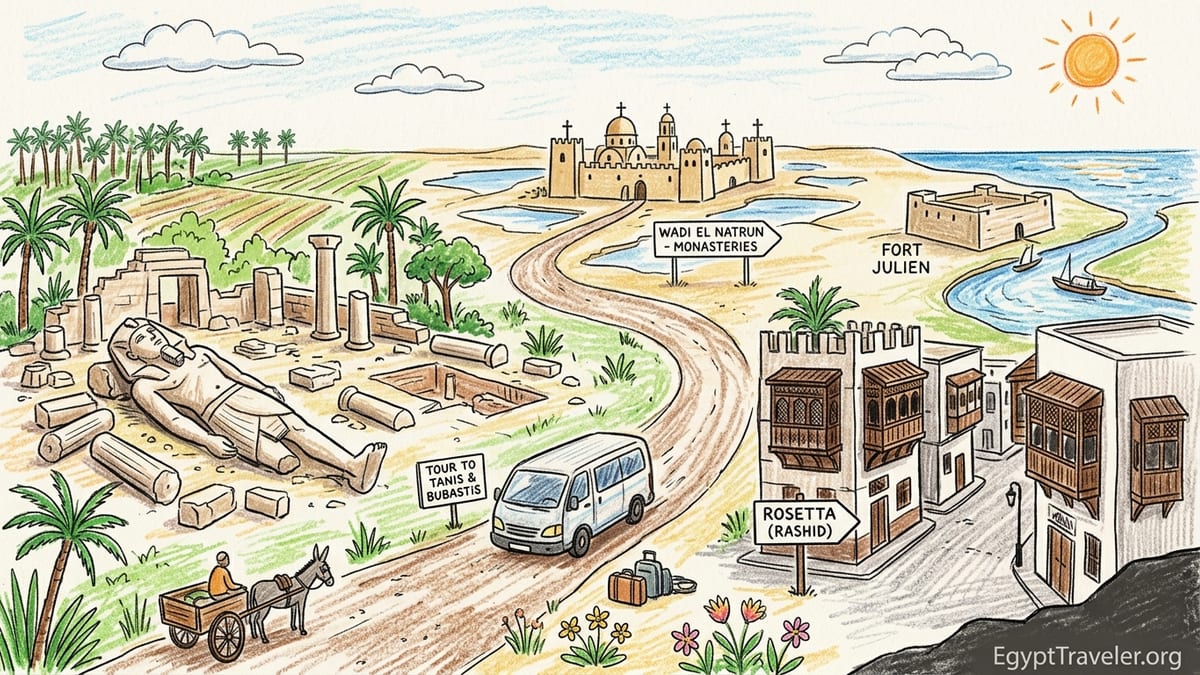
For travelers primarily interested in Pharaonic archaeology, a combined Tanis and Bubastis day trip is the most rewarding Delta excursion from Cairo. Tanis, near the modern village of San El Hagar, was the capital of Egypt during the 21st and 22nd Dynasties and is famous for the royal tombs excavated by French Egyptologist Pierre Montet. The site today is a sprawling field of temple ruins, broken colossi and stone blocks recycled from earlier monuments at Pi-Ramesses, with an open, slightly wild feel compared with the manicured paths of Giza or Karnak.
Bubastis, also known as Tell Basta, lies near the modern city of Zagazig and was once the cult center of the cat goddess Bastet. Visitors today find a partially excavated temple complex with colossal granite blocks and remnants of sacred waterways that once framed the sanctuary. Modern excavations and geoarchaeological work are ongoing in the wider landscape, but the core temple ruins are accessible to visitors, often with very few other tourists around.
From Cairo, operators describe the drive to this area as around 2.5 to 3 hours each way depending on traffic and the exact route, usually heading northeast into the eastern Delta. Travelers who have driven independently report that the distance is roughly 160 kilometers to Tanis, but that frequent slowdowns through villages and on rural roads make it feel longer in practice. A realistic schedule sees you leaving Cairo around 7:00 a.m., stopping first at Bubastis for one to two hours, then continuing on to Tanis for a longer visit before making the return journey, often arriving back in Cairo around early evening.
These archaeology-heavy tours are typically offered as private excursions with an Egyptologist guide and driver, since there is very little tourist infrastructure on site. Expect a full day of driving on a mix of highways and local roads, with boxed lunches or simple meals from local restaurants rather than polished tourist buffets. Entrance fees are modest compared with the big sites in Upper Egypt, but they are sometimes excluded from headline prices, so check whether your tour quote includes site tickets, lunch and bottled water, or only transport and guiding.
Rosetta (Rashid): Ottoman Heritage on the Rosetta Branch
Rosetta, or Rashid, sits on the Rosetta branch of the Nile near where the river meets the Mediterranean. It is best known in world history for the Rosetta Stone, discovered by French soldiers in 1799 at nearby Fort Julien and later taken to the British Museum. Today, tours to Rosetta from Cairo focus not on the stone itself, which is no longer in Egypt, but on the preserved Ottoman architecture and riverine landscapes that survive in the town and at the fort.
Typical Rosetta itineraries include a visit to Fort Julien, the 18th-century Ottoman fort that overlooks the final stretch of the Nile before it reaches the sea. The fort is a low rectangular structure with bastions and a central blockhouse, and guides use its story to explain both the Napoleonic campaign and Egypt’s shifting coastal defenses. Back in town, visitors usually walk through narrow streets lined with multi-story Ottoman houses featuring wooden mashrabiya balconies and internal courtyards, such as those used today as the Rosetta Museum or restored mansions.
From Cairo, a Rosetta day trip is a long but manageable outing. Most operators route via the Alexandria Desert Road toward the coast and then turn east along the Delta, a journey of roughly three hours in good traffic. The day usually starts with an early pick-up between 6:30 and 7:30 a.m. and returns to Cairo in the evening. Because Rosetta is not a mass tourism destination, tours tend to be private, though it is possible to find places on shared small-group excursions during high season if you book through larger resellers or specialized cultural tour companies.
Prices vary widely, but as a rule of thumb, a private Rosetta tour for two people with an English-speaking Egyptologist, air-conditioned car, hotel pick-up and drop-off, lunch at a local restaurant and basic site fees may be quoted in the mid to high double digits per person in US dollars, depending on the season and the agency’s standard. Many operators can also add Rosetta to a longer circuit that continues on to Alexandria or back through Wadi El Natrun, turning the day into a broader exploration of the western side of the Delta.
Wadi El Natrun: Coptic Monasteries and Christian Heritage
Wadi El Natrun lies west of the Nile Delta along the Cairo–Alexandria Desert Road and has been a center of Coptic monasticism since the early centuries of Christianity. The valley is scattered with salt lakes and historic monasteries, several of which are open to visitors. Modern Coptic tradition still regards Wadi El Natrun as one of the most important monastic centers in the country, and many tours from Cairo present it as the spiritual highlight of a trip.
Current Wadi El Natrun day trips from Cairo are heavily oriented toward private travel. Operators such as Egypt Day Tours, Travel Joy Egypt, WOW Tours Egypt and others advertise full-day private excursions including hotel pick-up in Cairo or Giza, an English-speaking Egyptologist guide, a modern air-conditioned vehicle and visits to three or four of the main monasteries. Common stops include Deir al-Baramus, considered one of the oldest monasteries in the valley, Anba Bishoy Monastery, where the relics of Saint Bishoy are venerated, the Monastery of the Syriacs (Deir El-Suryani), the smallest of the communities, and sometimes the Paromeos Monastery.
The driving time from central Cairo is typically advertised as about 1.5 to 2 hours each way, depending on traffic leaving the city. Most itineraries start around 7:00 or 8:00 a.m. and return mid to late afternoon, making Wadi El Natrun one of the least tiring Delta excursions in terms of hours on the road. Several operators include lunch at a local restaurant or a simple meal arranged near the monasteries, while others provide only bottled water and leave you to organize food. Entrance fees to the monasteries themselves are usually not high and are sometimes handled informally, but check whether your tour price assumes separate donations or includes any expected contributions.
Because Wadi El Natrun is both a religious site and a living monastic community, tours here tend to emphasize respectful behavior and modest dress. Your guide will usually handle contact with monks and ensure that you visit churches and courtyards where visitors are welcome. For travelers especially interested in Coptic history or Christian pilgrimage routes, some agencies can build Wadi El Natrun into multi-day Holy Family or Christian heritage itineraries, combining it with sites in Cairo, the Red Sea region or Upper Egypt.
Multi-Site Private Circuits Across the Delta
For travelers with a deep interest in Egyptian history who want to see more than one Delta site, several Cairo-based operators offer private circuits that link two or more destinations in a single long day or over two days. A popular single-day combination is Tell Basta (Bubastis) in the morning and Tanis in the afternoon, with hotel pick-up around 7:00 a.m., highway driving to Zagazig, a guided tour of the Bastet temple ruins and then continuation to San El Hagar for a more extended exploration of Tanis. Travelers who have done this combination report full 12-hour days, returning to Cairo around sunset after a final tea or late lunch on the road.
Another style of circuit builds Wadi El Natrun into a broader western Delta itinerary. In this case you might leave Cairo in the morning, stop for several hours visiting three monasteries in Wadi El Natrun with an Egyptologist guide, then continue north to Rosetta in the same day or overnight in Alexandria before touring the coast and Rosetta the following morning. Pilgrimage-focused tour companies sometimes follow a similar pattern, using comfortable coaches and incorporating prayer time and talks at the monasteries.
True multi-day Delta-focused packages remain a minority product, but they are increasingly offered as add-ons to longer Egypt trips built around Cairo and Upper Egypt. Some agencies advertise 10 to 14-day itineraries that include a day in Wadi El Natrun between Cairo and Alexandria, or a detour east to Tanis as part of a biblically themed “Land of Goshen” excursion. These extended circuits typically use private vehicles for flexibility and schedule monastery or ruin visits at quieter times of day.
If you are considering a multi-site circuit, be realistic about the amount of driving involved. Combining Tanis and Rosetta in a single day from Cairo, for example, is theoretically possible but punishing, with hours of backtracking across the Delta. Pairings that align naturally with the major highways, such as Bubastis plus Tanis for the eastern Delta or Wadi El Natrun plus Rosetta or Alexandria for the western side, are usually more comfortable and less rushed.
Comparing Tour Formats, Inclusions and Driving Time
Across the Nile Delta, tours sold from Cairo broadly fall into three practical formats. The first is the private full-day excursion with hotel pick-up, an Egyptologist guide and a dedicated vehicle. This format dominates for Tanis, Bubastis and Wadi El Natrun, where visitor numbers are too low for regular big-group departures. The second is the occasional small-group tour, more likely to appear on major booking platforms for Wadi El Natrun, where demand from culturally curious Cairo visitors and pilgrims supports shared departures. The third is the custom multi-day circuit that folds Delta sites into a longer Egypt itinerary, often operated for faith-based or specialist archaeology groups.
Driving time is a key factor in choosing where to go. From Cairo, Wadi El Natrun is the quickest Delta destination at about 1.5 to 2 hours each way on the main desert highway, making it suitable even for travelers who tire easily or are short on time. Bubastis lies roughly 1.5 to 2 hours away by road to Zagazig, while continuing on to Tanis adds another hour or more on slower roads, so a combined day can involve 5 to 6 hours of driving. Rosetta requires around 3 hours each way in good conditions, since you are effectively going much of the way toward the Mediterranean coast.
In terms of inclusions, many mid-range private tours now routinely bundle hotel pick-up and drop-off, bottled water and the services of a licensed Egyptologist. Some operators, particularly those marketing to international clients through resellers, also include entrance fees and lunch at a local restaurant in the advertised price, simplifying budgeting. Others quote a lower base rate that covers only transport and guiding. Because site entrance charges and food costs can add up over a day for two or three people, it is wise to compare like with like and to ask for a clear written list of what your payment covers.
Larger international platforms sometimes charge more per person than local agencies for broadly similar itineraries, in exchange for standardized cancellation policies, credit card payments and English-language customer support. Local agencies, on the other hand, can often tweak itineraries to fit your interests, for example adding a short stop at a village market between Bubastis and Tanis, or allowing extra time at a particular monastery in Wadi El Natrun if you have a religious connection there.
Which Delta Tour Fits Your Interests?
Rather than treating all Nile Delta excursions from Cairo as interchangeable “off-the-beaten-path” days out, it is more useful to match each destination to your specific interests. If your primary focus is Pharaonic archaeology, the Tanis and Bubastis circuit is the most logical choice. You will spend most of your time walking among temple ruins, royal necropolis areas and scattered blocks inscribed with royal names from the New Kingdom and Third Intermediate Period. The experience is closer to visiting a vast open-air dig than a packaged archaeological park, and you should expect relatively basic facilities and few crowds.
Travelers drawn mainly to Christian history or modern Coptic life will find Wadi El Natrun far more rewarding. A standard day tour allows time to visit several monasteries, enter churches adorned with icons and frescoes, and, if monks are available, hear about monastic traditions that have continued in the valley since late antiquity. This itinerary involves less walking over rough ground than Tanis and can be more contemplative, though you will still be on your feet exploring church courtyards and chapels.
If Ottoman heritage, Islamic architecture and late-medieval Nile trade appeal more than ancient temples or monasteries, then a Rosetta day trip is the natural fit. You will spend most of your time in and around a living town, moving between restored wooden-balconied houses, the riverside fort and, depending on the guide, local workshops or cafes. This makes Rosetta a good choice for visitors who like a blend of historical sites and present-day urban life rather than a purely archaeological focus.
For travelers trying to balance different interests within one party, private tours make it easier to adjust the emphasis. A family might, for example, book a Wadi El Natrun day trip but ask the guide to keep explanations comparatively light for younger children, or choose a Tanis and Bubastis excursion structured around a teenager’s interest in hieroglyphs. Similarly, a custom two-day circuit could give one day to monasteries and one to Rosetta, satisfying both Coptic and Ottoman history enthusiasts without overloading either day with too many sites.
The Takeaway
Nile Delta tours from Cairo are no longer the preserve of researchers and niche group trips. A range of private and small-group excursions now makes it relatively straightforward to visit Tanis, Bubastis, Rosetta and Wadi El Natrun on a day trip or as part of a longer itinerary. What has not changed is the character of the Delta itself: distances are longer than they look on the map, tourist infrastructure is thin outside a few pockets, and the rewards are subtle but memorable, from windswept temple fields to quiet monastery courtyards and Ottoman alleyways.
Choosing the right tour comes down to matching the destination to your interests and tolerance for time on the road. Archaeology enthusiasts willing to accept a long driving day will get the most out of Tanis and Bubastis, while travelers drawn to Christian heritage and contemplative spaces are better served by Wadi El Natrun. Fans of Ottoman architecture and riverfront urban history will find Rosetta the most engaging stop, especially when combined with a broader western Delta or Alexandria itinerary.
Whatever you choose, a well-structured Delta excursion is best booked with a clear understanding of what is included: confirm whether your quote covers entrance fees, lunch, monastery donations and tips, and check the total driving time expected. With those practicalities settled, a Nile Delta tour offers a chance to step away from Egypt’s headline monuments and spend a day in landscapes that have shaped the country’s history for millennia yet remain overlooked by most itineraries.
FAQ
Q1. How long does a typical Nile Delta day tour from Cairo last?
Most Delta day tours run between 8 and 12 hours door to door. Wadi El Natrun is usually on the shorter side at about 8 to 9 hours, while combined Tanis and Bubastis or Rosetta trips can easily stretch to 10 or 12 hours including driving and site visits.
Q2. Are Nile Delta tours usually private or in groups?
The majority of current Nile Delta excursions sold from Cairo are private, with a dedicated car, driver and Egyptologist guide for your party. Small-group options are more common for Wadi El Natrun, but large coach tours to Tanis, Bubastis or Rosetta remain rare.
Q3. Do I need an Egyptologist guide for Tanis and Bubastis?
While it is not mandatory, having an Egyptologist guide is highly recommended at Tanis and Bubastis. The sites are extensive and only partially signposted, so a specialist guide can help you interpret the ruins and make the most of a long travel day.
Q4. How much driving is involved in a Wadi El Natrun monastery tour?
From central Cairo, expect about 1.5 to 2 hours of driving each way on the Cairo–Alexandria Desert Road, plus short transfers between monasteries once in the valley. Overall driving time is usually 3 to 4 hours in a day that runs around 8 to 9 hours total.
Q5. Is Rosetta a good choice for travelers not deeply into archaeology?
Yes. Rosetta focuses more on Ottoman-era houses, a riverside fort and present-day town life than on ancient ruins. It suits travelers who enjoy architecture, local streetscapes and the story of the Rosetta Stone rather than purely Pharaonic sites.
Q6. Are entrance fees and lunch usually included in tour prices?
Many mid-range private tours include entrance fees and a simple lunch in the quoted price, but some operators offer a lower base rate that covers only transport and guiding. Always check the inclusions carefully so you can budget for any additional site tickets, meals or donations.
Q7. Can I combine multiple Delta sites in one day?
Certain combinations work well in a single day, such as Bubastis plus Tanis or Wadi El Natrun plus Rosetta for early starts. More ambitious pairings across the eastern and western Delta are possible but involve long hours on the road and are better split over two days when time allows.
Q8. What should I wear when visiting Wadi El Natrun monasteries?
Dress modestly, with shoulders and knees covered, and avoid tight or revealing clothing. Lightweight long trousers or a long skirt, along with a loose shirt, are appropriate. Women may wish to carry a scarf for entering churches, and comfortable closed shoes are recommended.
Q9. Are Nile Delta tours suitable for children?
They can be, but consider attention spans and driving time. Wadi El Natrun, with shorter drives and more varied stops, is usually easier for children than Tanis or Rosetta. A private tour allows you to adjust the pace, add breaks and shorten explanations to keep younger travelers engaged.
Q10. How far in advance should I book a Nile Delta tour from Cairo?
For private tours, booking a few days to a week in advance is often sufficient outside peak holiday periods, especially for Wadi El Natrun. For more complex multi-site circuits or during busy seasons, arranging your tour several weeks ahead gives operators time to coordinate guides, vehicles and any special access.