


From ground level, Tanis looks like a windswept mound of broken stone in the northeastern Delta, a far cry from the dramatic cliffs of Luxor or the pyramids of Giza. Yet beneath its eroded blocks lies one of Egypt’s most important archaeological sites: the little-visited royal capital of the 21st and 22nd Dynasties, with a cluster of royal tombs that preserved treasures to rival those of the Valley of the Kings. For archaeology-minded travelers willing to make the journey from Cairo, Tanis (modern San el-Hagar) offers an unusually raw encounter with excavation in progress, monumental temple ruins, and the story of a royal city largely built from the spoils of earlier pharaohs.
Tanis in Context: A Royal Capital in the Delta
Tanis, known today as San el-Hagar in Sharqia Governorate, rose to prominence around the beginning of the 21st Dynasty, roughly the 11th century BCE, when political power in Egypt was divided between the north and Thebes in the south. Northern rulers established Tanis as their royal residence and religious center, turning this sandy “island” in the Delta into a capital city with a vast Amun temple precinct, palaces and, crucially, a royal necropolis built inside the temple enclosure. Archaeologists often describe Tanis as the northern counterpart to Thebes, with its own line of kings and its own sacred landscape focused on Amun.
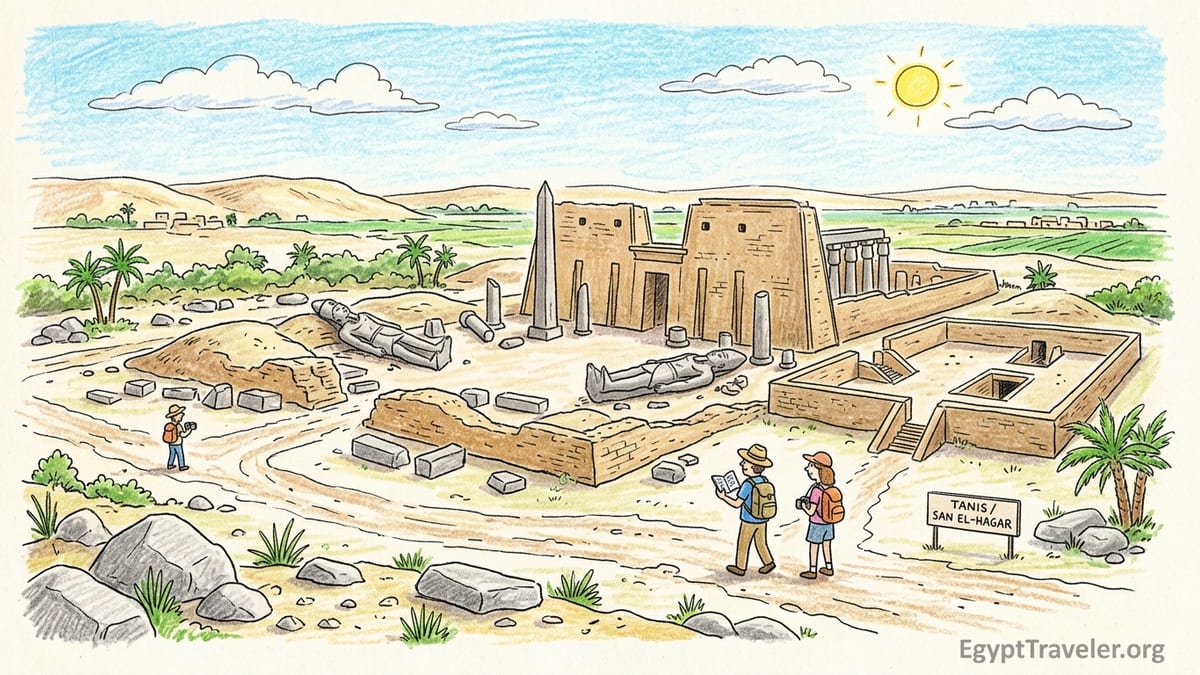
To walk across the site today is to traverse the former heart of that capital. You move over low mounds where houses and palaces once stood, past scattered granite blocks carrying cartouches of kings like Ramesses II, and between the foundations of shrines from the 21st and 22nd Dynasties. The scale only becomes clear when you realize the main temple enclosure, attributed largely to Psusennes I, measures several hundred meters on a side. Although much of the architecture lies ruined or quarried away, the footprint still evokes a powerful religious and political center that anchored the north for centuries.
Tanis also illustrates a broader historical shift. By the time its kings ruled, Egypt was no longer the unified empire of the New Kingdom. Authority was fragmented, and resources were limited. Rather than carve new quarries in distant Aswan, builders at Tanis systematically reused earlier monuments, especially those from the abandoned Ramesside capital of Pi-Ramesses. Many of the colossal statues and obelisks at Tanis began their lives in earlier cities, then were dragged here to proclaim the power of new dynasties in a changing world.
The Amun Temple Precinct and Ramesside Spoils
The centerpiece of Tanis is the sprawling temple precinct dedicated to Amun. Within a massive mud-brick enclosure wall built largely under Psusennes I, a complex of stone temples, courtyards, pylons and subsidiary chapels once rivaled the great sacred precincts of Karnak. Today, visitors see lines of column bases, scattered blocks carved with offering scenes, and the stumps of pylons, all surrounded by broad, dusty spaces. It takes a practiced eye to imagine the towering gateways and roofed halls, but the plan is legible, especially if you walk with a knowledgeable guide or a printed site map bought in Cairo before you travel.
One of the most striking aspects of the precinct is the abundance of Ramesside material. Colossal granite statues of Ramesses II, some toppled and broken, lie across the temple courts, and several obelisks still stand or rest in sections on the ground. In many cases, the 21st and 22nd Dynasty kings simply reinscribed older monuments with their own names. A block might show Ramesses II smiting enemies, while a nearby cartouche has been recut for Psusennes I or a Libyan king of the 22nd Dynasty. For visitors, this reuse makes Tanis a vivid outdoor textbook of Egyptian recycling, where layers of political history are literally carved into the same stone.
The precinct also includes traces of later activity. Chapels and shrines from the 25th and 26th Dynasties, and even Persian and Ptolemaic phases, testify that Tanis remained significant long after its heyday as a capital. Archaeological missions, particularly the long-running French team, continue to clarify how temples for deities such as Horus and Mut fitted into the wider sacred city. When you stand at the center of the main court, with Ramesside colossi around you and low mud-brick ramparts on the horizon, it becomes clear that Tanis was more than a cluster of tombs. It was a living religious complex for over half a millennium.
The Royal Necropolis: Psusennes I and the Intact Tombs
Near the southwest corner of the Amun precinct lies a seemingly unremarkable area of cut stone and low walls. This is the royal necropolis of Tanis, where kings of the 21st and 22nd Dynasties chose to be buried within the protective aura of Amun’s temple. In 1939, French Egyptologist Pierre Montet began uncovering this corner of the enclosure and, to his astonishment, found a cluster of underground tombs, some of them still sealed. Over several seasons, interrupted by the Second World War, he revealed a concentration of royal burials unmatched anywhere else in the Delta.
The most famous of these is the tomb often designated NRT III, a multi-chambered complex that eventually housed Psusennes I, his queen Mutnedjmet, his successor Amenemope, a royal son Ankhefenmut, the general Wendjebauendjed and the later king Shoshenq II. The burial chamber of Psusennes I itself produced a solid silver coffin, a gold funerary mask and jewelry that immediately drew comparison with the finds from Tutankhamun’s tomb. Humid Delta conditions had destroyed most of the organic materials, including the king’s mummy wrappings, but metal and stone objects survived in outstanding condition.
Several other tombs in the cluster belonged to later rulers. The necropolis contains burials for kings such as Osorkon II and Shoshenq III along with Prince Hornakht, whose richly decorated burial further expanded the picture of royal funerary customs during the Third Intermediate Period. Although some tombs had been disturbed in antiquity, the total assemblage from Tanis is one of the most important sources for royal grave goods between the New Kingdom and the Late Period, filling a chronological gap between the Valley of the Kings and the Saite burials at sites like Sais.
Hidden Splendor: Why the Treasures Outshine the Ruins
Visitors approaching Tanis for the first time are often surprised by how ruined and low-lying the site appears. Unlike Luxor, where towering columns frame the skyline, Tanis offers scattered stones, eroded mud-brick and shallow depressions in the sand. Many first-time travelers describe a moment of disappointment on arrival, particularly if they have driven several hours from Cairo. The key to appreciating Tanis is understanding that its greatest treasures were removed to museums, while the fragile architecture has suffered from centuries of flooding, quarrying and salt-laden soil.
The royal tomb finds underline this contrast. The solid silver coffin of Psusennes I, with its finely modeled facial features, is one of the most remarkable pieces of royal funerary equipment ever discovered in Egypt. Golden masks belonging to both Psusennes and Amenemope, elaborate pectorals, gold finger and toe stalls, inlaid bracelets, and the exquisite jewelry of General Wendjebauendjed all came from chambers hidden beneath the paving of the temple enclosure. Today, many of these objects are displayed in the Egyptian Museum in Cairo or have been earmarked for the new Grand Egyptian Museum in Giza, where their brilliance and craftsmanship can be appreciated under controlled lighting.
Standing on the bare stone outlines of the necropolis, it can be hard to connect the emptiness underfoot with those glittering artifacts. Yet when you have seen the treasures in Cairo before visiting Tanis, the experience changes. The rough-cut entrance pits and corroded granite sarcophagi suddenly represent the original context of masterpieces that most travelers view only behind glass. For archaeology enthusiasts, this juxtaposition between museum display and on-site remains is precisely what makes Tanis memorable. It shows how modest, even chaotic, excavation areas can conceal royal burials that remained untouched for three thousand years.
French Archaeological Mission and What You See Today
After Montet’s pioneering seasons in the mid-20th century, work at Tanis has been carried forward by the Mission française des fouilles de Tanis, an Egyptian–French archaeological team that has operated on and off since the 1960s. Their research has refined the plan of the Amun precinct, clarified the sequence of building phases and continued to investigate the royal necropolis. Recent seasons have included conservation of decorated blocks, digital mapping of temple and tomb structures, and the study of additional funerary deposits associated with later 22nd Dynasty rulers.
For visitors, this sustained archaeological interest means the site remains very much “alive.” You may see marked trenches, stacked crates of pottery, or fenced-off areas protecting fragile stone reliefs. Occasional information panels, usually in Arabic and French, describe the broad history of the city and highlight key monuments such as the enclosure wall of Psusennes I or the gates attributed to Osorkon II and Shoshenq III. However, interpretive signage is limited compared with major tourist centers, so travelers who want to understand what they are seeing should arrive with background reading or visit with a specialist guide.
One tangible result of the mission’s work is better delineation of the royal tombs. Low walls and protective coverings mark the outlines of NRT III and neighboring tombs, while some burial chambers are accessible via modern stairways or ramps under the supervision of the site guards. Conditions can change from year to year depending on conservation needs, so do not expect every chamber to be open. Even when access is restricted, you can usually look down into tomb pits and see the massive stone sarcophagi that once contained the intact burials.
Reaching Tanis from Cairo and On-Site Conditions
Tanis lies in the northeastern Nile Delta, roughly 150 to 170 kilometers by road from central Cairo depending on the exact route. Most travelers reach the site by private car with driver or as part of a custom tour organized through a Cairo-based agency. As of mid-2026, a realistic travel time from downtown Cairo is about three and a half to four hours each way, taking into account traffic leaving the capital and slower driving on rural roads. There is no direct train or public bus serving the archaeological zone itself, so independent travel by public transport is cumbersome and generally not recommended for a short day trip.
In practice, many visitors arrange a full-day excursion that combines pick-up from their Cairo hotel around 6:00 or 7:00 in the morning, a mid-morning arrival at San el-Hagar, three to four hours on site, and a late afternoon return to Cairo. Reputable local tour operators or freelance Egyptologist guides can arrange the necessary vehicle, driver and site permissions. Prices at the time of writing for a private Tanis day trip from Cairo are typically in the range of what you might pay for a long-distance excursion to sites like Fayoum: expect a few hundred US dollars for a car, driver and guide for two people, excluding tips and entry fees, but confirm current rates in advance as fuel and operating costs fluctuate.
On arrival, you pass through a modest ticket office area before stepping out onto the tell itself. Paths across the site are informal dirt tracks, not paved walkways, and there is minimal shade except near a few scattered trees or beside standing stone monuments. Basic facilities are limited: you should expect simple restrooms near the entrance and perhaps a small kiosk or local vendor selling bottled water and soft drinks, but not a full visitor center or restaurant. Many travelers bring their own snacks or a packed lunch from Cairo, along with more water than they think they will need.
Heat, Visibility and How Much Time to Allow
The Delta climate at Tanis can be unexpectedly demanding, especially between late spring and early autumn. Temperatures commonly rise well above 30 degrees Celsius by late morning, and the combination of humidity and reflected heat from the sand and stone can be tiring. There is very little shade inside the enclosure walls, and the low relief of the site means even a light breeze offers only partial relief. Good preparation is essential: a wide-brimmed hat, high-SPF sunscreen, closed walking shoes suitable for uneven ground, and at least one and a half to two liters of water per person for a half-day visit.
Because the ruins are low and heavily eroded, Tanis rewards slow, attentive exploration. Archaeology enthusiasts should plan on a minimum of three hours on site, and four if possible. That allows time to walk the perimeter of the Amun temple precinct, examine the Ramesside statues and obelisks up close, study the outlines of subsidiary chapels, and spend a focused period at the royal necropolis area. Rushing through in under two hours often leaves visitors with the impression of a featureless stone field, rather than a sophisticated sacred city.
The best times of day for visibility and comfort are early morning and late afternoon, when the low sun casts longer shadows that help reveal architectural features on the ground. In the middle of the day, the combination of flat overhead light and glare can make it harder to read wall lines and column bases. Photographers in particular will appreciate the softer light that brings out inscriptions on granite and limestone surfaces. In winter and early spring, when temperatures are lower and the air clearer, Tanis becomes one of the most pleasant archaeological excursions from Cairo.
Do You Need a Guide, and What Expertise Adds
Unlike sites with tall standing structures, Tanis can be challenging to interpret without expert help. A significant portion of the architecture survives only at foundation level, and the royal tombs are simply not self-explanatory to non-specialists. Traveling with an experienced Egyptologist guide, or at least hiring the on-site inspector if one is available and authorized to accompany you, transforms the visit. A good guide can point out, for example, how the blocks under your feet once formed the enclosure wall of Psusennes I, or how a half-buried statue base shows the recarved name of a 22nd Dynasty king over a Ramesside original.
Guides familiar with the French mission’s publications can also reconstruct the layout of the royal necropolis, explaining which shafts belong to NRT III, where the sarcophagus of Shoshenq II was found, and how the tomb of General Wendjebauendjed fits within the complex. They can describe the sequence of discoveries from Montet’s first clearance in 1939 through post-war seasons, giving you a sense of the excitement as one intact burial after another emerged. This narrative context is rarely available from signage alone and makes standing above those tombs far more evocative.
If you are particularly interested in archaeology, consider coordinating your visit to include both the site and the relevant museum displays in Cairo or Giza on adjacent days. For example, you might spend one afternoon at the Egyptian Museum focusing specifically on the Tanis objects, then travel to San el-Hagar the following morning. Many independent guides will design such an itinerary on request, and some specialist operators that cater to archaeological societies already offer Delta-focused study days including Tanis, Bubastis or Tell Basta.
The Takeaway
Tanis is not the easiest Egyptian site to appreciate, nor the most convenient to reach, but it offers something unusual: a royal capital whose most precious treasures came to light in the 20th century rather than the 19th, and whose landscape still feels like an active excavation. For travelers accustomed to the vertical drama of Karnak or Abu Simbel, the low, windswept ruins of San el-Hagar at first seem modest. Yet once you connect the scattered stones with the silver coffin of Psusennes I, the gold mask of Amenemope and the jewelry of Wendjebauendjed in Cairo’s museum cases, the site’s true significance comes into focus.
For serious archaeology enthusiasts with time in Cairo, a day trip to Tanis is deeply rewarding. It demands preparation, patience and a willingness to look beyond the obvious, but repays that effort with insight into how Egypt’s royal cities evolved after the New Kingdom, how older monuments were recycled into new ideological programs, and how chance and context allowed some tombs in a remote Delta temple enclosure to survive intact into the modern era. Tanis will never draw the crowds of Giza or Luxor, and that is precisely its appeal: a vast, quiet tell where the traces of a forgotten capital still lie underfoot.
FAQ
Q1. Is Tanis worth visiting if I have already seen Luxor and the pyramids?
Yes, if you are interested in archaeology and history. Tanis offers a very different experience from the monumental desert sites: it is a low, sprawling Delta capital where you walk through active excavation zones and stand above royal tombs whose treasures you may have just seen in Cairo. It feels more like being inside a dig than visiting a finished monument.
Q2. How long does it take to travel from Cairo to Tanis, and can it be done as a day trip?
Expect about three and a half to four hours each way by private car or organized tour, depending on traffic and road conditions. Most visitors do Tanis as a long day trip from Cairo, leaving early in the morning, spending three to four hours on site, and returning by evening.
Q3. Are there any facilities at the site, such as restrooms or a café?
Facilities are basic. You can usually count on simple restrooms near the entrance and sometimes a small kiosk or local vendor selling bottled drinks, but there is no full café or restaurant. Bring snacks or a packed lunch from Cairo and carry ample drinking water.
Q4. Do I need a special permit to visit the royal tomb area at Tanis?
For general tourists, access to the royal necropolis area is normally included with the standard site ticket, though individual tomb chambers may be closed for conservation. Professional filming or research work requires additional permits arranged well in advance through the relevant Egyptian authorities or in coordination with an archaeological mission.
Q5. What is the best time of year to visit Tanis?
The most comfortable months are roughly November through March, when daytime temperatures are milder and humidity is lower. In late spring, summer and early autumn, heat and glare on the open tell can be intense, so early starts, sun protection and plenty of water become even more important.
Q6. Can I see the treasures from the Tanis royal tombs on site?
No, the major treasures such as the silver coffin and gold masks were removed for conservation and are displayed in national museums in Cairo or Giza. On site at Tanis, you see the architectural remains of the tombs, sarcophagus blocks and the wider temple context in which they were discovered.
Q7. Is it safe to travel to Tanis and the surrounding Delta region?
Security conditions can vary over time, but Tanis itself is a recognized archaeological site regularly visited by small groups, researchers and specialist tours. Travelers typically visit as part of an organized excursion with a reputable operator, which coordinates with local authorities. Always check current travel advice and follow guidance from your embassy and local tour partner.
Q8. How much walking is involved, and is the site accessible for people with limited mobility?
Visiting Tanis involves walking over uneven ground, with low mounds, loose stones and occasional shallow pits. There are no extensive paved paths, and access to some tomb areas involves steps or ramps. Visitors with limited mobility may find parts of the site challenging; a private guide and driver can help tailor the visit to focus on the more accessible areas.
Q9. Do I need an Egyptologist guide, or can I visit Tanis on my own?
You can visit independently, but a knowledgeable guide makes a significant difference. Much of Tanis survives only at foundation level, and without explanation it can look like scattered rubble. An Egyptologist can reconstruct the ancient plan, explain the royal tombs and point out reused Ramesside blocks you might otherwise overlook.
Q10. Can I combine Tanis with other archaeological sites in the Delta in one day?
In theory, yes, but in practice the long driving times and the size of Tanis make it best as a stand-alone day trip from Cairo. Very specialized itineraries sometimes combine Tanis with another nearby site for research groups, but most leisure travelers will get more from dedicating a full day to exploring Tanis in depth.