


For most visitors, Egypt means Cairo’s skyline, Giza’s pyramids and the temples of Luxor and Aswan. Yet north of Cairo, where the Nile splits into its Rosetta and Damietta branches and fans into the Mediterranean, lies a very different Egypt. The Nile Delta, or Lower Egypt, is a flat expanse of fields, canals, port towns and scattered ancient sites that sees only a fraction of the tourists who head south to Upper Egypt, but rewards those who make the detour with riverfront promenades, Coptic monasteries and glimpses of everyday rural life.
Understanding Lower Egypt and the Nile Delta
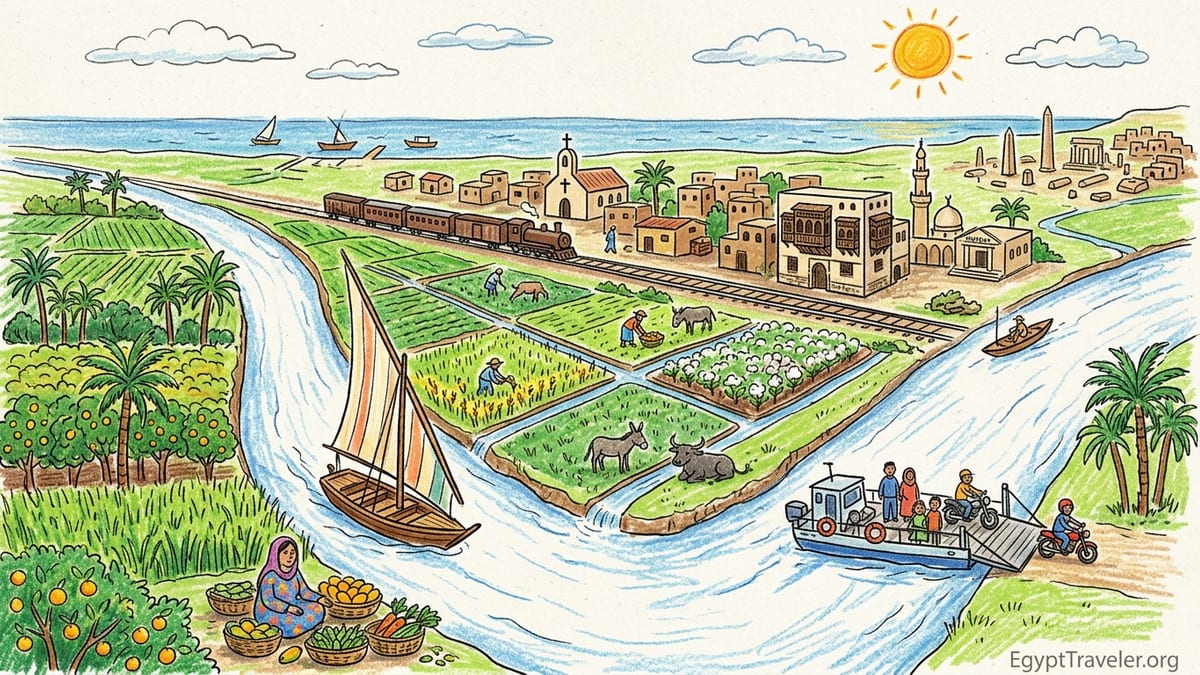
Lower Egypt refers to the broad Nile Delta north of Cairo, where the river breaks into two main branches that flow into the Mediterranean. Around 20 to 25 kilometers north of the capital, near the Delta Barrage at El Qanater, the Nile divides into the western Rosetta branch and the eastern Damietta branch, creating a triangular patchwork of farmland, villages and canals between Alexandria in the west and Port Said in the east. The landscape is low and green rather than mountainous or desert, with roads and railway lines running roughly parallel to the river channels.
Historically, this area was the breadbasket of Egypt and home to important cities like Tanis and Bubastis, as well as an early Christian heartland. Today, the Delta is still heavily agricultural, planted with rice, wheat, citrus and cotton, and dotted with fish farms and irrigation canals. From the window of a train between Cairo and Mansoura or Damietta, you are more likely to see buffaloes in the fields and farmers on motorbikes than pharaonic temples. The region’s daily rhythm is shaped by harvest seasons rather than tour bus schedules.
The Delta receives far fewer international visitors than Upper Egypt for several reasons. Its main attractions are more dispersed, less dramatically preserved and less heavily marketed than the famous temples around Luxor and Aswan. There are fewer large, tourist-oriented hotels outside Alexandria, and English-language signage or visitor centers can be limited. Security restrictions after the 2010s also led many mainstream tours to focus on the well-known Cairo–Luxor–Aswan circuit, leaving the Delta largely to domestic travelers and independent visitors.
For travelers who appreciate low-key destinations and local life, this relative obscurity is part of the charm. You might spend an afternoon in Rosetta sitting at a simple riverside café watching ferries cross the Rosetta branch, or stroll the corniche in Damietta in the evening with Egyptian families on holiday. While you will not find the concentration of blockbuster monuments of Upper Egypt, the Delta offers something different: an accessible look at how modern Egypt lives, framed by both ancient and Coptic heritage.
How the Rosetta and Damietta Branches Shape the Region
The modern Nile Delta is defined by its two surviving distributaries. The Rosetta branch, about 240 kilometers long, flows northwest toward the town of Rosetta near the Mediterranean coast, forming the western arm of the delta. The Damietta branch, of a similar length, flows northeast toward the port of Damietta, which anchors the eastern arm. Between and alongside these channels spreads one of the most intensively cultivated landscapes in the Middle East, with irrigation networks drawing on both branches to water fields and orchards.
For travelers, these branches act as informal corridors. Many road and rail routes follow or cross them, and several of the destinations in this guide line their banks. Rosetta itself sits near the mouth of the Rosetta branch, combining a historic Ottoman core with a working river port. Damietta and Ras El Bar occupy the area where the Damietta branch meets the sea, one of the classic Egyptian summer holiday zones. Further inland, cities such as Tanta, Mansoura and Zagazig act as transport hubs for side trips to places like Wadi El Natrun and Tell Basta.
The two branches have historically had slightly different roles. The Damietta side has long been favored for certain kinds of irrigation and trade, with Damietta developing into a significant port and furniture manufacturing center. The Rosetta side has been more strictly agricultural in many stretches, though Rosetta itself played a role in coastal defense and navigation. For visitors, this means the Damietta corridor feels more urban and commercial, while the Rosetta side still offers stretches of quietly flowing river punctuated by market towns.
Water management along both branches is tightly controlled, especially since the completion of the Aswan High Dam. You may notice barrages, sluice gates and canals diverting water from the main channels. These engineering works rarely affect travel directly, but they explain why the Delta feels both fertile and heavily managed. When planning routes, it helps to visualize the branches as two spines: a western line running past Rosetta, and an eastern one past Damietta, with agricultural roads and small towns stitching the space between.
Key Destinations Beyond Cairo and Alexandria
Rosetta, or Rashid, is one of the most atmospheric towns on the western side of the Delta, about 65 kilometers east of Alexandria. It rose to international fame as the place where the Rosetta Stone was discovered, though the original is now in London. Visitors today come for well-preserved Ottoman-era houses with carved wooden mashrabiya balconies, a small but engaging local museum and a relaxed corniche along the Rosetta branch. Half a day is enough to wander the old streets, step into a few restored mansions and sit by the river with grilled fish at a simple restaurant popular with local families.
On the eastern side of the Delta, Damietta is both a busy port and a regional capital known across Egypt for its carpentry workshops and furniture showrooms. A stroll through its commercial streets introduces you to polished, ornate bedroom sets often destined for newlyweds furnishing their homes. Nearby Ras El Bar, at the tip where the Damietta branch meets the Mediterranean, has long served as a summer resort for Egyptian families. In July and August, its streets are filled with domestic holidaymakers renting sea-breeze villas or staying in mid-range hotels while they walk the corniche, eat helwa turki sweets from local patisseries and watch the sun set where river and sea meet.
Inland, Wadi El Natrun lies along the desert highway between Cairo and Alexandria and offers a very different experience. This depression, studded with salt lakes, has been home to Coptic Christian monastic communities since the early centuries of Christianity. Several monasteries, such as Deir Anba Bishoy and Deir El Baramous, welcome respectful visitors who dress modestly and avoid photographing monks without permission. The combination of old frescoes, incense-filled churches and quiet courtyards makes Wadi El Natrun a powerful contrast to the busy agricultural plains. It is one of the best places in Egypt to understand the Coptic spiritual tradition in a living context.
Two ancient sites are particularly important for travelers interested in pharaonic history. Tanis, near the modern village of San El Hagar in the northeastern Delta, served as a capital in the Third Intermediate Period and is associated with several royal tombs discovered in the 20th century. Today, visitors find a large, fairly open archaeological zone with scattered obelisks, temple ruins and blocks inscribed with the names of Ramesside pharaohs and their successors. Tell Basta, identified with ancient Bubastis near modern Zagazig, was a major cult center of the cat goddess Bastet. Excavations here have revealed temple remains and a wealth of small finds; on the ground, you will see low ruins, scattered statues and a modest museum space.
Coptic Heritage and Rural Landscapes of the Delta
The Nile Delta played a pivotal role in the early spread of Christianity in Egypt, and the Coptic presence remains visible not only in Wadi El Natrun but in village churches and shrines throughout the region. In many Delta towns, you will see Coptic churches tucked behind main streets, announced by simple crosses rather than towering domes. While tourist infrastructure is minimal, travelers who visit with local guides or friends may be welcomed to attend a service or step briefly into a church, provided they dress conservatively and avoid disrupting worship.
Wadi El Natrun is the most accessible window into this heritage. The monasteries here are living communities, not museums, and visiting feels more like being a respectful guest than a tourist. On a typical visit, you might arrive by private car from Cairo around mid-morning, enter one or two monasteries, and be shown around by a monk or a lay guide who points out ancient icons, old defensive towers and libraries. A donation is customary instead of an entrance ticket, and facilities are basic: perhaps a simple café serving tea and soft drinks, and restrooms in a separate building. Many Egyptian pilgrims visit on weekends, so midweek can be quieter for foreign travelers.
Outside these spiritual centers, the everyday rural landscape is what many visitors remember most about the Delta. The flat terrain, cut by irrigation canals, supports fields of rice, clover, citrus and vegetables. It is common to see water buffaloes cooling in the canals, donkeys pulling carts stacked with sugarcane or fodder, and children cycling along narrow raised paths. Between larger cities like Tanta or Mansoura, roadside stands sell seasonal produce such as strawberries in spring or mangoes in late summer. A simple stop for sugarcane juice at a roadside stall can turn into a friendly chat with locals, many of whom are curious about foreign visitors in areas that rarely see them.
This landscape is also a reminder of how central the Delta is to Egypt’s food security. The water that branches into Rosetta and Damietta not only shapes scenery but irrigates much of the country’s farmland. Travelers may notice intensive drainage works, pumps and canals, as well as plastic-covered greenhouses and fish ponds. While these are not conventional tourist sights, they form the real backdrop of Lower Egypt, and seeing them helps put the better-known monuments of Upper Egypt into economic and social context.
Why Lower Egypt Sees Fewer Visitors and How to Plan Around It
Compared with Upper Egypt, where highlights are tightly clustered along a single Nile corridor, Lower Egypt’s attractions are scattered across a web of roads and canals. Tanis, Tell Basta, Wadi El Natrun, Rosetta and Damietta all lie in different governorates, and there is no single tourist-friendly town that anchors them the way Luxor anchors the south. Many international tour operators find it easier to sell a Nile cruise between Luxor and Aswan than to design a route through Delta towns with modest hotels and limited foreign-language services.
The region’s low profile has practical consequences. You cannot rely on English-language signs at every site, and museum opening times may vary more than at mainline attractions. Some archaeological zones have small security posts where you may need to show your passport details in a logbook. Guided tours in European languages are not always available on the spot, so arranging a licensed guide from Cairo or Alexandria who knows the Delta can make visits smoother. When you go independently, it helps to travel with offline maps, have key place names written in Arabic script, and budget extra time for navigating local transport or asking directions.
On the positive side, the lack of mass tourism means fewer crowds and more spontaneous encounters. At Tanis or Tell Basta, you may be one of only a handful of visitors walking among the ruins, with a local guard or site caretaker happy to point out details in exchange for a small tip. In Damietta and Ras El Bar, prices in cafés and hotels are aimed at middle-class Egyptian families rather than international tourists, which can make your budget stretch further. A clean double room in a mid-range hotel in Damietta might cost the equivalent of a simple guesthouse in downtown Cairo, and street food such as koshari or taameya sandwiches is usually inexpensive.
To make the most of a Delta trip, planning is essential. Think in terms of clusters and corridors rather than individual isolated sites. Combine Wadi El Natrun with a road journey between Cairo and Alexandria, or pair Rosetta with an overnight in Alexandria. Group Tanis and nearby sites in the northeastern Delta into one excursion from Cairo, and allow extra time for potential traffic or checkpoints. With realistic expectations and some flexibility, the Delta can be integrated into a broader Egypt itinerary without rushing.
Day Trips from Cairo vs Longer Delta Journeys
Cairo is the most practical base for first forays into the Delta. Several destinations are realistic day trips, especially if you use a private car and driver. Wadi El Natrun, depending on traffic and your starting point, can be reached from Cairo in roughly one and a half to two hours via the desert highway toward Alexandria. A typical day trip might involve leaving Cairo around 8 a.m., visiting two or three monasteries with a pre-arranged guide, stopping for lunch at a simple roadside restaurant that serves grilled chicken and mezze, and returning to Cairo by early evening.
Tell Basta, near Zagazig, is also feasible as a day trip from Cairo. You can reach Zagazig by train in roughly an hour and then take a local taxi to the site, or hire a private driver to cover both legs. A combined visit to the archaeological zone and the small museum might take two to three hours on site, leaving time to walk through town and have a late lunch at a local restaurant before driving back to Cairo. This is an example of a trip where arranging a guide in advance can be helpful to interpret low-lying ruins that lack extensive signage.
Destinations like Tanis, Damietta and Ras El Bar require more time and are better approached as overnight or multi-day journeys. Reaching Tanis involves traveling deep into the northeastern Delta, often via the town of Zagazig or Mansoura and then along smaller roads. While an extremely long day trip from Cairo is technically possible with a private car, it would mean many hours in transit and a short visit. A more comfortable plan is to combine Tanis with a night in a Delta city such as Mansoura, giving you time to see local markets and riverfront life.
Damietta and Ras El Bar are even further, close to the Mediterranean coast. Many travelers choose to spend at least one night, arriving by train or bus in the afternoon, walking the corniche in the evening, and then taking a boat ride at the river mouth the next morning before heading onward. Combining Damietta and Ras El Bar with a broader loop that also includes Port Said or Lake Manzala, or returning via a different route through Mansoura or Tanta, turns the journey into a fuller exploration of the eastern Delta rather than a rushed out-and-back excursion.
Getting Around: Trains, Drivers and Guided Tours
Egypt’s national railway network is the backbone of public transport into the Delta. From Cairo’s main Ramses station, frequent trains run to cities such as Tanta, Zagazig, Mansoura and Damietta. Travel times vary by service type, but as an example, a standard-class train from Cairo to Damietta typically takes several hours and costs the equivalent of a modest restaurant meal. Carriages range from basic second class, with padded seats and open windows, to air-conditioned first class on some routes. For travelers comfortable with local transport and some crowds, trains can be a good option for reaching major Delta hubs, then connecting onward by taxi.
For more flexibility, many visitors rely on private cars and drivers, either booked through Cairo hotels, local travel agencies or ride-hailing platforms where available. Hiring a driver for a full day trip from Cairo to Wadi El Natrun or Tell Basta will likely cost less than a similar private excursion in Western Europe, especially if you share the cost among two or three people. In practice, you might meet your driver outside your Cairo hotel at 8 a.m., agree on a return time and stops, and settle the fare in cash at the end of the day. It is important to clarify whether fuel, tolls and waiting time are included in the quoted price.
Guided tours into the Delta are less common than to classic sites, but some Cairo-based operators will arrange custom itineraries. These might include an Egyptologist guide for Tanis or Tell Basta, or a guide familiar with Coptic monastic rules for Wadi El Natrun. Such tours can be especially useful if you do not read Arabic and prefer not to navigate rural roads or security checkpoints on your own. Costs depend on group size and itinerary complexity, but custom day trips are generally more expensive than joining a standard group tour to Giza or Saqqara.
Within Delta cities and towns, transport is mostly by local taxi, microbus and tuk-tuk. In Damietta, for instance, you may take a short taxi ride from the train station to your hotel near the corniche, and then use tuk-tuks for small hops between neighborhoods. In Rosetta, much of the historic area is walkable, though you might hire a local pickup taxi to reach the beach or outlying villages. As always in Egypt, it is best to agree on fares before riding, carry small bills, and be prepared for some negotiation, especially in places unused to foreign visitors.
The Takeaway
Lower Egypt rarely features on first-time itineraries focused on pyramids and temples, but for travelers willing to step beyond the usual trail, the Nile Delta offers a different and rewarding side of the country. This is a region shaped by the twin branches of the Nile, where fields and canals dominate the horizon and pharaonic ruins sit quietly at the edges of modern villages. Rosetta, Damietta, Ras El Bar, Wadi El Natrun, Tanis and Tell Basta each reveal a piece of the story, from Ottoman trading towns and seaside resorts to early Christian monasteries and former royal capitals.
Planning a Delta visit from Cairo involves more logistics than booking a straightforward Nile cruise, yet the payoff is a richer understanding of how most Egyptians live today. Watching farmers irrigate fields along the Rosetta branch, sharing tea with a local family in Ras El Bar or listening to the bells of a Coptic monastery at Wadi El Natrun creates memories that complement, rather than compete with, the grandeur of Upper Egypt. Treat Cairo, Giza and Alexandria as hubs, and use them to frame side trips or longer loops into the Delta, always allowing extra time for the unexpected.
Whether you begin with a simple day trip to Wadi El Natrun or commit to a multi-day circuit linking Tanis, Damietta and Rosetta, approaching the Nile Delta as a living landscape rather than a checklist of monuments is key. With realistic expectations, flexible plans and a willingness to engage with quieter, less polished destinations, Lower Egypt can become one of the most memorable chapters of your Egyptian journey.
FAQ
Q1. Is the Nile Delta safe for independent travelers?
Independent travel in the Nile Delta is generally possible, especially on main routes and in larger towns. Conditions and regulations can change, so check recent advice, register with your embassy if recommended, and consider hiring a local guide or driver for more remote archaeological sites.
Q2. Can I visit Wadi El Natrun as a day trip from Cairo?
Yes, Wadi El Natrun is one of the most straightforward day trips from Cairo. With a private car, the journey typically takes one and a half to two hours each way, allowing time to visit two or three monasteries and return to the city by evening.
Q3. Do I need to speak Arabic to travel in Lower Egypt?
You do not need to be fluent, but knowing a few basic Arabic phrases helps. English is less commonly spoken in small Delta towns than in Cairo or tourist centers, so carrying place names written in Arabic and using translation apps or a local guide can make travel smoother.
Q4. Are there good hotels in Damietta and Ras El Bar?
Damietta and Ras El Bar have a range of mid-range and budget hotels aimed mainly at Egyptian families on holiday. Facilities are usually comfortable but not luxurious, with simple rooms, air conditioning and sometimes sea or river views. Advanced booking in high summer is advisable.
Q5. How many days should I spend exploring the Delta?
As a first-time visitor, one or two day trips from Cairo to places like Wadi El Natrun or Tell Basta can be enough to get a feel for the region. For a deeper experience including Tanis, Damietta, Ras El Bar and Rosetta, plan three to five days, possibly split between different base towns.
Q6. Is Rosetta worth visiting if I have already seen Alexandria?
Rosetta offers a smaller, quieter riverfront atmosphere and historic Ottoman houses that contrast with Alexandria’s larger, more cosmopolitan feel. If you are interested in Egyptian everyday life and history beyond major cities, Rosetta is a worthwhile half-day or day trip addition.
Q7. What should I wear when visiting Coptic monasteries in Wadi El Natrun?
Dress conservatively, with shoulders and knees covered. Women may wish to bring a scarf to cover their hair inside churches. Avoid loud clothing, keep your phone on silent, and ask before taking photos of monks or worshippers.
Q8. Can I reach Damietta by train from Cairo?
Yes, Cairo is connected to Damietta by regular train services, often with a change at an intermediate station such as Mansoura. Journey times are several hours, and it is wise to check current schedules locally and arrive at the station with time to spare.
Q9. Are sites like Tanis and Tell Basta crowded?
These archaeological sites usually see far fewer visitors than high-profile monuments in Upper Egypt. On many days you may share the ruins with only a handful of other people, which allows for a quieter, more contemplative visit but also means fewer on-site services.
Q10. Should I visit the Nile Delta on my first trip to Egypt?
If your time is short, focusing on Cairo, Giza, Luxor and Aswan makes sense. However, adding even one day trip into the Delta can provide valuable context for how modern Egypt lives and works, and may appeal especially to travelers who enjoy off-the-beaten-path destinations.