

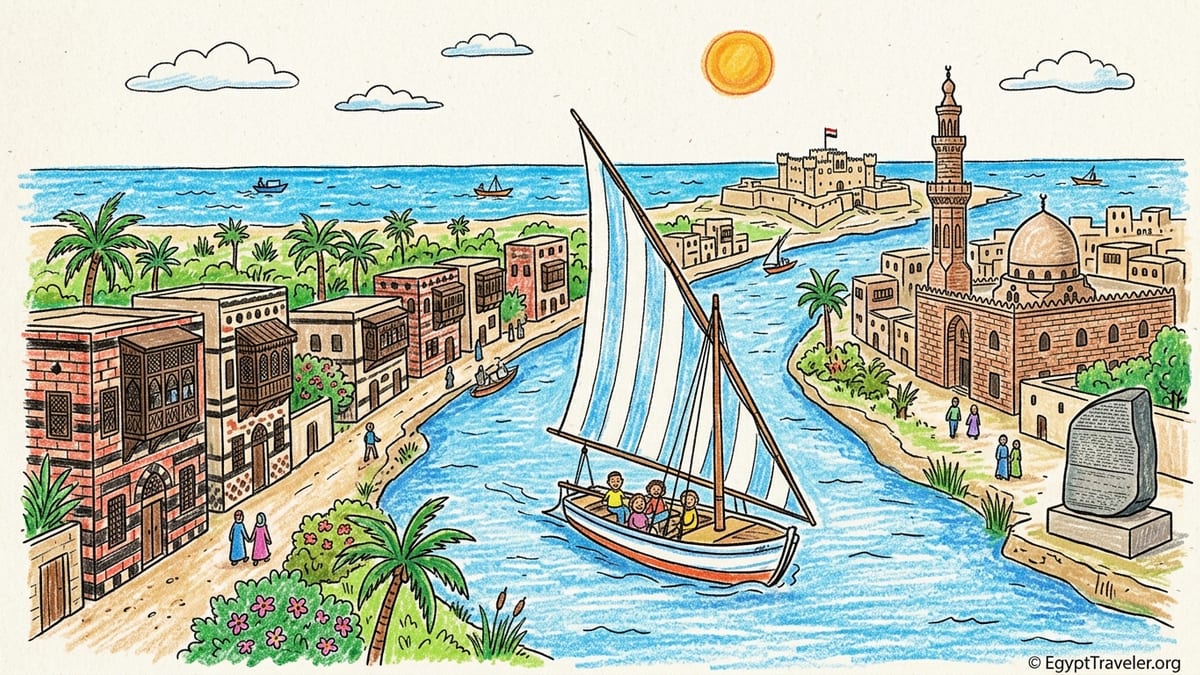
Rosetta, known locally as Rashid, sits quietly at the mouth of the Rosetta branch of the Nile, about an hour east of Alexandria. Most visitors only know the name from the Rosetta Stone, the basalt slab that unlocked ancient Egyptian hieroglyphs. Yet the town itself is one of Egypt’s richest open air showcases of late medieval and Ottoman Islamic architecture, with 22 preserved merchant houses, historic mosques, a riverside citadel and atmospheric alleys that still feel lived in rather than staged. This guide focuses on what you can actually see in Rosetta today, and how to weave its main sites into a satisfying day out, or a simple overnight, from Cairo or Alexandria.
Why Rosetta Matters Beyond the Famous Stone
Rosetta’s fame rests on a single object, the Rosetta Stone, discovered in 1799 when French soldiers were strengthening the walls of a coastal fort north of town. That fort, originally built in the 15th century under the Mamluk sultan Qaitbay to guard the mouth of the Nile, later became known as Fort Julien under the French. The stone’s trilingual inscription eventually allowed scholars to decipher hieroglyphs and opened up pharaonic history to modern research. It is a compelling story, but it can overshadow the place itself.
Today the original Rosetta Stone is in the British Museum in London. Rosetta’s connection comes through high quality replicas and the landscape where it was found. Within the town, a copy is displayed in the Rashid National Museum, while another stands at the Qaitbay Citadel near the Mediterranean. For visitors, this means you can follow the stone’s journey in reverse: from a replica in a former Ottoman governor’s house in town to the windswept coastal fort where an officer of Napoleon’s expedition noticed an unusual slab in the rubble.
Crucially, Rosetta offers more than a stone-shaped footnote. Egypt’s own tourism authorities point out that this small Nile Delta town preserves 22 Ottoman period houses, around a dozen historic mosques, a public bathhouse and a rare surviving animal driven grain mill. Many of these are within walking distance of one another in a compact historic core. Unlike Cairo, where Islamic monuments rise amid intense traffic, Rosetta’s lanes feel scaled to the pedestrian, making it an appealing day trip for travellers who want architecture, local life and river scenery without big city stress.
Rosetta also carries a different slice of Egyptian history. It was a commercial town in the Ptolemaic and Ottoman periods, prospering as a port before Alexandria eclipsed it. In 1807 it was the scene of a notable defeat for a British invasion led by General Fraser, commemorated in displays at the Rashid National Museum. Walking between its brick mansions and quiet mosques, you encounter layers of coastal defense, Nile trade and local resistance that rarely make it into standard Nile cruise itineraries.
Getting to Rosetta and Navigating the Town
Rosetta lies roughly 65 kilometers east of Alexandria in Egypt’s Beheira governorate, on the west bank of the Rosetta branch of the Nile. Independent travelers most commonly reach it from Alexandria. Shared microbuses run from the Alexandria agricultural road corridor toward Rashid via towns such as Abu Qir and Idku, typically taking around 60 to 90 minutes depending on traffic. These vehicles are basic but frequent and inexpensive by international standards, though you should confirm the current departure point locally because Egyptian bus stands sometimes change location.
From Cairo, the journey is longer but feasible as a long day trip if you start early. Buses and microbuses head toward Damanhur and then on to Rashid, usually in three to four hours depending on traffic around the capital. A private car with driver, booked through your Cairo or Alexandria hotel or a reputable local operator, is the most flexible option for small groups who want to combine Rosetta with stops at coastal villages or at Abu Qir. Ride hailing apps are evolving in Egypt’s Delta region but cannot be relied on once you leave the larger cities, so plan on conventional taxis for local trips.
Once in Rosetta, the historic core is compact enough to explore on foot. The Rashid National Museum, several Ottoman houses, Hammam Azouz and the Zaghlul Mosque cluster in and around the old town streets where brick facades with dark wooden mashrabiya balconies still line the lanes. Expect some uneven pavements and occasional puddles in winter, but distances are short. Most visitors then arrange separate transport to Qaitbay Citadel at Borg Rashid, about six kilometers downriver, often by tuk tuk, local taxi or prearranged driver. If you are not fluent in Arabic, it helps to carry the fort’s name written in Arabic script on paper or on your phone to show drivers.
Rosetta has the feel of a working Nile town rather than a polished resort, so services are simple but adequate. Around the main squares you will find small koshary shops, grills and juice stands where you can eat a local lunch between sightseeing stops. Carry small denomination Egyptian pounds for museum tickets, taxis and snacks, and do not count on card payments except perhaps in larger supermarkets on the main road. As with most Nile Delta towns, summer is hot and humid, so an early start and a rest in the midday heat will make walking between sites much more pleasant.
Rashid National Museum: Gateway to the City’s Story
The natural starting point for a visit is the Rashid National Museum, housed in the former residence of Arab Killy Hussein Bey, an 18th century Ottoman governor. The building itself is an exhibit: a tall, narrow brick mansion with characteristic Rosetta red and black brick banding, wooden lattice windows and an inner courtyard. Inside, the museum tells the story of Rosetta from ancient times through the Ptolemaic, Mamluk and Ottoman eras to the town’s role in resisting both French and British incursions in the late 18th and early 19th centuries.
Exhibits include paintings and dioramas of battles, traditional costumes, weapons from the 18th and 19th centuries, and everyday objects from domestic life and crafts. One room focuses on the 1807 Fraser campaign, in which local defenders helped repel a British force landing on the Delta coast. Another highlights traditional handicrafts and tools, giving a sense of how life in this Nile port revolved around both river trade and nearby agriculture. Among the most photographed items is a replica of the Rosetta Stone, which allows visitors to see the famous trilingual text without leaving Egypt.
The museum’s displays are straightforward rather than high tech, but the combination of period rooms, wooden ceilings and views onto the courtyard gives you a feel for elite urban life in Ottoman Rashid. Visitors typically spend 45 to 90 minutes inside, depending on their interest in military history. Explanatory panels are usually in Arabic, with varying degrees of English support, so hiring a local guide through an Alexandria operator, or arranging for a licensed guide to accompany you from Cairo, can bring the context to life, especially if you are unfamiliar with Egypt’s 18th and 19th century history.
Opening hours and ticket prices in Egypt can change, particularly after renovations, so check locally in Alexandria or with your hotel before you travel, especially if you are visiting during Ramadan or on public holidays. As a rule of thumb, most Egyptian provincial museums open in the morning and close by late afternoon, with a short closure on some prayer times. Aim to visit the Rashid National Museum soon after arrival, then step out into the surrounding streets to continue exploring on foot.
Ottoman Merchant Houses and Abu Shaheen Mill
Rosetta’s greatest charm lies in its concentration of Ottoman era merchant houses woven into the urban fabric. Egyptian heritage officials count 22 historic houses, many dating from the 17th and 18th centuries, built in brick with projecting wooden balconies and intricate latticework. Among the best known are the Amasili, Mezouni, Ramadan, Alwan and Tokatly houses, plus the Arab Killy house that now forms the Rashid National Museum. Even if the interiors of all these houses are not always open, their facades provide a strong sense of the town’s historic skyline.
The Amasili House is often singled out as a showpiece of Ottoman domestic architecture, with its carved wooden mashrabiya overlooking the street and a plan that steps back from public spaces into increasingly private family quarters. The Mezouni House carries its own lore: local stories tell of Zubaida bint al-Bawwab, a Rosetta woman who married the French commander Jacques-Francois Menou after he converted to Islam during the French occupation. Whether or not you delve into every legend, these houses demonstrate how wealthy merchants combined privacy, climatic adaptation and urban prestige within their homes.
One particularly distinctive monument is the Abu Shaheen Mill, dating to around the 17th century and described by Egyptian sources as one of the oldest surviving mills in Egypt. Unlike modern flour mills, Abu Shaheen was powered by animals, its large wooden gears turned by donkeys walking in a circle. Today visitors can step inside to see the heavy timber mechanisms, stone grinding wheels and the compact interior spaces where grain was hoisted, crushed and sifted. The mill offers a very tangible glimpse of everyday economic life in Rosetta at a time when local bread and regional trade were literally driven by such hidden machinery.
These houses and the Abu Shaheen Mill are concentrated in and around the old quarters not far from the Rashid National Museum. A simple walking loop might take you from the museum along Dehliz al Malik Street, where several of the finest residences stand, detouring into side lanes to admire brick patterns and carved doorways. Informal local guides sometimes offer to accompany visitors through the quarter for a small fee, pointing out details such as original wooden doors, restoration work and the way upper floors project over the street to cast shade. Agree any fee in advance and treat such offers as optional, as you can also explore at your own pace.
Hammam Azouz, Zaghlul Mosque and Rosetta’s Sacred Architecture
Rosetta’s religious monuments form a second layer of its heritage, with a dozen historic mosques and one notable public bathhouse. Hammam Azouz, dating to the Ottoman period, is among the rare surviving examples of a traditional urban bath in the Nile Delta. From the outside it is a modest brick structure, but inside, visitors can still see the sequence of changing rooms and hot, warm and cool chambers that once formed the social heart of the town. Domed ceilings with small glass openings filtered light while preserving privacy, and hot water pipes beneath the floors created the steam that patrons associated with cleanliness and social ritual.
Although Hammam Azouz no longer functions as a working bath, its preserved layout helps visitors imagine the rhythms of daily life when such facilities were essential, especially for women’s gatherings and pre wedding rituals. Interpretation can be minimal, so a guidebook or local guide is useful to understand features such as the hypocaust heating system or the role of attendants. The hammam lies within walking distance of the main historic houses, making it an easy addition to a half day wander through the old town.
The Zaghlul Mosque, Rosetta’s largest and one of its oldest mosques, anchors another corner of the historic center. Its construction unfolded in several phases from the Mamluk through the Ottoman period, with inscriptions referring to dates in the 14th and 16th centuries and later additions. Architecturally, the mosque is known for its expansive flat roof supported by numerous columns, a minaret with a sturdy square base and the use of Rosetta’s characteristic red brick reinforced with stone. Historically, the mosque served not only as a place of worship but also as a center of learning and local political life, and it featured in the town’s resistance to the British Fraser campaign in 1807.
Nearby stand other notable mosques, including the Ali al Mahalli Mosque, the Jundi Mosque and the hanging mosque known as Ahmed Agha Demciis, each with its own foundation date and architectural details. For visitors, the Zaghlul Mosque is typically the most accessible and atmospheric, especially around Friday prayers when the surrounding streets fill with worshippers. Dress modestly, remove your shoes before entering, and ask permission before photographing people at prayer. The combination of call to prayer echoing among brick facades and glimpses of carved wooden doors reinforces the sense that Rosetta’s Islamic architecture is still part of a living urban fabric rather than a static museum.
Qaitbay Citadel and the Mouth of the Rosetta Branch
To connect the town’s lanes with the landscape that made Rosetta historically important, you need to head out to Qaitbay Citadel near the mouth of the Nile. Located about six kilometers northwest of the town center at Borg Rashid, this fort was commissioned in the late 15th century by Sultan Qaitbay as part of a chain of coastal defenses. It stands on the west bank of the Rosetta branch, close to where the river meets the Mediterranean, and its square plan with round corner towers typifies late Mamluk military architecture later adapted by the French.
It was here, during French rebuilding works in 1799, that an officer noticed a reused stone with inscriptions in three scripts. That stone became the Rosetta Stone. Today, inside the citadel, visitors will find a modern replica marking the discovery rather than a dramatic set piece, but the power of the site lies in its setting. Standing on the ramparts you can look back along the river toward the green Delta and out toward the open sea, appreciating why successive rulers invested in fortifications at this strategic gateway. The fort’s masonry, a mix of limestone blocks, reused columns and distinctive Rosetta brick, shows layers of repair from Mamluk, Ottoman and modern periods.
The approach to the citadel typically involves a short taxi or tuk tuk ride along rural roads lined with fields and low houses. There is often a small ticket office near the entrance, and interior spaces may be partially open depending on restoration work. Do not expect polished interpretive displays; instead, think in terms of exploring courtyards, climbing staircases and finding vantage points over the river mouth. In the late afternoon, light softens over the water, making this one of the most atmospheric viewpoints in the Delta, especially on days with clear visibility when you can see fishing boats at work off the coast.
After or before visiting the citadel, it is worth spending a little time near the riverbank in town, where you can observe daily life along the Rosetta branch. Small ferries cross to the opposite bank, fishermen mend nets, and local families stroll in the cooler hours. While river cruises do not originate here as they do in Upper Egypt, simply watching the mix of freshwater and sea air at the Nile’s northern fringe can provide a satisfying contrast to tourist heavy stretches further south. This sense of the Nile flowing into the Mediterranean gives emotional weight to the fort and the town beyond its role in the story of a single stone.
Planning Your Visit: Walking Routes, Timing and Overnight Stays
Most travelers will experience Rosetta as a long half day or full day trip from Alexandria, combining the museum and old town with Qaitbay Citadel and perhaps a riverside meal. A practical sequence is to start at the Rashid National Museum in the late morning, when the air has warmed but crowds are still light, then take a walking loop through the nearby Ottoman houses, Abu Shaheen Mill, Hammam Azouz and the Zaghlul Mosque. Break for lunch at a simple local restaurant serving grilled fish or koshary, then arrange transport to Qaitbay Citadel for an afternoon visit and sunset views if weather permits.
Walking distances within the historic center are modest, but navigation can be confusing in the warren of lanes. Using the tall minaret of Zaghlul Mosque and the facade of the museum as landmarks helps you orient yourself. Carry a paper map or offline map on your phone in case mobile data is patchy. There is no strict one way route: part of Rosetta’s charm lies in wandering past carved wooden balconies, peeking through open doorways and pausing to buy a juice or coffee from small street side kiosks. Just remember that many of the houses are still in residential areas, so keep voices low and dress respectfully.
As for whether Rosetta deserves an overnight stay, the honest answer depends on your interests. Accommodation in town is limited to very simple local hotels and guesthouses, often targeting domestic travelers and business visitors rather than international tourists. If your priority is comfort, you will likely be happier basing in Alexandria, where a range of mid range and higher end hotels line the Corniche, and visiting Rosetta as a day trip. However, if you are a photographer, architectural enthusiast or researcher who wants to capture dawn light over the river or explore side streets at different times of day, an overnight in or near Rosetta can be rewarding.
Season and timing also matter. In high summer, humidity along the Delta coast can be intense, and midday walking quickly becomes tiring, arguing for shorter visits or stays with strong air conditioning. In the milder months from late autumn to early spring, temperatures are far more pleasant, and spending a full day on foot between the museum, houses, mosques and citadel feels realistic. Fridays and public holidays can be lively, with more local visitors at the riverfront and mosque courtyards, which some travelers enjoy for their atmosphere. If you prefer quieter interiors and photography without crowds, consider visiting on a weekday morning outside local school holidays.
The Takeaway
Rosetta is not a polished resort town or a stop on standard Nile cruise itineraries. Instead it offers something rarer: a compact, lived in urban landscape where 17th and 18th century Ottoman architecture, Mamluk coastal defenses and the everyday life of a Delta port still intersect. You come here not primarily to chase the original Rosetta Stone, which remains in London, but to stand in the governor’s house that now serves as the Rashid National Museum, trace the alleyways between merchant mansions, step into the quiet chambers of Hammam Azouz, and look out from Qaitbay Citadel toward the line where river water meets the Mediterranean.
For travelers based in Alexandria or Cairo who are prepared for simple infrastructure, Rosetta rewards curiosity. It is a place where you can imagine the soldier who first noticed the inscribed slab at the fort in 1799, but also the mill worker driving donkeys at Abu Shaheen, the merchants leaning from mashrabiya balconies to watch caravans arrive, and the worshippers spilling from Zaghlul Mosque after Friday prayers. With realistic expectations about transport and amenities, a visit here can deepen your sense of Egypt as a layered country in which pharaonic, Greek, Islamic and modern histories all meet at the water’s edge.
FAQ
Q1. Where exactly was the Rosetta Stone discovered?
French soldiers found the Rosetta Stone in 1799 during reconstruction works at the coastal fort near Rosetta now called Qaitbay Citadel or Fort Julien, several kilometers north of the town center.
Q2. Where is the original Rosetta Stone today?
The original Rosetta Stone is displayed at the British Museum in London; visitors to Rosetta see accurate replicas in the Rashid National Museum and at Qaitbay Citadel.
Q3. How do I get to Rosetta from Alexandria without a tour?
Independent travelers usually take a shared microbus or bus from Alexandria toward Rashid, a trip of roughly 60 to 90 minutes, then walk or use local taxis and tuk tuks within town.
Q4. Is Rosetta suitable as a day trip from Cairo?
It is possible but long; expect around three to four hours each way by bus or car, so many visitors prefer to base in Alexandria and visit Rosetta as a shorter excursion from there.
Q5. Are the Ottoman houses and Abu Shaheen Mill within walking distance of each other?
Yes, the Rashid National Museum, several key Ottoman houses, Abu Shaheen Mill, Hammam Azouz and Zaghlul Mosque all sit within the compact historic core and can be linked on foot.
Q6. Do I need a guide to explore Rosetta’s historic sites?
You can walk the town independently, but a licensed guide, especially one starting from Alexandria or Cairo, adds valuable context inside the museum, mosques, houses and the citadel.
Q7. What should I wear when visiting mosques and historic areas in Rosetta?
Dress modestly with shoulders and knees covered, remove shoes before entering mosques, and consider carrying a light scarf; this helps you blend in and shows respect for local customs.
Q8. Is Qaitbay Citadel in Rosetta the same as the one in Alexandria?
No, they are separate forts built under the same Mamluk sultan; Alexandria’s citadel stands on the former Pharos lighthouse site, while Rosetta’s guards the mouth of the Rosetta branch.
Q9. Are there good hotel options in Rosetta itself?
Accommodation in Rosetta is basic, with simple local hotels and guesthouses; most international visitors stay in Alexandria, which offers a wider range of comfortable hotels.
Q10. How much time should I allow to see Rosetta’s main sights?
A full day is ideal, with a few hours for the museum and historic core, time for lunch, and an afternoon visit to Qaitbay Citadel and the river mouth before returning to your base.