


For travelers who have already seen the Pyramids and the Egyptian Museum and want to go deeper into pharaonic history, a day tour from Cairo to Tanis and Bubastis in the eastern Nile Delta is one of Egypt’s most rewarding off-the-radar excursions. This is an archaeology-heavy trip that trades crowds and polished visitor centers for windblown temple blocks, royal tombs and cat-goddess sanctuaries scattered across the fields of the Delta.
Why Combine Tanis and Bubastis in One Eastern Delta Day
Tanis (San el Hagar) and Bubastis (Tell Basta, on the edge of modern Zagazig) sit within the same broad corner of the eastern Delta yet represent different chapters of ancient Egyptian history. Tanis became a royal capital in the Third Intermediate Period, famous for its silver and gold royal tombs, while Bubastis rose as the cult center of the feline goddess Bastet and capital of a later dynasty in the Delta. Seeing them together gives you a compact survey of how power and religion shifted within Lower Egypt over more than a thousand years.
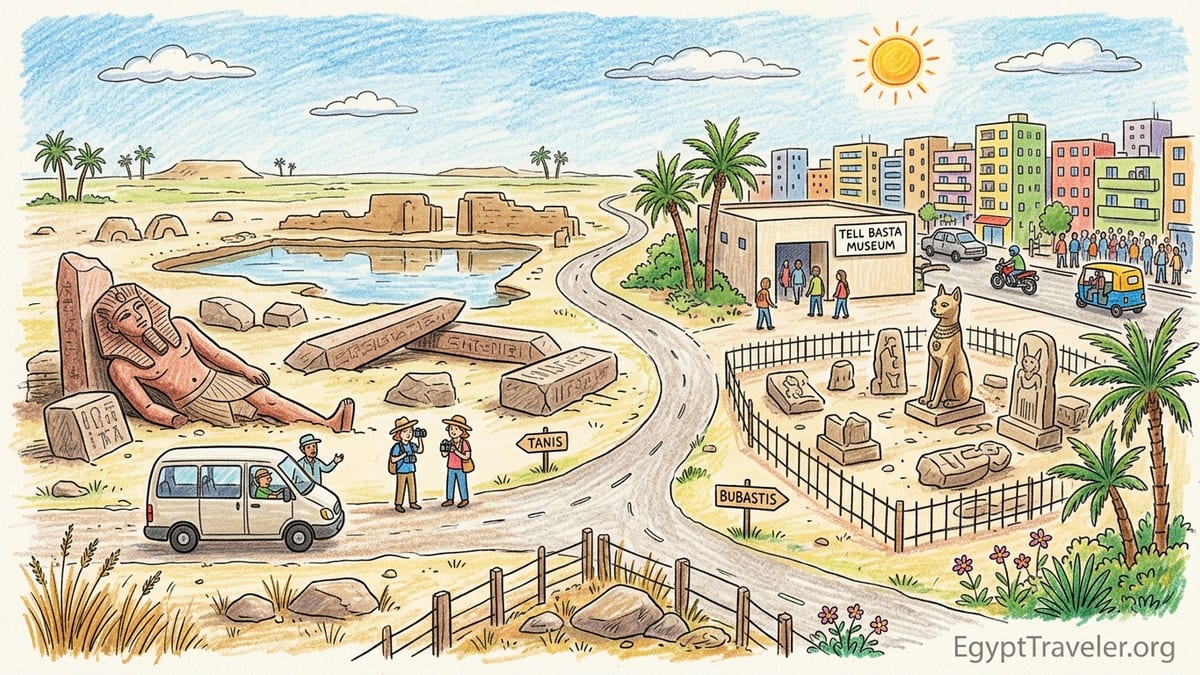
The contrast on the ground is striking. Tanis today is a wide, quiet archaeological field where colossal statues of Ramesside kings lie collapsed beside granite obelisks and the outlines of the great Amun temple. Bubastis, by comparison, is hemmed in by the modern city of Zagazig, with temple ruins, statue fragments and a small museum embedded within an urban landscape. Moving from the open, almost rural atmosphere of Tanis to the more compressed feel of Bubastis shows how ancient sites survive differently when they sit under, or beside, living cities.
Practically, the sites complement each other in how they fill the day. Tanis rewards a slower, more immersive walk, following your guide through temple courts, sacred lakes and royal tomb areas that are not heavily signposted. Bubastis is a more compact stop, often 60 to 90 minutes including the Tell Basta Museum. Many private operators in Cairo now sell them as a single 8 to 12 hour excursion, using the same private vehicle and Egyptologist guide throughout, which makes logistical sense given the similar direction of travel.
For travelers comparing options on platforms such as GetYourGuide, Viator, Booking’s activities section or regional specialists’ own websites, Tanis-and-Bubastis tours are typically marketed as “Delta archaeology” or “off the beaten path” days. They are best suited to repeat visitors, ancient Egypt enthusiasts and photographers who value atmosphere and context over blockbuster monuments and souvenir markets.
Driving Time, Route and Ideal Order of Visits
The core of the day is the drive north and east from Cairo into the Delta. Distances can look modest on a map, but road realities in the agricultural north mean you should allow more time than the kilometers suggest. Tanis lies roughly 130 kilometers from Cairo as the crow flies, yet visitors and tour companies consistently report about three hours each way by private car or minivan, depending on traffic and exact pickup location. The route uses a mix of major highways and busy local roads with motorcycles, tuk-tuks and agricultural traffic.
Bubastis, by contrast, is much closer. Tell Basta on the outskirts of Zagazig is roughly 80 to 90 kilometers from central Cairo and usually takes around 90 minutes by road in a private vehicle, again assuming moderate traffic. Many current itineraries marketed as eight to ten hour Tanis and Bubastis tours describe a 1.5 hour drive to Zagazig, followed by another 60 to 90 minutes onward to Tanis across the fields and villages of Sharqia governorate.
The most efficient order for an archaeology-focused day from Cairo is usually Cairo to Tanis first, then Tanis to Bubastis, then Bubastis back to Cairo. Leaving Cairo between 6:30 and 7:30 in the morning lets you reach Tanis mid-morning, when the light is good for photography and the site is still relatively cool outside of high summer. After two to three hours at Tanis, you can break for a quick lunch in the Tanis area or in Zagazig, then continue to Bubastis for a shorter late afternoon visit before returning to Cairo by early evening.
Some tour operators reverse the order, stopping at Bubastis first because it lies on the way toward Tanis. This can work if your priority is to minimize backtracking, but many travelers find that starting with the long drive to Tanis when they are fresh, and saving the shorter hop from Bubastis back to Cairo for last, makes the day feel less tiring. In both cases, expect a total road time of four and a half to six hours, depending on traffic, combined with four to five hours on site and breaks, which aligns with the common 8 to 12 hour tour descriptions.
What You Actually See on the Ground at Tanis
Tanis is not a polished, reconstructed temple like Karnak; it is an archaeologist’s site, an extensive scatter of ruins where a knowledgeable guide makes the difference between “some blocks in a field” and a former royal city. On arrival, most tours start at the great temple precinct of Amun. You walk through vast open courts where huge red granite statues of Ramesses II and other kings now lie fallen, many of them re-used from older sites such as Pi-Ramesses and brought to Tanis in antiquity. Granite obelisks, broken colossi and sphinxes emerge from the sand, some half buried, others standing in lines that hint at former processional ways.
Toward the rear of the Amun precinct your guide can lead you to the royal necropolis, where tombs of kings from the 21st and 22nd Dynasties were discovered with superb treasures, now in the Egyptian Museum. The chambers themselves are empty but atmospheric, with granite sarcophagus boxes and reused blocks still in place. Most travelers will recognize the name of Psusennes I, whose intact silver coffin and gold mask once lay here. Standing in those modest, stone-cut tombs while hearing how they yielded some of the richest finds since Tutankhamun is one of Tanis’s highlights.
Around the main complex you also see the remains of other temples and mudbrick city walls, along with a sacred lake and scattered blocks inscribed with cartouches. There is minimal shade and limited interpretation on site, so this is a place where you follow your guide’s line of sight and imagination. Many visitors comment that the isolation is part of the appeal. Unlike Giza or Luxor, you are likely to share Tanis with only a handful of other travelers, if any, plus local site guards and the occasional archaeologist or student group working in the area.
Because Tanis covers a large area, sturdy walking shoes and sun protection are essential. The ground is uneven, with low mounds, sandy paths and occasional debris. Most tours keep the visit to two to three hours, which allows time for the main temple, royal tombs area and some free wandering for photography. Very keen archaeophiles could easily spend longer, but within a single-day framework from Cairo, three hours is a realistic and rewarding window.
Bubastis and the Tell Basta Museum: Cat Goddess Capital in the City
By the time you reach Bubastis, the mood of the day changes. Instead of an isolated tell in open fields, you arrive at an archaeological zone bordering the lively city of Zagazig, with its apartment blocks, local traffic and university crowds. Ancient Bubastis, known as Per-Bastet, was the principal cult center of the goddess Bastet and capital of the 22nd Dynasty, and the ruins reflect that religious and political importance, even if much of the stone has long been quarried away.
Within the fenced archaeological area, your guide will point out the remains of the main temple of Bastet, whose foundations and scattered blocks outline a once-impressive sanctuary. You may see sections of granite columns and statues, a few inscribed blocks with cartouches from different periods, and the footprint of later additions. Excavations have also revealed elements of a temple of Pepi I and a palace of Middle Kingdom king Amenemhat III, but for visitors what stands out are the fragmented statues and the sense that this city was sacred ground for the cult of the cat goddess.
Close by, the Tell Basta Museum adds context in a focused, manageable way. Housed in a modern building, it displays finds from the surrounding Sharqia region: small bronzes of Bastet and other deities, everyday objects, terracotta figurines and pieces of decorated stonework. As of 2026, official information from the Ministry of Tourism and Antiquities and local press indicates that foreign adult tickets for the Tell Basta archaeological site and museum are in the range of roughly 150 Egyptian pounds, with students paying about half and Egyptian visitors substantially less, making it one of the more affordable major sites in the country.
Plan on 60 to 90 minutes for Bubastis, split between the outdoor ruins and the museum. Because the site lies near a modern city, you have easier access to simple local restaurants and cafés for a lunch stop than you do at Tanis, where options are more limited and often arranged through your tour operator. For many travelers, Bubastis feels like a satisfying “second act” to the day: shorter, denser and easier to interpret thanks to the museum, while still firmly rooted in the Delta’s layered history.
Guides, Private Tours and Realistic Costs
Unlike central Cairo or Luxor, where you can hop in a taxi and improvise, an eastern Delta archaeology day really benefits from a structured private tour. You are dealing with long drives on busy regional roads, limited English signage at the sites and entry procedures that are more comfortable when a local professional handles tickets and timing. An Egyptologist guide also brings these relatively un-reconstructed sites to life, explaining why so many Ramesside statues ended up at Tanis or how Bubastis rose to royal capital status.
Current offerings on major booking platforms and directly with local agencies typically describe Tanis and Bubastis as an 8 to 12 hour private excursion. Prices vary by season and inclusions, but as of mid 2026 many Cairo-based companies advertise full-day private tours in the broad range of about 75 to 160 US dollars per person for two people sharing, with lower per-person rates for larger private groups. For example, some Delta specialists offer an 8 hour Tanis and Bubastis day from Cairo starting around the equivalent of 75 US dollars excluding entrance fees, while others list 10 hour private archaeology days with lunch included for around 120 to 140 US dollars per person.
These tour prices generally cover hotel pickup and drop-off in Cairo or Giza, private air-conditioned vehicle, Egyptologist or professional guide and bottled water. Entrance tickets at Tanis and Bubastis, along with any camera fees and lunch, are usually separate unless clearly stated otherwise. As a planning rule of thumb, budget an additional 10 to 20 US dollars total in local currency for the two sites’ entrance fees as a foreign adult, plus whatever you prefer to spend on lunch and tips for guide and driver.
Private arrangements also allow more flexibility with timing. If you find yourself captivated by the royal tombs at Tanis, you can stay longer and make Bubastis a shorter stop, or vice versa. Solo travelers and archaeology fans often arrange custom start times, sometimes leaving Cairo as early as 6 in the morning to beat outer-city traffic and enjoy the cool hours at Tanis. Compared with group bus excursions, which are rare on this route, a private car or minivan is both more efficient and more comfortable for a day that can easily approach 300 kilometers of driving.
How Long the Day Really Takes, and When to Go
On paper, many tours describe this as an 8 to 10 hour excursion. In practice, you should prepare for the upper end of that range, especially if you are deeply interested in the archaeology or traveling in busier traffic periods. A fairly typical day might look like this: depart Cairo hotel at 7:00, reach Tanis around 10:00, explore until about 12:30, drive to Bubastis and break for lunch, visit the site and museum from around 14:30 to 16:00, then return to Cairo by 18:00 or 19:00 depending on congestion on the approach to the city.
That schedule yields a total of roughly five hours of driving and four hours on site, plus lunch and short breaks. Twelve hour days are not uncommon if you start later, linger for photos or encounter heavier traffic. Travelers who have shared their experiences online often mention leaving Cairo at 7:00 and not returning until early evening, noting that the slower rural stretches near Tanis in particular can add time even when the distance seems short.
The eastern Delta is accessible year-round, but the experience is more comfortable outside the hottest months. From late October through March, daytime temperatures are milder and the low-angled light is excellent for photography of reliefs and stone textures. In high summer, sun and heat at exposed sites like Tanis can be intense; in that period, aim for an early start, carry plenty of water and sun protection, and consider shortening your time on the most exposed parts of the tell.
Because these sites receive far fewer visitors than Giza or Luxor, you rarely need to worry about crowds. The main timing considerations are traffic in and out of Cairo and the official opening hours of the sites and museum, which generally follow the standard pattern of opening around 9 in the morning and closing in the late afternoon or early evening depending on season. Your tour operator and guide will plan departure times to ensure you clear ticket offices comfortably before last entry.
Adding the Suez Canal: Enriched Experience or Diluted Archaeology
A number of longer itineraries marketed from Cairo now combine Tanis and Bubastis with a stop at the Suez Canal, often near Ismailia. These versions are typically advertised as 12 to 14 hour days and focus on the contrast between ancient Delta capitals and Egypt’s modern engineering achievement. Some listings on large booking platforms and local agencies describe routes that run Cairo to Zagazig and Bubastis, then on to Tanis, followed by a drive south or east to the Canal zone for a late lunch and canal-side views before returning to Cairo in the evening.
Whether this extra stop improves or dilutes your day depends on your priorities. If you are dividing your attention between ancient history and modern Egypt, watching container ships glide through the Canal while you sit at a café in Ismailia can be memorable, and it gives a sense of how this region remains strategically important. However, that detour adds significant driving: an extra hour or more each way between the archaeology sites and the Canal zone, plus the eventual return to Cairo from the east instead of the north, turning an already long outing into what can feel like a marathon.
For travelers who are primarily archaeology-focused, the Suez Canal addition often means compressing the time spent at Tanis and Bubastis. Tour descriptions that promise three ancient stops and the Canal in one day frequently allocate as little as 60 to 90 minutes at each site, including walking from the car park, buying tickets and taking photos. In real terms, that can leave you with only a quick walk through the main courts at Tanis, a brief look at the Bastet temple ruins and a canal viewpoint, without the deeper exploration or guide storytelling that makes these places special.
As a decision guide, if your core goal is to understand the archaeology and feel the atmosphere of a royal Delta city and a cat-goddess cult center, a dedicated Tanis and Bubastis day is usually the better choice. Reserve the Suez Canal for a separate excursion from Cairo, perhaps with Ismailia or Port Said as the focus. If, on the other hand, you have limited days in Egypt and want a sampler that connects pharaonic capitals to modern maritime history, then a combined Tanis, Bubastis and Suez Canal tour can work, provided you are comfortable with a very long day and relatively fast-paced site visits.
The Takeaway
A private day tour from Cairo to Tanis and Bubastis is one of Egypt’s most rewarding choices for travelers ready to go beyond the classic highlights. It trades polished tourist infrastructure for real archaeological landscapes, combining the scattered colossi and royal tombs of an ancient Delta capital with the urban-edge ruins and museum of a cat-goddess sanctuary town. Together, the two sites provide a layered look at power, religion and daily life in Lower Egypt across centuries.
From a practical point of view, this is a full day of four and a half to six hours on the road, plus around four hours on site, best done with a private vehicle and Egyptologist guide. Entrance fees remain comparatively modest, especially alongside the cost of reaching the sites, and current tour offers in the 75 to 160 US dollar per person range for small private groups provide good value for travelers who care about depth of interpretation and flexibility over volume tourism.
For an archaeology-centered experience, dedicating the day solely to Tanis and Bubastis is usually preferable to tacking on the Suez Canal. The extra driving to the Canal often reduces your time amid the ruins just when the sites begin to make sense. If you have the days to spare, consider keeping your Delta archaeology and modern engineering experiences as separate excursions.
Ultimately, the Tanis and Bubastis day is not for everyone. Casual visitors who want iconic photos and easy logistics will be happier in Giza or Luxor. But for repeat visitors, history buffs and photographers drawn to quiet ruins under big skies, it is exactly the kind of journey that turns a second or third trip to Egypt into something personal and unforgettable.
FAQ
Q1. How long does a Tanis and Bubastis day tour from Cairo really take?
Most travelers should expect 10 to 12 hours door to door. That usually includes about five hours of driving, three hours at Tanis, 60 to 90 minutes at Bubastis and time for lunch and short breaks.
Q2. Is it better to visit Tanis or Bubastis first?
For an archaeology-focused day, many travelers prefer to drive directly to Tanis first while fresh, then stop at Bubastis on the way back. Some operators reverse the order because Bubastis lies closer to Cairo, but the “Tanis first” plan often feels less tiring overall.
Q3. Do I really need an Egyptologist guide for these sites?
Strictly speaking, you can visit with only a driver, but most visitors find an Egyptologist guide invaluable. There is limited signage at both sites, and a good guide explains the layout of the Amun temple at Tanis, points out the royal tombs and helps interpret the scattered remains and museum displays at Bubastis.
Q4. What kind of vehicle is used for Tanis and Bubastis tours?
Most private tours use modern air-conditioned sedans for one to two people or minivans for small groups. Given the long driving time and variable road conditions in the Delta, it is worth confirming that your vehicle has working air conditioning and seat belts before departure.
Q5. How much should I budget for entrance fees on a Tanis and Bubastis day?
Entrance prices change periodically, but as of 2026 foreign adults can expect to pay the equivalent of roughly 10 to 20 US dollars in total in local currency for both sites and the Tell Basta Museum, with students paying about half and Egyptian visitors significantly less.
Q6. Is adding the Suez Canal to the itinerary a good idea?
Adding a Suez Canal stop creates a very long day and usually shortens your time at Tanis and Bubastis. It suits travelers who want a broad overview of both ancient and modern Egypt in one trip, but if your main interest is archaeology, a dedicated Tanis and Bubastis day without the Canal is usually more satisfying.
Q7. What should I wear and bring for this excursion?
Wear comfortable closed walking shoes, light breathable clothing, a hat and sunblock. Bring sunglasses, plenty of water, some snacks and a light layer for air-conditioned car rides. In cooler months, an extra layer for windy conditions at Tanis is useful.
Q8. Are there decent food and restroom stops along the way?
Yes. Most tours include stops at roadside cafés or simple local restaurants near Zagazig or on the road between Cairo and Tanis, where you can use restrooms and have a basic lunch. Facilities are simpler near Tanis itself, so many travelers prefer to plan their main meal closer to Bubastis or on the return leg toward Cairo.
Q9. Is this day trip suitable for children?
It can be, but families should consider the long driving times and limited shade. Older children with a strong interest in history may enjoy exploring the open ruins and hearing stories about royal tombs and the cat goddess, while younger children may find the day long and the heat tiring, especially in summer.
Q10. How far in advance should I book a Tanis and Bubastis tour?
For most of the year, booking a week or two in advance is sufficient, especially with local operators. During peak periods such as Christmas, New Year and major spring holidays, booking earlier helps ensure availability of good Egyptologist guides and vehicles.