


Egypt’s Mediterranean coast stretches from historic Alexandria to the resort strips of Sahel, New Alamein and Marsa Matruh, and for most travelers it starts with one question: what is the smartest way to get there from Cairo? Whether you are heading for a long summer stay in the North Coast, a quick weekend in Alexandria or a road trip to Marsa Matruh, each transport option comes with different trade-offs on time, comfort, luggage and cost.
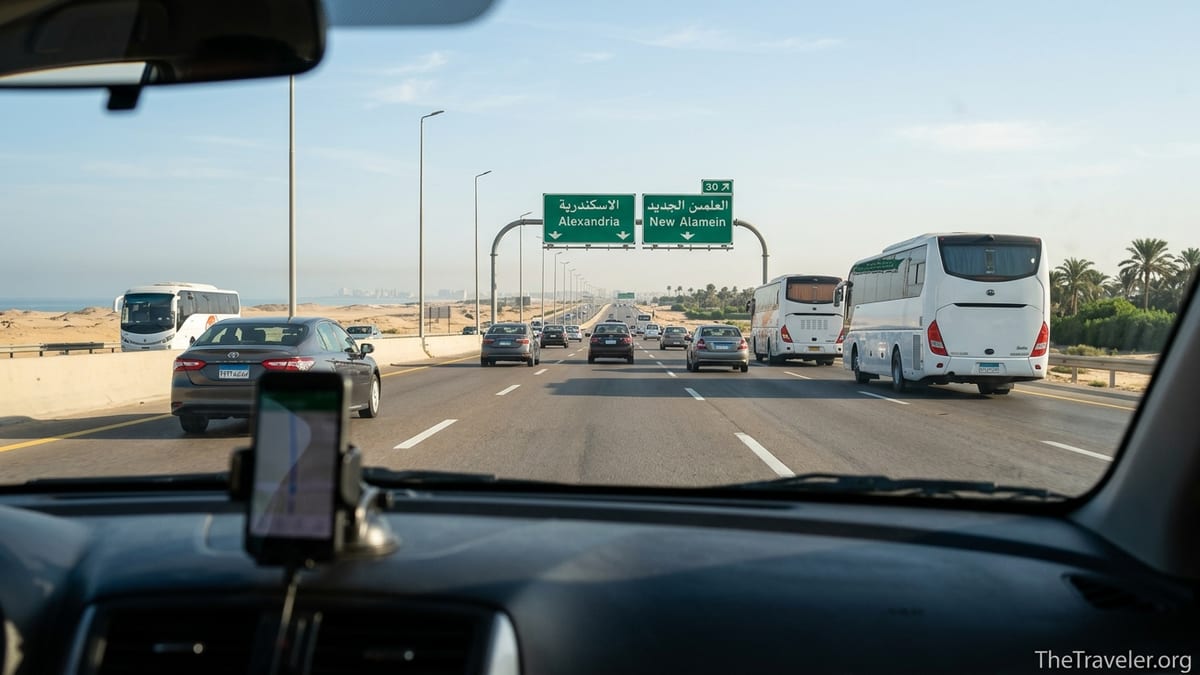
Key routes from Cairo to the Mediterranean coast
Most journeys from Cairo to the Mediterranean follow one of two main corridors. For Alexandria and much of the traditional North Coast, travelers use the Cairo–Alexandria Desert Road or the agricultural road that tracks the Nile Delta. For New Alamein, Sahel resorts and Marsa Matruh, the trip typically continues west along the International Coastal Road through Alamein and on toward Matrouh. In practice, this means decisions you make for the first leg to Alexandria often shape the entire journey.
From central Cairo to Alexandria is roughly 220 to 230 kilometers by road, depending on your exact starting and ending points. In light traffic on the Desert Road, confident drivers can make this run in around 2.5 to 3 hours, but at busy holiday times or weekends it can easily stretch to 4 hours or more. Continuing from Alexandria to New Alamein adds another 100 to 120 kilometers, while Marsa Matruh sits about 500 to 520 kilometers from Cairo, commonly a 6 to 7 hour drive under reasonable conditions.
Travelers use these routes in several ways. A family might take the train from Cairo Ramses to Alexandria’s Misr Station, then transfer by private car or app taxi along the coast to a Sahel compound like Marina or Hacienda. Others prefer a direct bus from Cairo to specific North Coast stops such as New Alamein, Sidi Abdel Rahman or even Marsa Matrouh, avoiding the need to change vehicles with luggage in tow.
The decision is less about a single “best” option and more about what fits your itinerary. Alexandria city breaks lend themselves to trains and taxis. Long summer stays with a lot of baggage often favor self-driving or a private transfer straight to your compound. Budget-conscious solo travelers may lean toward intercity buses, even if the trip is slower.
Driving from Cairo: freedom and responsibility
Driving yourself from Cairo to the Mediterranean coast appeals to travelers who want flexibility, especially families or groups carrying multiple suitcases, strollers and beach gear. From western Cairo neighborhoods, you can be on the Cairo–Alexandria Desert Road within 30 to 45 minutes, and once you clear the city’s ring road, the highway is wide, relatively modern and punctuated by service stations selling fuel, snacks and coffee.
Rental cars are widely available in Cairo from international brands and local agencies operating out of Cairo International Airport and central districts like Heliopolis, Zamalek and Dokki. Travelers commonly rent compact sedans or small SUVs for trips to Sahel or Marsa Matrouh, as these handle highway conditions and luggage better than city cars. Insurance typically includes basic coverage, but you will want to confirm details on excess charges, cross-governorate travel and whether roadside assistance is part of the package. It is also sensible to choose an automatic if you are new to Egyptian traffic.
For Alexandria, drivers usually follow the Desert Road all the way to the city outskirts before switching to local roads into districts like San Stefano, Gleem or the Corniche. For New Alamein and the North Coast compounds, a common pattern is to exit near Alexandria or Borg El Arab and then continue west on the International Coastal Road. Roads toward New Alamein and well-known resorts near Sidi Abdel Rahman are generally in good condition, and many Sahel compounds have clearly signed exits along the highway.
That freedom comes with responsibilities. Egyptian driving can feel aggressive to visitors, with frequent lane changes, variable adherence to speed limits and occasional unlit vehicles at night. Many residents strongly prefer daytime driving, especially on the long coastal stretch between Alexandria and Marsa Matrouh. If you are unused to local traffic norms or traveling with children, a compromise is to rent a car with a driver for the longer legs, then drive yourself only in quieter coastal areas where you feel more comfortable.
Taking the train: Cairo to Alexandria and beyond
The backbone of public transport between Cairo and Alexandria is the national rail line. Trains depart from Cairo’s Ramses Station to Alexandria’s Misr Station and Sidi Gaber throughout the day, with a mix of air-conditioned express services and slower, cheaper trains. Typical journey times for the faster services are around 2.5 to 3 hours, comparable with driving in light traffic but with far less stress.
Ticket prices on standard air-conditioned trains remain relatively affordable compared with private transfers or car rentals. First and second class prices are still low enough that many travelers opt for first class for the extra comfort, particularly on weekends and holidays when carriages can be busy. You can usually buy tickets at the station on the day of travel, but during peak summer months or Eid holidays it is wise to book in advance through official channels or travel agents to avoid crowded departures and long queues.
For luggage, Egyptian trains are pragmatic rather than strict. Travelers commonly bring medium suitcases and small cabin bags, stowing them above seats or in the space at carriage ends. Oversized luggage or multiple large bags can be awkward on busy services, especially when navigating station steps at Ramses or Misr, so the train is more comfortable if you are traveling relatively light for a weekend in Alexandria rather than relocating an entire family to Sahel for a month.
Beyond Alexandria, rail options along the coast are more limited for tourists heading to resort areas. There are trains running west toward Marsa Matrouh, but schedules are less frequent and may be seasonal or subject to change. In practice, many visitors use the train only for the Cairo to Alexandria leg, then switch to a car, taxi or bus for the final stretch to coastal resorts, New Alamein or Matrouh. If your main destination is a central Alexandria hotel near the Corniche, the train plus short taxi ride remains one of the most efficient and relaxing combinations.
Intercity buses: budget-friendly access to Sahel and Matrouh
Intercity buses are a practical and widely used way to reach Egypt’s Mediterranean coast on a budget while avoiding the stress of driving. Private operators such as Go Bus and Blue Bus run routes from Cairo to Alexandria, the North Coast and Marsa Matrouh, often with multiple daily departures during the summer season. Coaches are usually modern and air-conditioned, with reclining seats, onboard movies and occasional refreshments.
From Cairo, buses to the North Coast typically depart from designated stations or pick-up points in districts like Nasr City, Heliopolis or central Cairo. Routes may call at Alexandria’s stations, then continue along the coast to key stops such as New Alamein, Marina, Sidi Abdel Rahman and sometimes all the way to Marsa Matrouh. Typical journey times can range from 3.5 to 4.5 hours to Alexandria and 5.5 to 7 hours to Marsa Matrouh, depending on traffic, rest stops and the specific routing.
Ticket prices on these buses are generally higher than the cheapest standard trains but lower than private transfers or renting a car for several days. Travelers can often choose between standard, business and so-called VIP classes, with higher classes offering more legroom, fewer seats per row and sometimes free snacks or drinks. Booking in advance, especially for weekend departures in July and August, is strongly recommended. Many residents now reserve seats online or via operator apps, choosing front or aisle seats to minimize motion sickness.
Luggage allowances are usually sufficient for typical holiday baggage. It is common to see passengers checking one medium or large suitcase in the hold and carrying a smaller bag or backpack onboard. Very bulky items may incur extra fees or be refused in busy periods, so it is sensible to arrive early and speak directly with staff if you are carrying items like surfboards, diving gear or multiple large bags. For solo travelers and couples with moderate luggage who want to go directly to a Sahel compound without changing vehicles, a bus that stops near their specific exit can be a smart middle ground between cost and convenience.
Private transfers and hired drivers: comfort for door-to-door trips
For travelers prioritizing comfort, privacy or time, private transfers and hired drivers are a compelling option. Many Cairo-based agencies, hotels and independent drivers offer fixed-price trips from Cairo to Alexandria, New Alamein or Marsa Matrouh in sedans, SUVs or minibuses, with door-to-door service from your hotel or apartment to your coastal accommodation. This is especially attractive for late-night arrivals, families with children, older travelers and small groups sharing costs.
Packages typically include pick-up from central Cairo or Cairo International Airport, air-conditioned vehicles and a direct drive via the Desert Road and coastal highways. For example, a family arriving on an evening flight might book a private SUV to take them straight from the airport to a rental villa in a North Coast compound, avoiding the need to navigate public bus terminals or late-night driving. Some operators will also arrange short rest stops on the highway for coffee, fuel and bathroom breaks at agreed points.
Pricing varies widely according to vehicle type, season and operator reputation. While specific figures change frequently, it is fair to say that a private car from Cairo to Alexandria will cost significantly more than two or three train or bus tickets, but may become competitive when split among four or five passengers. To Marsa Matrouh or remote stretches of the coast, private transfers become noticeably more expensive but also save considerable time and complexity, particularly when train and bus schedules are limited.
Another variation is hiring a car with a driver for multiple days, rather than a one-off transfer. This arrangement allows you to move between Alexandria, Sahel resorts and Matrouh at your own pace, while leaving the actual driving to a local professional who knows the routes, fuel stations and security checkpoints. For travelers considering complex itineraries such as Cairo to Alexandria, then west to Sahel, then onward to Marsa Matrouh and even south toward Siwa, a trusted driver who stays with you can simplify logistics dramatically.
Choosing the right option for Alexandria, North Coast, Alamein and Marsa Matruh
In practice, the best transport choice depends heavily on your specific Mediterranean destination and how long you plan to stay. For Alexandria city breaks of a night or two, the combination of train plus local taxi or ride-hailing app is usually the easiest and most economical. You avoid long drives and parking headaches on Alexandria’s busy streets and can still reach central landmarks like the Bibliotheca Alexandrina, the Corniche and Montaza quickly from Misr or Sidi Gaber stations.
For North Coast and Alamein resorts, especially if you are staying in closed compounds or renting a serviced apartment for several weeks, the priorities shift. Many Egyptian families favor self-driving or private transfers so they can carry large amounts of luggage, groceries, beach gear and even small appliances, and then keep their car on hand for supermarket runs and short trips between beaches and restaurants. Buses can work well if your resort is directly served by a specific route and you are not carrying more than one or two bags per person.
Marsa Matrouh and more distant stretches of the northwest coast demand extra planning. The road distance from Cairo is long enough that fatigue and daytime driving become real considerations. It is common for travelers to break the trip with a night in Alexandria or New Alamein before continuing further west, particularly when traveling with children. Intercity buses and some private transfers run directly from Cairo to Matrouh, but departure times, rest stops and onboard comfort should be checked carefully when booking.
Mixed strategies can work well. A couple might take the morning train from Cairo to Alexandria, spend a day exploring the city, then pick up a pre-arranged private transfer the following morning along the coast to Sidi Abdel Rahman or Marsa Matrouh. Others may travel out by bus and then return to Cairo by train, using the outbound bus’s coastal stops and the inbound train’s predictable schedule to balance convenience with cost. Thinking about the whole trip as a series of legs, rather than a single journey, opens up more comfortable combinations.
Luggage, comfort and practical tips on the move
Luggage weight and size often dictate which transport mode feels realistic. If you are a solo traveler or couple heading to Alexandria with one suitcase each, the train or bus will usually be more than adequate, and the slight hassle of carrying bags through Ramses Station is offset by low fares and predictable journey times. On the other hand, a family of five with three large suitcases, hand luggage, a stroller and a cooler full of food would likely find a private car or minivan far more practical than negotiating bus holds and station platforms.
Comfort is another important factor. Egyptian summers along the Mediterranean are more temperate than in Upper Egypt but still hot, especially at midday. Air conditioning on trains, buses and private cars is not just a luxury. On a five or six hour trip to Marsa Matrouh, reliable cooling, seat recline and access to water make a noticeable difference. If you are sensitive to motion sickness, front seats on buses and mid-carriage seats on trains can help, as can scheduling travel for early morning or later evening when temperatures and traffic are lower.
Security and checkpoints are a standard part of long-distance travel in Egypt. Drivers on the Desert Road and coastal highways pass through multiple police and military checkpoints, where officers may briefly check IDs and ask about destinations. Professional drivers and bus staff are used to this and usually handle any communication. If driving yourself, keeping passports or ID cards easily accessible, along with rental documents, reduces delay. It is also sensible to stick to major, well-lit routes and avoid experimental shortcuts, especially at night.
Finally, build flexibility into your timings. On busy summer Fridays, traffic leaving Cairo for the coast can be heavy from the late afternoon into the evening, and return traffic on Sundays and after public holidays can be similarly congested. Planning departure early in the morning, booking midweek travel where possible, and allowing extra time for connections between train, bus and private transfers can turn a potentially stressful move into a smoother part of your holiday.
The Takeaway
Travel between Cairo and Egypt’s Mediterranean coast has become easier and more varied, but the growing range of options can also make planning feel complex. Thinking concretely about your route, group size, luggage and tolerance for driving helps clarify the trade-offs. Alexandria favors trains and short urban transfers, North Coast and Alamein often reward travelers who arrange a car or private driver, and the more distant sands of Marsa Matrouh call for extra attention to timing and comfort.
Whichever mode you choose, the essential patterns are consistent. Self-driving and private transfers offer maximum flexibility at higher cost and responsibility. Trains provide a calm, predictable backbone between Cairo and Alexandria, ideal for city stays and light packers. Intercity buses stitch Cairo directly to many Sahel and Matrouh stops, trading speed for price and simplicity. Mixed itineraries that combine these modes often work best, especially for travelers who want to see both Alexandria’s history and the North Coast’s beaches in a single trip.
Planning a few practical details in advance goes a long way. Reserve peak-season seats on trains and buses as early as reasonable, choose daytime departures when possible, and be honest about how much luggage and how many hours of road time your group can handle comfortably. Getting these logistics right means that when you finally reach the Mediterranean and step onto the Corniche in Alexandria or the sands of Sahel, the journey from Cairo will already feel like a smooth part of the experience rather than an ordeal.
FAQ
Q1. What is the fastest way to travel from Cairo to Alexandria?
The fastest realistic options are either driving by private car or taking an express air-conditioned train, both typically around 2.5 to 3 hours in light traffic.
Q2. Is it safe to drive from Cairo to the North Coast or Marsa Matrouh?
The main highways are generally in good condition and widely used, but traffic can be fast and assertive, so daytime driving and experienced drivers are strongly recommended.
Q3. Can I go directly from Cairo to North Coast resorts by bus?
Yes, several private bus companies operate routes from Cairo to key North Coast and New Alamein stops, particularly in summer, so you can often reach your compound without changing vehicles.
Q4. Are trains a good option if I have a lot of luggage?
Trains can handle moderate luggage, but multiple large suitcases or bulky beach gear can be awkward at stations, so heavy packers usually prefer a car or private transfer.
Q5. How far is Cairo from Marsa Matrouh by road?
The road distance is roughly 500 to 520 kilometers, often taking about 6 to 7 hours of driving time depending on traffic, rest stops and exact starting and ending points.
Q6. Do I need to book Cairo–Alexandria train tickets in advance?
Outside peak periods you can often buy on the day, but in summer, on weekends and during holidays, advance booking is advisable to secure seats on preferred departures.
Q7. Are private transfers from Cairo to the coast worth the price?
For families, late-night arrivals or travelers prioritizing comfort and door-to-door convenience, private transfers can be excellent value when costs are shared among several passengers.
Q8. Which option is best for a weekend in Alexandria without a car?
The train plus short taxi or ride-hailing trip is usually the most convenient and economical combination for a short Alexandria city stay without the hassle of parking.
Q9. Is it possible to combine train, bus and private car in one trip?
Yes, many travelers mix modes, such as taking the train to Alexandria, then a private car or bus along the coast to a North Coast resort or Marsa Matrouh.
Q10. What time of day is best to travel from Cairo to the Mediterranean coast?
Early morning departures usually offer cooler temperatures, lighter traffic and smoother checkpoint procedures, especially on busy summer weekends and holidays.