


Egypt rewards travelers who plan around distances, traffic and internal flights rather than just ticking off bucket-list names. This guide breaks down realistic 5, 7, 10, 14 and 21 day itineraries that combine Cairo, the Giza Pyramids, Luxor, Aswan, a Nile cruise and optional Red Sea time, with concrete examples of travel times, typical flight patterns and sensible overnight allocations.
How Long Do You Really Need in Egypt?
The classic first-time route in Egypt links Cairo and Giza with Luxor and Aswan, often including a 3 or 4 night Nile cruise between Luxor and Aswan. Nonstop flights from Cairo to Luxor take around 1 hour and are operated several times per day by EgyptAir and other domestic carriers, which makes it feasible to cover large distances in a short trip if you plan carefully.
A 5 day itinerary is enough for a focused highlights trip that covers Cairo, Giza and either Luxor or a short Luxor–Aswan cruise. Seven days lets you see Cairo, do a standard 3 or 4 night Nile cruise and still not feel completely rushed. Ten days is the sweet spot for most visitors, giving you time for Cairo, a cruise, Abu Simbel and either extra time in Luxor or a brief Red Sea break.
If you have 14 days you can slow the pace, build in rest days and stay both in a Nile-front hotel and on a cruise ship. With 21 days you can combine the classic Nile route with several nights in Hurghada or El Gouna on the Red Sea, or even extend to less visited oasis towns, while still keeping travel days manageable.
Costs vary widely, but as a reference point, many midrange Nile cruises between Luxor and Aswan run 3 or 4 nights and often start around the mid hundreds of US dollars per person, including full board and guided temple visits. Domestic one-way flights such as Cairo to Luxor or Cairo to Aswan often price in the low to mid hundreds of US dollars if booked in advance, depending on season and airline.
Transport Basics: Flights, Trains, Cruises and Transfers
The main logistical spine of most itineraries is the trio of airports at Cairo, Luxor and Aswan. Cairo to Luxor and Cairo to Aswan are both served by multiple daily nonstop flights, with typical airborne times close to 1 hour. In practice, you should allow at least 3 to 4 hours door to door when you factor in check-in, security and transfers between airport and hotel.
Many travelers underestimate Cairo’s traffic. A ride from Cairo International Airport to downtown can easily take 45 to 60 minutes, and reaching the Giza Plateau from the airport can take from around 45 minutes up to 2 hours depending on time of day. Booking a private transfer in advance or using a ride-hailing app is usually more predictable than negotiating with taxis on arrival.
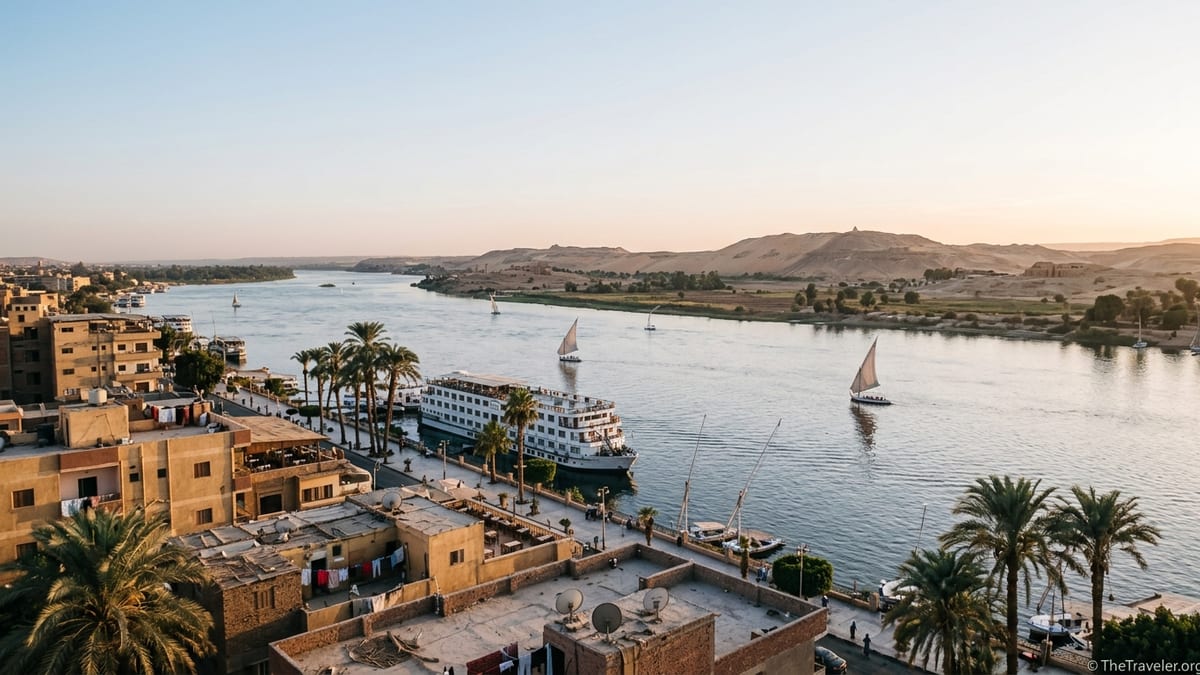
Between Luxor and Aswan, the most popular option for first-time visitors is a 3 or 4 night Nile cruise. These cruises typically include stops at Esna, Edfu and Kom Ombo along the roughly 200 kilometer stretch of river. A 3 night cruise often runs Aswan to Luxor, sailing with the current, while a 4 night cruise commonly goes Luxor to Aswan, with days split between sailing and temple visits.
Trains also run between Cairo, Luxor and Aswan. Night trains can be a budget-friendly option, but schedules, comfort and punctuality vary. For a short holiday itinerary where time is more valuable than saving every dollar, most travelers opt for at least one domestic flight to avoid losing daylight hours in transit.
5 Day Egypt Highlights Itinerary
With only 5 days in Egypt, you need to prioritize. The most realistic options are either a Cairo–Giza–Luxor combination using flights or a Cairo–Giza focus with a compact Luxor extension. Trying to cover Cairo, Luxor, Aswan, a cruise and a Red Sea stay in 5 days will feel rushed and waste too much time in transit.
One practical 5 day route is: Day 1 arrive Cairo, settle downtown or in Giza; Day 2 full day Giza Pyramids, Sphinx and Saqqara; Day 3 Cairo Museum in the morning, Islamic Cairo in the afternoon, then an evening flight to Luxor; Day 4 full day West Bank of Luxor, including the Valley of the Kings and Hatshepsut’s Temple; Day 5 morning at Karnak and Luxor Temple, then fly back to Cairo for your international departure.
In this scenario you would usually book an early evening Cairo to Luxor flight on Day 3, giving yourself at least 2.5 to 3 hours from leaving your Cairo hotel to flight departure. On Day 5 you can often catch a mid-afternoon or evening Luxor to Cairo flight that connects to a late-night international departure, but it is safer to allow a generous buffer in case of delays.
If you prefer to minimize domestic flights, another option is to base entirely in Cairo and Giza. You could spend 3 nights in Cairo, doing the pyramids, museums and old neighborhoods, followed by a 2 night side trip to Luxor by flight. This works best outside the hottest summer months, when full days of outdoor sightseeing in Luxor would otherwise be exhausting.
7 Day Itinerary: Adding a Short Nile Cruise
A week in Egypt allows you to add a short Nile cruise between Luxor and Aswan without turning your entire trip into a blur of packing and unpacking. A common first-timer pattern is 2 nights in Cairo followed by 4 nights on a cruise and a final night in either Aswan or Cairo depending on flight connections.
One realistic 7 day plan could be: Day 1 arrive Cairo; Day 2 Giza Pyramids and the Sphinx, with sunset views if possible; Day 3 Egyptian Museum or Grand Egyptian Museum and a walking tour of Islamic Cairo before an evening flight to Luxor; Days 4 to 7 four night Nile cruise from Luxor to Aswan, visiting Karnak and Luxor Temples, the West Bank tombs, Edfu and Kom Ombo along the way, then disembarking in Aswan on Day 7 for your flight back to Cairo.
With this structure you effectively have 2.5 touring days in Cairo and Luxor before boarding the ship. Cruise itineraries vary, but many four night sailings spend the first night docked in Luxor, sail south over two days with sightseeing at Edfu and Kom Ombo, and finish with one or two nights in Aswan. This gives you a taste of the river without the need to pack and unpack repeatedly.
For travelers who prefer more independent time, you could instead spend 2 nights in Cairo, 2 nights in Luxor and 2 nights in Aswan with a single overnight train or flight between Luxor and Aswan. You would skip the cruise in this version but gain more flexible time to wander Luxor’s corniche, visit the Nubian Museum in Aswan and adjust sightseeing to your energy levels.
10 Day Itinerary: The Ideal First-Time Route
With 10 days to work with, you can design a route that includes Cairo, Giza, Luxor, Aswan, a Nile cruise and Abu Simbel without feeling excessively rushed. Many tour operators sell 9 or 10 day packages that mirror this structure, and you can replicate a similar pattern independently with a mix of prebooked flights and flexible days.
One well-balanced 10 day route might look like this: Day 1 arrive Cairo; Day 2 Giza Pyramids, Sphinx and Saqqara; Day 3 Egyptian Museum or Grand Egyptian Museum plus Islamic or Coptic Cairo; Day 4 morning at leisure, evening flight to Luxor and overnight at a Nile-front hotel; Days 5 to 8 four night Nile cruise from Luxor to Aswan; Day 9 early morning excursion to Abu Simbel from Aswan by flight or road, returning to Aswan that afternoon; Day 10 fly Aswan to Cairo and connect to your international departure.
In this structure, domestic flights are clustered so that you are not constantly backtracking. You would typically take one evening flight from Cairo to Luxor and one morning or midday flight from Aswan to Cairo. Most Abu Simbel excursions leave Aswan very early, often before dawn, so it makes sense to keep your Aswan stay at the end of the trip when you are already acclimatized.
A 10 day trip is also long enough to include a short Red Sea stay if you are willing to cut back slightly on time elsewhere. An alternative version could be: 2 nights Cairo, 3 nights Nile cruise between Aswan and Luxor, 2 nights in Luxor and 3 nights in Hurghada. In that case you would usually travel by road for about 4 to 5 hours between Luxor and Hurghada and then fly from Hurghada back to Cairo for your international flight.
Whichever 10 day pattern you choose, build in at least one slower afternoon in either Luxor or Aswan where you can enjoy a felucca sail at sunset or a relaxed stroll along the river rather than racing from site to site. The intense sun and crowds at major temples can make unbroken days of sightseeing tiring, even outside the peak summer heat.
14 Day Itinerary: Balancing Culture and Relaxation
Two weeks in Egypt lets you keep all the highlights while adding recovery time and more flexible days. This is particularly valuable if you are sensitive to heat or traveling with children, since you can schedule early morning sightseeing sessions followed by leisurely afternoons at your hotel pool or on the river.
One balanced 14 day route could be: Days 1 to 3 Cairo and Giza; Day 4 fly to Luxor and overnight; Days 5 to 8 four night Nile cruise from Luxor to Aswan; Days 9 and 10 Aswan at leisure with an optional Abu Simbel day trip; Days 11 to 14 Red Sea stay in Hurghada or El Gouna, then flight or road transfer back to Cairo for departure. This pattern spaces out your longest days and ensures you are resting on the coast toward the end of the trip.
Travel between Aswan and the Red Sea usually involves either a domestic flight via Cairo or a combination of road and air. Some travelers choose to return from Aswan to Luxor by road or train, then continue by road to Hurghada in around 4 to 5 hours. From Hurghada you can then fly back to Cairo in less than an hour or arrange a road transfer of several hours depending on your departure time and tolerance for long drives.
Another way to use 14 days is to split your stay more evenly between land and river. For instance, you might spend 3 nights in Cairo, 3 nights in Luxor at a hotel, 3 nights on a shorter cruise between Luxor and Aswan, 2 nights in Aswan and 3 nights on the Red Sea. This gives you more time to explore neighborhoods on foot and return to favorite spots rather than compressing everything into a tight schedule.
21 Day Itinerary: Grand Tour With Red Sea Stay
A 21 day Egypt itinerary allows you to slow your pace significantly and explore beyond the classic highlights. It is realistic in three weeks to spend several nights in both Hurghada and El Gouna or to add an oasis stay in the Western Desert, while still having generous time in Cairo, Luxor, Aswan and on the Nile itself.
One example grand tour might be: Days 1 to 4 Cairo and Giza, including multiple museum visits and a day exploring Islamic and Coptic quarters; Days 5 to 7 Luxor hotel stay with extended West Bank exploration, such as Medinet Habu and the Valley of the Queens in addition to the main tombs; Days 8 to 11 four night Nile cruise to Aswan; Days 12 to 14 Aswan and Abu Simbel; Days 15 to 20 Red Sea stay split between Hurghada and El Gouna, focusing on snorkeling or diving days balanced with pool and beach time; Day 21 return to Cairo for departure.
In a three week itinerary, transferring between hubs becomes a central consideration. You might, for example, fly Cairo to Luxor, then travel Luxor to Hurghada by road, Hurghada to Cairo by flight, and Cairo to Aswan by flight later in the trip. Alternatively, you can cluster your Nile segment first, then finish with a single long stay on the Red Sea before a final flight back to Cairo.
Longer trips also make it easier to choose a higher quality Nile cruise, since you are not trying to squeeze everything into the absolute cheapest option. Many travelers find that stepping up one category in cruise quality or choosing a smaller vessel leads to noticeably better food and guiding, which can make a big difference during four or more nights on board.
Because 21 day itineraries involve more moving parts, consider leaving at least one full unplanned day in Cairo at the end of your trip. This acts as a buffer in case of minor delays on domestic flights or road transfers and also gives you a final chance to shop, revisit a favorite cafe or simply rest before your international journey home.
Practical Tips for Booking Flights, Cruises and Hotels
When comparing domestic flights, look at total travel time rather than just ticket price. A very early morning flight between Cairo and Luxor might be cheaper but could leave you exhausted for a full day of temple visits. Many visitors prefer mid to late morning departures that allow a relaxed breakfast and still have you checking in to your next hotel around lunchtime.
Nile cruises are sold across a wide range of price points, from budget-standard boats with simple cabins to upscale vessels with more spacious rooms and varied dining. Star ratings on marketing materials are not always reliable, and it is common for even modest ships to describe themselves as five star. Focus instead on recent traveler reports, ship age, cabin photos and the specific daily schedule.
In Cairo and Luxor, location can matter more than hotel category. A midrange hotel with Nile views in Luxor or a property near the Giza Plateau can save significant time and taxi costs compared with a more luxurious place that is far from the sites you want to visit. At the Red Sea, many resorts are self-contained, so check what is included in meal plans and activities when comparing prices.
Whichever itinerary length you choose, try to avoid building tight same-day connections between a Nile cruise disembarkation and an international flight. It is safer to plan one night in Cairo at the start or end of the trip as a cushion, especially in high season when airports and roads can be busier than expected.
The Takeaway
Designing an Egypt itinerary is as much about pacing as it is about choosing famous names on a map. A focused 5 day trip can deliver Cairo, Giza and Luxor in a concentrated burst, while 7 and 10 day itineraries add a Nile cruise and, in many cases, a side trip to Abu Simbel. At 14 and 21 days you can combine the classic Nile route with meaningful relaxation on the Red Sea and slower days soaking up the atmosphere along the river.
Think first in terms of how many full days you truly have on the ground, then match your ambitions to realistic travel times between Cairo, Luxor, Aswan and the coast. Use domestic flights to bridge long distances efficiently, choose a Nile cruise length that fits your style and leave room for rest in between big sightseeing days. With the right structure, any of these itinerary lengths can give you a richly layered introduction to Egypt’s history, landscapes and river life.
FAQ
Q1. Is 5 days in Egypt enough to see Cairo, Luxor and Aswan?
Five days is usually too short to cover Cairo, Giza, Luxor, Aswan and a Nile cruise without feeling rushed. With 5 days it is more realistic to focus on Cairo, Giza and Luxor, using a domestic flight to connect Cairo and Luxor and skipping Aswan or saving it for a future trip.
Q2. How many days are ideal for a Nile cruise between Luxor and Aswan?
The most common and comfortable length for a Nile cruise between Luxor and Aswan is 3 or 4 nights. Three night sailings often run Aswan to Luxor, while four night itineraries frequently travel Luxor to Aswan and allow a slightly more relaxed pace with extra time at key temples.
Q3. Should I book domestic flights in Egypt in advance?
It is usually wise to book domestic flights between Cairo, Luxor, Aswan and the Red Sea in advance, especially in high season and around holidays. Buying tickets ahead gives you better choice of flight times, which helps minimize fatigue and wasted hours at airports.
Q4. Can I fit the Red Sea into a 7 day Egypt itinerary?
You can technically add a short Red Sea stay to a 7 day trip, but it will compress your time in Cairo and along the Nile. Most travelers find that 10 days or more works better if they want both a Nile-focused itinerary and at least two or three full days by the sea for snorkeling or relaxing.
Q5. Is it better to start my trip in Cairo or Luxor?
Most international flights arrive in Cairo, so many itineraries naturally begin there with a couple of nights for the pyramids and museums. If your schedule allows and you find a good connection, starting in Luxor can also work well, especially if you want to end the trip with Giza and a final night in Cairo before flying home.
Q6. How much time should I allow between a domestic and international flight in Cairo?
When connecting in Cairo between a domestic and international flight, it is prudent to allow at least 3 to 4 hours between scheduled arrival and departure times. This gives you a buffer for delays, security checks and any terminal transfers, which can be time consuming in busy periods.
Q7. Do I need a guide for sites like the Pyramids and the Valley of the Kings?
You can visit major sites independently, but many travelers find that hiring a licensed guide for at least some days adds valuable context and helps with logistics. For complex locations such as the Egyptian Museum or the West Bank of Luxor, a guide can make the experience more efficient and informative.
Q8. Is it safe to travel between Luxor and Aswan by road instead of by cruise?
Many visitors travel between Luxor and Aswan by road with private drivers or organized transfers, and this is a common alternative to a cruise. Conditions and regulations can change, so it is best to check current advice locally or with your accommodation before finalizing road travel plans.
Q9. When is the best time of year to follow these Egypt itineraries?
The most comfortable months for Egypt itineraries that include extensive outdoor sightseeing are typically from late autumn through early spring. Daytime temperatures are milder then, which makes exploring the pyramids, temples and tombs more pleasant than in peak summer heat.
Q10. How far in advance should I book a Nile cruise?
For high season departures or specific ships, booking a Nile cruise several months in advance is sensible. In shoulder seasons and for more flexible travelers, it is sometimes possible to secure space closer to departure, but booking early gives you more choice of cabin category and itinerary.