


Between Luxor’s temple pylons and Aswan’s granite hills, the Nile narrows and meanders past fields, palm groves and villages. For many visitors to Egypt, a cruise along this stretch of river is the centerpiece of their trip. Yet once you start searching, you quickly find hundreds of ships, conflicting reviews and prices that range from budget-friendly to eye-watering. This guide breaks down how Luxor to Aswan Nile cruises work in practice, what you really get on different types of boats, and how to book the right option for your dates and travel style.
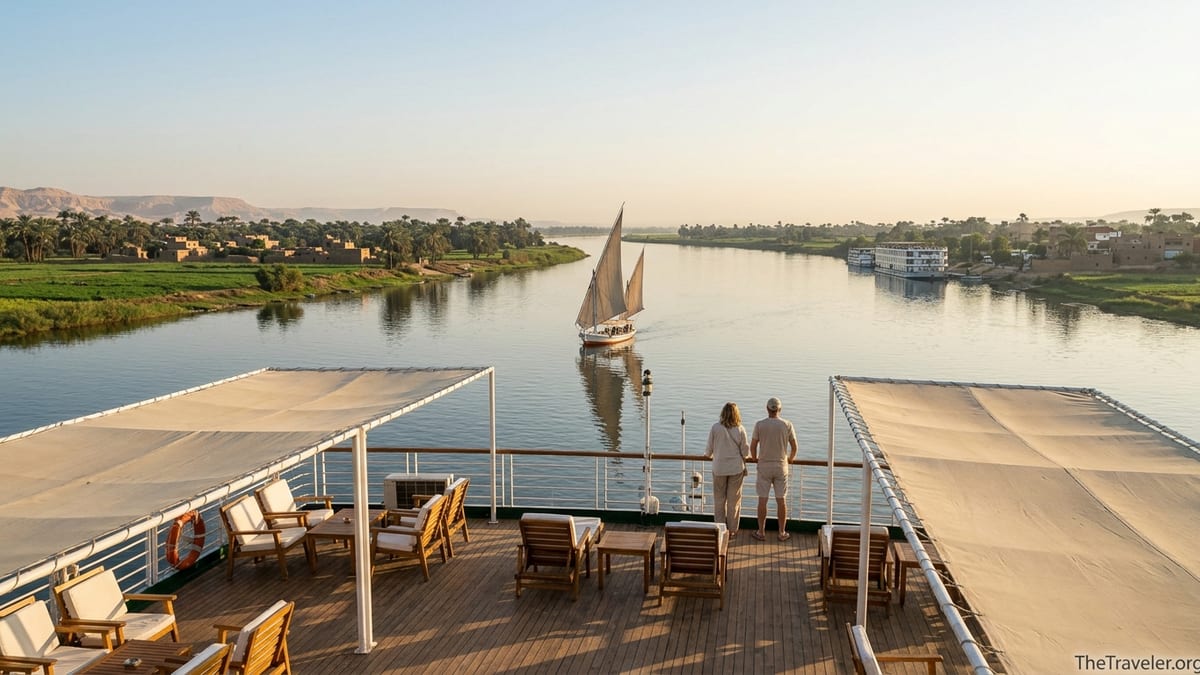
How Luxor to Aswan Nile Cruises Work
The classic Nile cruise route runs between Luxor and Aswan in Upper Egypt, a section of roughly 215 kilometers packed with major temples and ancient sites. In practical terms, most modern itineraries are 3 or 4 nights on a large motor ship or 4 to 6 nights on a smaller dahabeya sailing boat. Departures operate year-round, with peak season typically from October through April when daytime temperatures are more comfortable for sightseeing.
Most big-ship cruises follow a similar pattern. A 3-night Aswan to Luxor sailing often departs Aswan on a Friday and arrives in Luxor on Monday, with calls at Kom Ombo and Edfu along the way. A 4-night Luxor to Aswan cruise might start on a Monday and end on Friday, adding extra time in Luxor and Aswan for sightseeing. Schedules published for specific boats such as Historia or Mövenpick’s Nile cruisers show this Monday or Friday rhythm repeating through the season, which helps you anchor the cruise within a wider Egypt itinerary.
Dahabeya itineraries are slightly slower and more flexible. Many sail between Esna (about an hour south of Luxor by road) and Aswan rather than directly from Luxor, making more stops at small villages, islands and lesser-known temples. A typical 4-night Luxor or Esna to Aswan dahabeya cruise will include quiet afternoons under sail, barbecues on the riverbank and visits to sites the larger ships skip, while still covering headline stops such as Edfu and Kom Ombo.
Importantly, a “3-night cruise” usually translates to four calendar days on the river with check-in around lunchtime on day one and disembarkation after breakfast on the final day. On many itineraries, the ship will be docked in port for one of the nights, so you should think of this as a floating hotel that moves some of the time rather than a continuous sail.
Choosing Between Big Ships and Dahabeyas
The first major decision when booking a Nile cruise between Luxor and Aswan is whether to sail on a large motor ship or a smaller dahabeya. Big cruise ships usually carry 80 to 150 passengers, have several decks, a small rooftop pool, a bar and lounge, and a dining room serving buffet or plated meals. Names you will often see when researching include Sonesta Star Goddess, Mövenpick Royal Lily and other ships operated by mid-range and upscale Egyptian or international companies.
Dahabeyas, by contrast, are traditional-style sailing boats built for modern comfort. Most carry between 10 and 20 passengers in 5 to 12 cabins. Examples often mentioned by recent travelers include Nour El Nil’s boats, Swan Dahabiya, Nun Goddess and other small operators running Esna to Aswan or Luxor to Aswan routes. These boats are usually towed part of the time by a small tug when the wind drops, but the experience on board feels far quieter and more intimate than on the larger ships.
If you prioritize amenities such as a small pool, a spa room, extensive air-conditioned indoor spaces and nightly entertainment, a big ship will likely suit you better. Families with younger children often appreciate the extra space and more structured environment, as well as the slightly lower per-person cost compared with high-end dahabeyas. On the other hand, if your ideal Nile experience is about silence, birdsong and unhurried river views with a small group of like-minded travelers, dahabeyas are designed for that slower style of travel.
There is a trade-off in price and flexibility. Standard big-ship itineraries generally include the same set of major temples and often bundle a licensed guide and entrance tickets into the cruise package. Dahabeyas may cost more per night but allow crews and guides to adjust the day around wind, light and crowd levels, for example arriving at Edfu Temple in the late afternoon when most large coach groups have left and then mooring at a nearby island instead of a busy town dock.
Typical Itineraries, Embarkation and Excursions
From Luxor to Aswan, a four-night cruise usually begins with check-in on board by midday, lunch, then a guided visit to Luxor Temple or Karnak Temple in the afternoon. The second day is commonly devoted to Luxor’s West Bank, including the Valley of the Kings and the mortuary temple of Hatshepsut, before the ship moves south, often passing through the Esna lock in the evening. On the third and fourth days you reach Edfu and Kom Ombo, both celebrated for their well-preserved reliefs, before continuing to Aswan for a final night.
On the shorter three-night Aswan to Luxor route, check-in typically happens in Aswan around lunchtime on day one, with a visit to Philae Temple and views of the High Dam or the Unfinished Obelisk. The ship then sails north, stopping at Kom Ombo and Edfu, and finishes in Luxor for West Bank and East Bank visits. Whichever direction you travel, the core archaeological stops are similar, and many travelers decide based on how the cruise fits around flights into Cairo or side trips to Abu Simbel.
Embarkation points are usually the East Bank of the Nile in Luxor and Aswan, close to the main hotel districts. Many operators provide complimentary pick-up from the airport, train station or central hotels. On dahabeya itineraries starting in Esna, you are normally collected in Luxor and transferred by road for the one-hour drive to the smaller dock where the sailing boats moor. This transfer is often included in the cruise price.
Most mainstream cruise packages include guided excursions in small groups, transportation to the sites by coach or minibus, and entrance tickets to the main temples and tombs listed in the itinerary. However, not all packages are identical. Some rates covering the ship’s cabin and full-board meals explicitly exclude sightseeing, leaving you to add a private guide and tickets separately. When comparing offers, always check whether temple visits, guiding and monument tickets are included or sold as an extra, as this can change the real price of the cruise by several hundred dollars.
Cabins, Onboard Life and What Is Included
Cabins on large Nile cruise ships are broadly comparable to mid-range hotel rooms. Typical standard cabins are around 18 to 22 square meters with large windows looking out over the river. Upscale ships such as some of the Mövenpick cruisers advertise cabin sizes of about 21 square meters with floor-to-ceiling windows that partially open, while more luxurious vessels offer larger suites with separate sitting areas and private balconies. Bathrooms are usually compact with a shower, toilet and sink rather than a full bath.
Dahabeya cabins are generally smaller but designed with traditional wooden details and large windows or doors opening onto a shared deck. On boats such as Swan Dahabiya or Nun Goddess, most cabins are double or twin rooms with en-suite bathrooms, ceiling fans and air conditioning that runs when the generator is on. A few may offer one or two more spacious suites with a private terrace. Since there are usually fewer guests overall, public spaces such as the shaded upper deck become an extension of your private space, with sun loungers, low cushions and a long dining table.
Most Nile cruises between Luxor and Aswan are sold on a full-board basis. This typically covers breakfast, lunch and dinner plus afternoon tea on deck. On big ships, meals are often buffet style with Egyptian and international dishes, while dahabeyas more commonly serve multi-course, home-style meals at a single communal table. Non-alcoholic drinks such as tea, coffee and water may be included or may be charged separately depending on the operator, and alcoholic drinks are almost always an extra cost.
Other inclusions vary by price level. On higher-end dahabeyas, it is common to find that meals, non-alcoholic drinks and entrance fees for all listed sites are bundled into the rate, while tips for the crew and guide are left to you. Mid-range large ships might include the cabin, full-board meals and a group sightseeing program, but leave drinks, some optional excursions and gratuities as add-ons. If you want to compare cruises accurately, ask every operator to itemize exactly what is and is not included in the quote.
How Much a Luxor to Aswan Nile Cruise Costs
Prices for Nile cruises fluctuate with season, ship standard and exchange rates, so any numbers should be considered approximate rather than fixed. As a broad guide, mid-range large ships on the Luxor to Aswan route in the main season often price a double cabin in the region of 450 to 600 US dollars per person for a three-night cruise and around 550 to 800 dollars per person for a four-night cruise, usually including full-board meals and some form of group sightseeing. Promotional or local deals can be lower, while certain premium or foreign-operated programs can be higher.
High-end dahabeyas aimed at international travelers usually cost more per night. For example, published rates for some five-day four-night dahabeya sailings from Luxor to Aswan show figures around 1800 to 2000 US dollars per person for a single cabin when booked in advance, including full-board meals and guided excursions. Other operators with more mid-range dahabeyas list seasonal schedules where a four-night Luxor to Aswan sailing can be around 900 to 1000 US dollars per person in a shared cabin during shoulder months, rising in December and around peak holiday periods.
Group tour packages that include a Nile cruise as part of a longer Egypt itinerary sometimes blur these lines. A brochure for a combined Cairo, Luxor and Aswan trip might advertise “4-night Nile cruise with full board and excursions” without spelling out the per-night cost. When you divide the overall tour price by the included nights, you may find that the cruise portion works out competitively compared with booking the same ship alone. The flip side is that you have less control over the exact vessel and sailing dates.
Whatever route you choose, remember to budget beyond the base fare. Gratuities for ship staff and guides, bottled water and drinks, optional extras such as a hot-air balloon ride over Luxor’s West Bank or an excursion to Abu Simbel from Aswan, and airport transfers outside the cruise inclusions can add a few hundred dollars to the total cost for a couple over the course of a week in Upper Egypt.
Which Type of Nile Cruise Suits Different Travelers
Different styles of Nile cruise serve different kinds of travelers. If this is your first time in Egypt and you want a straightforward experience with clear timetables and a high degree of comfort, a reputable large ship in the mid-range or upper-mid-range category is usually the easiest option. Couples who value a pool deck, regular housekeeping and a mix of Egyptian and international guests often find these cruises strike a good balance between price and comfort.
Dahabeyas are ideal for travelers who care less about hotel-style amenities and more about atmosphere, quiet and personal connection. Solo travelers, small groups of friends and couples celebrating a special occasion often choose these boats for their slower pace and smaller size. Some groups even charter an entire dahabeya for a private sail, turning the boat into a floating base for photography, yoga or family celebrations between Luxor and Aswan.
Families with young children might find that a larger ship with more structured spaces and a wider range of cabin types works better than a small sailing boat where other guests are mostly adults seeking tranquility. However, families with older teenagers who are interested in history and comfortable with a slower pace often enjoy dahabeyas immensely, especially outside the hottest months.
Budget-conscious backpackers sometimes skip overnight cruises altogether, choosing instead to travel between Luxor and Aswan by train or road and booking individual day tours to the major sites. This can be significantly cheaper than even the most economical cruise, though you miss the experience of watching the Nile at sunrise and sunset from the water. For some travelers, a shorter three-night Aswan to Luxor cruise on a simpler ship provides a middle ground between cost and the river experience.
Practical Booking Tips and When to Go
For cruises between Luxor and Aswan, the busiest months are usually from late October through April, when daytime temperatures are more moderate. In these months, especially around Christmas, New Year and Easter, popular ships and small dahabeyas can sell out weeks or even months ahead. If you are set on a particular boat or room category, booking well in advance gives you the best chance of securing your ideal dates and cabin.
In the hotter summer months from June through August, prices are often lower and there may be last-minute availability, especially on larger ships. However, excursions to temples and tombs can be extremely hot, particularly around midday. If you do choose a summer cruise, look for itineraries that schedule site visits very early in the morning and late in the afternoon, and plan to spend the middle of the day back on the ship resting in the shade or in your air-conditioned cabin.
When researching, you will find that some rates displayed online are aimed at residents of Egypt and neighboring countries, while others are tailored to international travelers. The same cabin on the same ship can be presented differently depending on the market and what is included in the package. Pay close attention to whether taxes, service charges and fuel surcharges are already factored into the price, or listed as “subject to change.” For the most accurate picture, ask for a final total in writing for your exact dates, cabin type and number of travelers.
Finally, consider how the cruise fits within your overall Egypt itinerary. If you arrive in Luxor by air from Cairo in the morning, a Monday-start four-night cruise from Luxor to Aswan can work well, leaving you a night or two in Aswan afterward for a day trip to Abu Simbel. Alternatively, flying into Aswan first and taking a three-night Aswan to Luxor cruise northbound can set you up for a few extra days exploring Luxor’s many sites independently after the group portion of the journey ends.
The Takeaway
A Nile cruise between Luxor and Aswan is not a single standard product but a spectrum of experiences. On one end are large motor ships with pools, buffets and structured sightseeing; on the other are quiet dahabeyas where you might share a long table with a dozen fellow travelers as you drift past palm groves at sunset. Prices, inclusions and itineraries vary widely, but the core route remains consistent: temples at Luxor, Edfu and Kom Ombo, and the riverfront beauty of Aswan.
The key to choosing well is to be clear about your priorities. Decide how many nights you realistically want on the river, how comfortable you are with a small-boat environment, how important amenities such as a pool or private balcony are to you and how much flexibility you want around sightseeing. Then compare a few specific ships or dahabeyas for your travel month, focusing on what is included and how recent travelers describe their experiences.
With realistic expectations and a carefully chosen boat, the journey between Luxor and Aswan can feel less like a packaged tour and more like a moving window onto Egyptian life along the Nile. Whether you are watching the sun rise over the fields from a ship’s sundeck or sipping tea on the shaded deck of a dahabeya, this stretch of river remains one of the most memorable ways to experience the country.
FAQ
Q1. How far in advance should I book a Luxor to Aswan Nile cruise?
For popular months between late October and April, it is wise to book several months in advance, especially for small dahabeyas or specific upscale ships. In hotter summer months, you may find more last-minute availability, particularly on larger vessels.
Q2. Is it better to cruise from Luxor to Aswan or from Aswan to Luxor?
The core sites are similar in both directions, so the choice usually comes down to flight schedules and how you want to structure the rest of your trip. Some travelers prefer starting in Luxor, where there are more major temples, then ending with a quieter stay in Aswan; others enjoy beginning in Aswan and finishing in Luxor for extra time at the Valley of the Kings.
Q3. How many nights do I need for a Nile cruise between Luxor and Aswan?
Three-night cruises cover the main highlights at a relatively fast pace, while four-night cruises add a bit more time in Luxor or Aswan. Dahabeya cruises often run four to six nights, offering a slower experience with more quiet time on the river and additional small stops.
Q4. What is included in most Nile cruise prices?
Typically you can expect a cabin with private bathroom and full-board meals. Many packages also include a licensed guide, ground transport to the listed sites and entrance tickets, but some budget or cabin-only deals cover only accommodation and food. Always check the inclusions for your specific booking.
Q5. Are dahabeyas safe and comfortable compared with big ships?
Licensed dahabeyas that operate regularly between Luxor, Esna and Aswan are designed for overnight guests and provide private cabins, life jackets and crew trained to navigate the river. They may lack pools and large indoor lounges, but offer comfortable cabins, shaded decks and a quieter atmosphere than big ships.
Q6. What is the best time of year for a Nile cruise?
The most comfortable period for sightseeing is typically from October to April, when daytime temperatures are lower. These months are also the busiest and most expensive. From May to September prices are often lower but it can be extremely hot, so early-morning and late-afternoon excursions become more important.
Q7. Can I book a Nile cruise directly, or should I use a tour operator?
You can do either. Booking directly with a cruise line or dahabeya company can give you clearer information about the specific ship and cabin. Using a tour operator may bundle domestic flights, transfers and other Egypt arrangements, which can be convenient if you prefer a single point of contact.
Q8. How formal is the dress code on Nile cruises?
During the day, modest, lightweight clothing suitable for hot weather and temple visits is appropriate. In the evenings, most guests wear smart-casual outfits such as shirts, blouses and simple dresses. Formal wear is rarely required, although some travelers enjoy dressing up slightly for dinner.
Q9. Are Nile cruises suitable for children?
Many large ships welcome families and provide flexible meal times and cabins that can sleep three. The days involve early starts and historical sites, which some children enjoy and others find tiring. Dahabeyas can work well for older children who are interested in the river and culture, but very small boats are usually quieter and aimed more at adults.
Q10. Do I need to worry about motion sickness on the Nile?
The Nile between Luxor and Aswan is generally calm, and the ships move slowly, often mooring overnight. Most travelers do not experience motion sickness, but if you are very sensitive it can still be wise to bring standard motion-sickness remedies and choose a mid-level cabin where movement is least noticeable.