


Egypt offers two very different dream holidays that often end up competing for the same vacation days: sailing past ancient temples on a Nile cruise or unwinding beside turquoise water at a Red Sea resort. Many travelers only have 7 to 12 days and need to decide whether to prioritize sightseeing, relaxation, or some combination of both. This guide compares Nile cruises and Red Sea resorts in practical, real-world terms so you can decide which experience fits your budget, travel style and companions, or whether it is worth planning a trip that combines them.
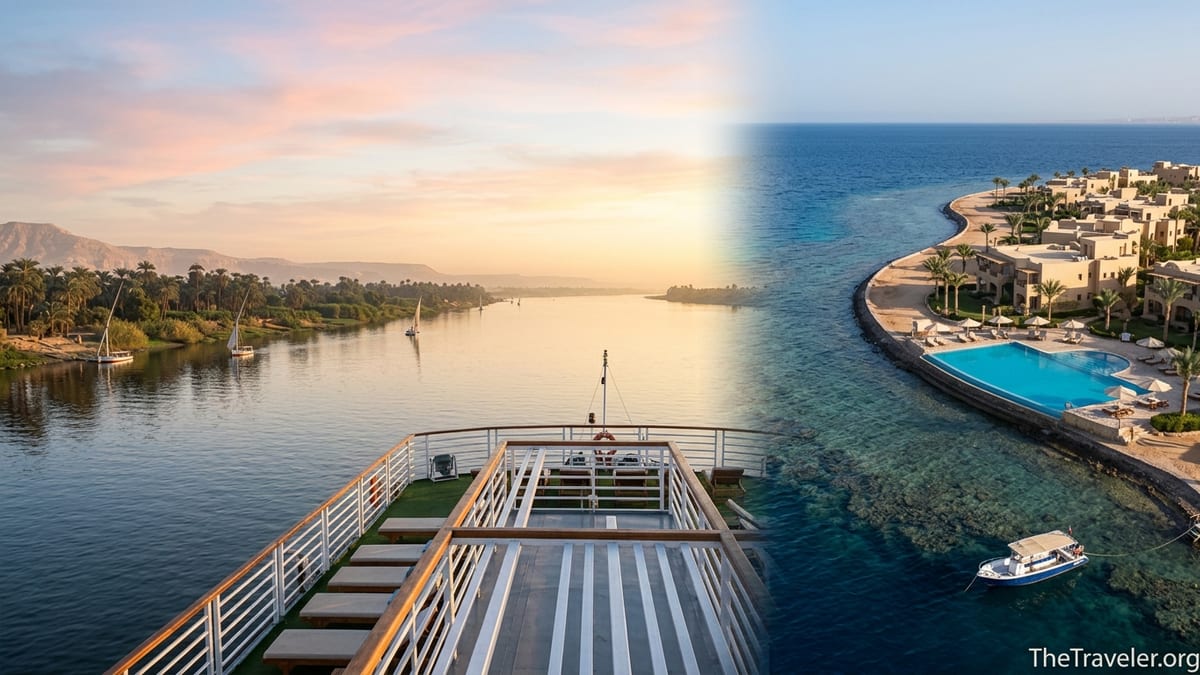
Sightseeing Powerhouse: What You Actually See on a Nile Cruise
A Nile cruise is first and foremost a sightseeing trip. Most classic itineraries run between Luxor and Aswan over 3 or 4 nights, with some longer 5 to 7 night sailings. Along this stretch you can visit a high concentration of Egypt’s headline monuments in a relatively relaxed way: the temples of Karnak and Luxor, the Valley of the Kings, Edfu, Kom Ombo and Philae. Many modern boats operate on a full-board basis and bundle these stops into guided excursions, which turns the cruise into a moving base for sightseeing rather than a conventional resort stay.
In practice, this means your days are structured around temple visits. A typical 4 night cruise from Luxor to Aswan might leave early for Karnak and Luxor temples on day one, explore Edfu and Kom Ombo on separate mornings as the ship sails south, and finish with Philae Temple, the Aswan High Dam and a felucca ride on the final day. Excursions are usually done in small groups with an Egyptologist guide, which makes the history far more accessible than visiting alone.
Travelers who want to maximize time among ancient sites often find that a cruise is more efficient than staying in hotels in Luxor and Aswan and arranging separate road transfers. You unpack once, your cabin becomes home, and the scenery of the Nile’s green banks, palm groves and villages glides by between stops. For a first-time visitor whose top priority is Pharaonic history, a cruise usually delivers more “wow” moments per day than any beach stay.
There are trade-offs. Sightseeing days can be long, especially in warmer months, and early starts are common to beat the heat at open-air sites like the Valley of the Kings. If you imagine a cruise as a lazy floating resort, the reality can be busier and more scheduled than expected. You will, however, still find time most afternoons to sit on deck with a coffee and watch feluccas, farmers and children along the riverbanks.
Red Sea Resorts: Relaxation First, Activities When You Want Them
A Red Sea resort stay flips the priorities. Here, your base is a hotel in Hurghada, El Gouna, Sharm el Sheikh, Marsa Alam or a similar coastal town on Egypt’s so-called Red Sea Riviera. The main draws are warm weather, pool time, house reefs for snorkeling, dive centers and a resort-style atmosphere that ranges from family-friendly all inclusive to quiet adults-only. You may still take occasional day trips, but sightseeing is not built into the daily rhythm in the same way as on the Nile.
In Hurghada, for example, many four and five star all inclusive resorts offer direct beach access, multiple pools, kids’ clubs and evening entertainment. Rates for standard double rooms often start around the equivalent of 35 to 90 US dollars per room per night outside peak holidays, depending on category and season, with higher pricing in winter and during Christmas and New Year. Sharm el Sheikh tends to skew slightly more upmarket, with a mix of large international brands and boutique dive resorts, while Marsa Alam is quieter and popular with divers seeking healthier reefs and fewer crowds.
Daily life at a Red Sea resort is much more self-paced. You might start the day with a long breakfast buffet, snorkel off the hotel jetty or join a half-day boat trip to offshore reefs, then spend the afternoon by the pool or in a spa. Families often appreciate the ability to split up, with one parent diving while the other stays with children at the kids’ pool or playground. If you want to see cultural sites, you can add optional excursions from some resorts to Luxor, Cairo or nearby desert canyons, though these are often long days with several hours of driving.
For travelers who mainly want winter sun, swimming and the underwater world, a Red Sea base is usually more satisfying than a Nile cruise. The trade-off is that you get only a taste of ancient Egypt via optional day trips, rather than the immersive temple-focused experience of a cruise.
Costs and Value: Cruise Cabins vs All Inclusive Packages
Comparing costs between a Nile cruise and a Red Sea resort can be tricky because packages are structured differently. A standard Nile cruise typically bundles accommodation, three meals a day and most guided sightseeing into one per-person rate. In contrast, Red Sea resorts are sold per room per night, often with separate charges for excursions and diving, although many properties offer all inclusive packages that simplify budgeting.
Recent trip reports suggest that mid-range 3 to 4 night Nile cruises between Luxor and Aswan, booked through international tour operators with an English-speaking guide, often fall in the broad range of several hundred to just over one thousand US dollars per person, depending on cabin type, season and inclusions. Some travelers report paying around 2,500 to 3,000 US dollars for two people for a 3 night cruise including a private guide, transfers and some extras, while budget options booked locally can cost significantly less but may involve older vessels and larger groups.
On the Red Sea, sample pricing for a seven night all inclusive stay for two adults at a mid-range Hurghada resort in early autumn might fall in the rough band of 450 to 900 euros or US dollars total, excluding flights. Higher-end properties in Sharm el Sheikh or boutique dive resorts in Marsa Alam can cost more, especially in peak holiday weeks, but per-night room rates are often still competitive compared to Mediterranean or Caribbean equivalents. Diving courses, boat trips and spa treatments are usually extra, so a week of daily diving can easily add several hundred dollars per person.
If your main goal is to see Egypt’s ancient sites efficiently, a Nile cruise can represent strong value because entrance fees and guiding are commonly wrapped into the price. If your priority is stretching your budget for a relaxing beach week, a Red Sea resort will often give you more days in comfort for the same overall spend. Travelers who combine both usually allocate more of their budget to the cruise portion and then choose a good mid-range, all inclusive resort to keep costs predictable.
Accommodation Style and Comfort: Floating Hotel or Beachfront Base
Modern Nile cruise boats are essentially floating hotels with cabins spread over several decks, a rooftop sun deck with small pool or plunge pool, restaurant and sometimes a spa or lounge bar. Cabins are usually compact but comfortable, with large windows or floor-to-ceiling sliding windows in higher categories. Newer ships tend to include contemporary decor, decent soundproofing and better air conditioning, while older vessels can feel dated. Some travelers prefer smaller traditional sailing boats such as dahabiyas for a quieter, more intimate experience, but these usually cost more per night than mainstream cruise ships.
Noise and motion levels vary. The Nile is calm and seasickness is rare, but you will hear engine noise during sailing and sometimes late-night docking or early morning departures. When several boats moor side by side at popular ports, your cabin window may look directly onto another ship, reducing privacy. Travelers who value quiet sometimes request cabins away from the engine and nightclub areas at booking.
Red Sea resorts, by contrast, come in almost every form: sprawling family complexes with waterparks, adults-only boutique hotels, golf and marina resorts in El Gouna, and small specialist dive lodges in Marsa Alam. Rooms are usually larger than cruise cabins and many have balconies or terraces. Pool and beach facilities can be extensive, with multiple restaurants, bars and entertainment venues. Waterfront properties in Sharm el Sheikh commonly have jetties leading to drop-off reefs, while some Hurghada and Marsa Alam hotels sit in sheltered bays with sandy entries more suitable for younger children.
For travelers who want their own space, consistent hot showers and the option to retreat from organized activities, a resort stay can feel more comfortable. Those who enjoy the novelty of life on the river, watching sunrise and sunset from the top deck and mooring in small ports, often prefer a cruise even if cabins are smaller. Your tolerance for compact spaces and shared schedules is a key factor in choosing between the two.
Families vs Couples: Matching Each Option to Your Travel Party
Families with younger children often lean toward the Red Sea because of the ease of all inclusive resorts, kids’ clubs and short walking distances between pools, slides and the beach. Hotels in Hurghada and Sharm el Sheikh in particular are geared to families, with dedicated children’s pools, early meal times and evening mini-discos. Snorkeling from sandy lagoons or shallow bays lets older children experience the Red Sea’s fish and corals without long boat rides.
Nile cruises can work for families, especially with teens who are interested in history, but the schedule is more structured. Long days at temples, early starts and hot conditions can be tiring for under-10s. Cabins are smaller than resort rooms and there is less space for children to burn off energy. That said, some boats welcome families and can arrange adjoining cabins or triple cabins; pairing a 3 night cruise with extra nights at a resort gives children a defined period of sightseeing followed by beach time.
Couples and honeymooners face a different calculation. If your dream is slow mornings on deck, candlelit dinners and sunsets over palm-fringed villages, a boutique-style Nile cruise or dahabiya can feel exceptionally romantic, especially outside the hottest months. For couples who bond over diving, snorkeling and shared outdoor activities, a quieter Red Sea base such as Marsa Alam or an adults-only wing of a Sharm or Hurghada resort may be a better fit.
Multi-generational trips often benefit from combining both. Grandparents might prioritize the cultural significance of Luxor and Aswan, parents may want a mix of history and relaxation, and children crave pool time. In that scenario, doing a 3 or 4 night cruise followed by 4 to 7 nights at a resort balances everyone’s preferences.
Activities, Pace and Ideal Trip Length
The pace of a Nile cruise is surprisingly full. In a compact 3 or 4 night itinerary, mornings and some afternoons are filled with guided temple visits and optional extras such as a hot air balloon flight over Luxor’s West Bank or a felucca sail in Aswan. Evenings are often relaxed on board, with informal entertainment like traditional music or a Galabeya night, but early wake-ups are common. For many travelers, 3 or 4 nights is the sweet spot: long enough to cover major sites without feeling rushed, but not so long that the onboard routine becomes repetitive.
On the Red Sea, you can build your own pace. Divers might schedule two boat dives per day for several consecutive days, while snorkelers join a handful of full-day trips to reefs and spend the rest of the time near the hotel. Non-divers might organize just one or two major outings, such as a desert quad-biking evening, a day trip to Ras Mohammed National Park from Sharm el Sheikh, or a boat trip to an offshore sandbar near Hurghada, and otherwise lean into pool and spa time.
For a trip focused mainly on the Nile, many visitors allocate 7 to 9 days: two or three nights in Cairo for the pyramids and museums, plus a 3 or 4 night cruise and one extra night in Luxor or Aswan at either end. A Red Sea focused trip without extensive sightseeing typically runs 7 to 10 nights at a single resort, or a split stay between two coastal towns. When combining both, a common pattern is 10 to 14 days: for instance, 3 nights Cairo, 3 nights cruise, and 4 to 7 nights at a resort in Hurghada or Sharm el Sheikh.
Season matters. Winter and early spring between roughly November and March are generally comfortable for temple visits, with warm days and cooler evenings along the Nile. These months are also popular for Red Sea stays, though sea temperatures in mid-winter can feel cool without a wetsuit. Summer brings intense heat in Upper Egypt; some travelers in July and August choose shorter cruises and favor air-conditioned coach transfers to temples, then escape to the sea for most of their stay.
Which Should You Prioritize, and When Is Combining Both Worth It?
If you must choose just one, start by asking what would make you feel that your trip to Egypt was complete. If imagining your return flight home without having seen Luxor, the Valley of the Kings or a Nile sunrise feels like a missed opportunity, then prioritize the Nile cruise. For many first-time visitors, the combination of temples, river scenery and the experience of sailing between ancient capitals is what makes Egypt feel unique compared to other sun and sea destinations.
On the other hand, if you have already visited major archaeological sites elsewhere, or you are mainly seeking a restful break with world class snorkeling and diving, a Red Sea resort may serve you better. The Red Sea’s coral reefs remain a major draw, with clear water and warm temperatures year round. Choosing between Hurghada, Sharm el Sheikh and Marsa Alam then becomes a secondary decision based on your tolerance for development, nightlife and travel time from your home country.
Combining both makes sense when you can spare at least 10 days and a moderate to comfortable budget. For example, a couple from Europe or North America might fly into Cairo, spend two nights for the pyramids and the Grand Egyptian Museum when open, connect to Aswan for a 3 night cruise to Luxor, then fly to Hurghada or Sharm el Sheikh for 4 or 5 nights beside the sea before flying home. This structure front-loads sightseeing while energy is high and finishes with relaxation, which many travelers find more satisfying than doing the resort week first.
Travel logistics are manageable. Domestic flights connect Cairo with Luxor, Aswan, Hurghada and Sharm el Sheikh, and there are road and sometimes ferry links between Upper Egypt and the Red Sea coast. Packaging the cruise and resort together through one tour company can simplify transfers, though confident independent travelers sometimes book each component separately to fine-tune dates and hotel choices.
The Takeaway
A Nile cruise and a Red Sea resort stay in Egypt deliver two different kinds of holiday that can complement each other beautifully but rarely substitute for one another. The cruise is about immersion in ancient history, sunrise over temple pylons and the quiet drama of life along the river. A Red Sea resort is about warm water, coral reefs, poolside downtime and the freedom to shape each day as actively or lazily as you like.
For history-focused travelers and first-time visitors with limited time, a 3 or 4 night Nile cruise paired with a couple of nights in Cairo is often the smarter priority. For those craving rest and underwater adventure above all, a week or more on the Red Sea can be a rewarding stand-alone trip, especially if you add a single long day or overnight to see at least one major site such as Luxor or the pyramids.
If your schedule and budget allow, consider investing in both experiences on a single itinerary. You will return home having watched the sun rise over the Valley of the Kings and set over the Red Sea, with memories of hieroglyphs and hammerhead sharks, temple colonnades and coral gardens, all from one remarkable journey.
FAQ
Q1. Is a Nile cruise or a Red Sea resort better for a first trip to Egypt?
For most first-time visitors who want to understand Egypt’s heritage, a Nile cruise combined with at least one full day in Cairo offers a more complete introduction. If you mainly want a relaxing sun and sea holiday with only a taste of culture, a Red Sea resort can still work well.
Q2. How many days do I need for a Nile cruise?
A 3 or 4 night cruise between Luxor and Aswan is enough to see major temples such as Karnak, Edfu, Kom Ombo and Philae. Longer 5 to 7 night cruises exist but are usually best for travelers who enjoy slow travel and extra time on the river.
Q3. Can I do both a Nile cruise and a Red Sea stay in one trip?
Yes, many travelers combine both. With 10 to 14 days, a practical plan is 2 or 3 nights in Cairo, a 3 or 4 night Nile cruise, then 4 to 7 nights at a Red Sea resort before flying home.
Q4. Which Red Sea resort area should I choose?
Hurghada and nearby El Gouna are convenient and family-friendly, Sharm el Sheikh offers dramatic reefs and a range of higher-end resorts, and Marsa Alam is quieter and popular with serious snorkelers and divers who want healthier reefs and fewer crowds.
Q5. Is a Nile cruise suitable for children?
It can be, especially for older children and teenagers interested in history. However, days can be hot and busy, and cabins are smaller than resort rooms. Many families prefer to keep the cruise to 3 nights and balance it with extra days at a beach resort.
Q6. Are Red Sea resorts all inclusive and good value?
Many resorts in Hurghada and Sharm el Sheikh offer all inclusive packages that include meals, drinks and some activities. These can provide good value compared to buying everything separately, especially for families, though diving, spa treatments and major excursions are often extra.
Q7. What time of year is best for a Nile cruise versus the Red Sea?
For Nile cruising and temple visits, cooler months from roughly November to March are most comfortable. The Red Sea is a year-round destination, though sea temperatures are warmest from late spring through autumn and winter evenings can feel cool out of the water.
Q8. How should I budget for a combined cruise and resort trip?
Expect the cruise portion to take a larger share of your budget because it usually includes full board and guided sightseeing. You can then manage costs by choosing a mid-range all inclusive resort on the Red Sea and being selective about extra excursions and diving.
Q9. Is it better to book through a tour operator or independently?
First-time visitors often appreciate the simplicity of a reputable tour operator that links Cairo hotels, Nile cruise and Red Sea resort with transfers and guiding. Independent travelers can save money or gain flexibility by booking each part separately, but should research carefully and allow buffer time between domestic flights and international connections.
Q10. What if I only have one week for Egypt?
With about 7 days, many travelers choose either a Cairo plus Nile cruise combination or a Cairo plus Red Sea itinerary. Trying to do Cairo, a cruise and a full Red Sea stay in one week usually feels rushed, so prioritizing one main focus tends to lead to a more enjoyable trip.