


The Egyptian Red Sea is not just another stretch of sand with sun loungers. From El Gouna’s engineered lagoons to Dahab’s legendary wind, Ras Sudr’s quick escape from Cairo and the remote flats of Marsa Alam and Wadi Lahamy, this is one of the world’s most concentrated regions for kitesurfing and wind sports. Choosing the right base can transform your trip, especially if you are travelling with non-kiters or trying to progress from first water-starts to powered tricks.
Why the Egyptian Riviera Works So Well for Wind Sports
The Red Sea coastline of Egypt lines up almost perfectly with the prevailing north and northwest winds that funnel down the Gulf of Suez and Gulf of Aqaba. Across much of the year, that means side-shore or side-onshore wind blowing over large areas of shallow reef and sand, with natural lagoons and sandbars that smooth out the chop. Official Egyptian tourism promotion now calls out El Gouna, Ras Sudr and Dahab as flagship windsurfing and kitesurfing towns, with Marsa Alam and Wadi Lahamy in the deep south joining the map as more remote, high-wind options.
For kiters and windsurfers, this geography translates into three big advantages. First, you get a long season: many centers in El Gouna and Dahab report rideable wind from roughly March through November, with summer months frequently hitting the 18 to 25 knot range on thermal days. Second, much of that wind blows cross or cross-on from the left, which is both comfortable to ride and safer for learners, who drift back toward the beach if they drop the kite. Third, many spots have natural or semi-artificial lagoons only waist to chest deep, which deliver flat water for learning, freeride tricks and fast runs.
Compared to classic wave destinations such as the Atlantic coast of Morocco or Portugal, Egypt’s Red Sea is primarily about flat-water freeride, freestyle and foiling, plus bump-and-jump windsurfing on the outside reefs. You will not come here for big down-the-line waves, but if you want to nail your first water-starts, unhooked tricks or foil jibes against a desert backdrop, there are few places on earth with such consistent practice conditions and dense networks of schools.
El Gouna: Purpose-Built Lagoons and Resort Comfort
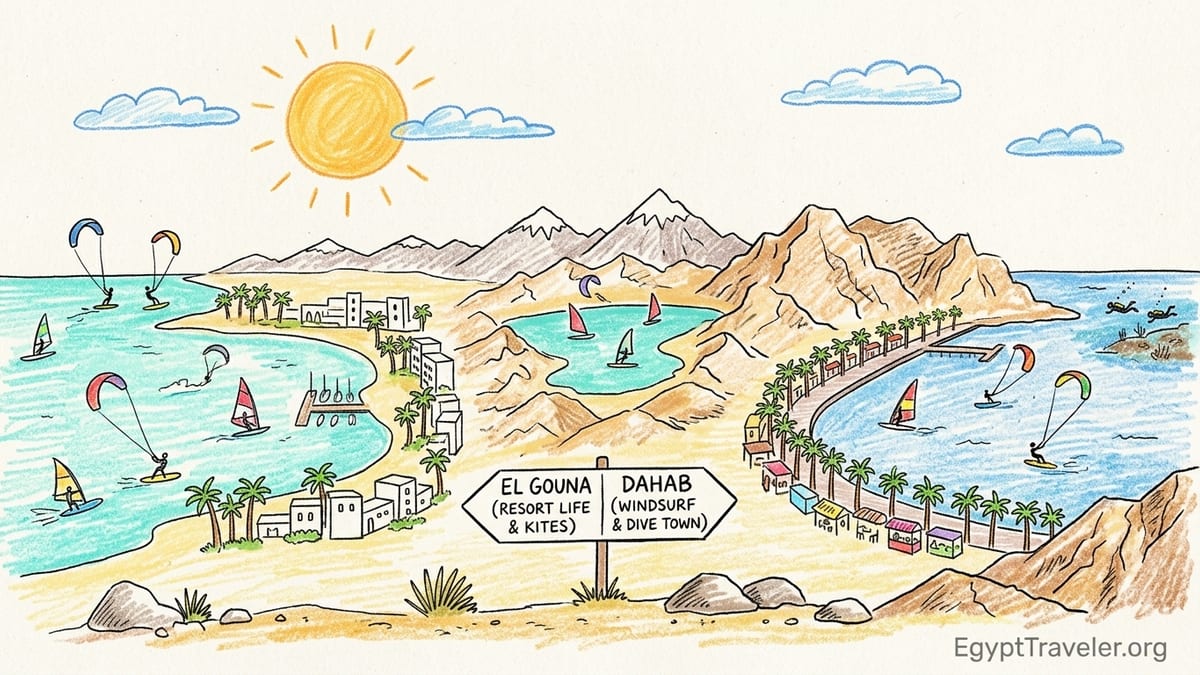
El Gouna is perhaps the best-known Red Sea kitesurfing destination internationally, helped by its reputation as a planned resort town with multiple marinas, private beaches and a compact lagoon coastline. The town has roughly 10 kilometers of shoreline, broken into dozens of islands and man‑made lagoons that naturally sort riders by level. Dedicated kite beaches such as those used by Makani Beach Club, Easy Surf and other IKO or VDWS affiliated centers sit on wide, shallow bays with sandy bottoms and very few obstructions.
These lagoons are the main reason El Gouna is so popular for lessons. A beginner can wade out into knee to waist-deep water, stand solidly while flying the kite and practice body dragging without being knocked off balance by waves. Rescue boats and dedicated teaching zones are normal, and large centers operate fleets of modern kites from brands such as Duotone, Cabrinha or North. In 2026, several schools in El Gouna list group beginner courses of around 8 to 12 hours for roughly 400 to 700 euros, with daily full-gear rental in the 90 to 120 euro range once you are certified.
Wind consistency in El Gouna is very good by Red Sea standards. The town benefits from both large-scale northwesterlies and local thermal winds, so visiting riders report that a one- or two-week trip between April and October often yields more than half the days on 9 to 12 square meter kites. Advanced riders can venture to deeper water past the sandbars for small wind chop, downwinders or foil sessions, while the lagoons remain friendly for newcomers. Launch space at the main clubs is generous, with wide sandy beaches and well-marked rigging zones, though it can still feel busy in peak European holiday weeks.
For non-kiters, El Gouna feels almost like a self-contained resort bubble. Between morning and afternoon sessions, partners can wander around the marina, take lagoon boat trips, play golf, book spa treatments or head into nearby Hurghada for shopping and nightlife. Beach bars such as those at the main kite clubs offer sunbeds, food and Wi‑Fi, so it is easy for mixed groups to spend the day together even if only one person rides. Evening life is livelier than in smaller wind villages, with bars, restaurants and occasional festivals or concerts in town.
Dahab: Wind Mecca With Diving and Independent Travel Vibe
On the Sinai Peninsula, Dahab has a very different feel from El Gouna. Historically a Bedouin settlement that grew into a backpacker and dive town, it is now famous in its own right for windsurfing and kitesurfing. Dahab’s main sports lagoon at the south end of town is a broad, semi-enclosed bay protected from the open Gulf of Aqaba by a reef. Multiple independent sources describe the water in the main lagoon as knee to waist-deep over a sandy bottom with steady side-onshore wind from the north, which means that anyone who crashes is gently blown back toward the beach rather than out to sea.
The lagoon layout naturally separates user groups. Inner zones are used for beginner and intermediate windsurfers, while kites are concentrated in defined kite training areas and along the outer edge where the water deepens. Just outside the reef line is a famed “speed strip” of flat water where strong winds and smooth chop attract advanced windsurfers and twin-tip freeriders wanting long, fast runs. Local guides and schools report average wind speeds for much of the high season in the 15 to 30 knot range, particularly between March and November, which makes Dahab attractive for lighter riders and small-kite sessions.
Dahab stands out because it combines top-tier wind conditions with a relatively low-rise, independent travel scene and a strong diving and freediving culture. Riders often split their days between kite or windsurf sessions and trips to dive sites such as the Blue Hole or Canyon. Lesson prices here tend to undercut many European resorts: recent figures from local centers and resident-run guides show beginner kitesurf courses of around 9 hours in the ballpark of 270 to 350 US dollars equivalent, and hourly lessons often advertised at roughly 50 to 70 dollars. Windsurf tuition and rental, offered by centers that have operated for many years, is similarly competitive.
Non-kiters in Dahab have more to do than in many pure kite camps. The palm-fringed seafront promenade is lined with cafes, small restaurants and dive shops, and inland you can arrange jeep trips to desert canyons or overnight Bedouin camps. Dahab has a relaxed nightlife of beach bars, shisha cafes and live music, rather than large nightclubs, which suits travelers who want atmosphere and social life without a heavy resort feel. It is also a town where many visitors stay for weeks or months, so the community of riders and divers is unusually international and long-stay oriented.
Ras Sudr: The Weekender’s Shallow Lagoons From Cairo
Ras Sudr (often written Ras Sedr) sits on the western shore of the Gulf of Suez, roughly 200 kilometers from Cairo and about an hour past the Suez Canal road tunnels. That proximity to the capital is one of its biggest selling points. For Egyptian riders and expats based in Cairo, Ras Sudr is one of the few places where you can finish work on Thursday, drive a few hours and be on a board before sunset, then ride again on Friday and Saturday before heading back to the city.
The coastline here is dotted with small resorts and simple hotels, and several of them front large natural lagoons or semi-enclosed bays with shallow water. In some resort areas, artificial lakes and sheltered lagoons have been created specifically to make learning easier, so that if a beginner loses control of the kite it drifts inland toward the beach rather than out to deep water. Long sand spits and tidal flats create wide practice areas with plenty of launch space and minimal obstacles, though riders still have to watch for shells and shallow sandbars uncovered at low tide.
Wind in Ras Sudr is driven by the same north to northwest flows funneled down the Gulf of Suez, with local kite schools and riders talking of a long spring-to-autumn season and frequent 15 to 25 knot days. Several centers in the area operate IKO-style beginner courses and rentals, though there tend to be fewer simultaneous schools than in El Gouna. Prices shared by local riders in recent years suggest that multi-day beginner courses here are often priced to attract the domestic market, sometimes lower than equivalent packages in high-profile tourist towns, though you will find fewer large, international-branded centers.
For non-kiters, Ras Sudr is low-key. Most activity focuses on the beach itself: lounging by the lagoon, joining yoga or fitness classes that some kite camps offer, or taking short excursions in the desert hinterland. There is little in the way of classic resort nightlife or shopping streets. That suits Cairo-based regulars who come primarily to ride and relax, but if you are travelling internationally with a partner who wants a broader mix of dining, bars and sightseeing, Ras Sudr is best framed as a quiet, wind-focused weekend rather than a standalone long holiday.
Marsa Alam and Wadi Lahamy: Remote Flats and High-Wind Escapes
Farther south along the Egyptian Red Sea, Marsa Alam and the Wadi Lahamy area are gradually appearing on more kitesurfers’ radar. Marsa Alam began as a quiet village and now has a small town, an international airport and a strip of resorts strung along the coast. Several hotels near Marsa Alam host kite centers that make use of wide sandy bays and offshore reef flats. Wind here benefits from strong pressure gradients between the hot interior desert and cooler sea, giving a long warm-water season and frequent planing conditions for both kitesurfing and freeride windsurfing.
Even more specialized is Wadi Lahamy, sometimes called Wadi Lahami. It lies in Egypt’s deep south near the boundary of Wadi El Gemal National Park and is reached by a long desert drive from Marsa Alam airport. The kitesurfing setup here is essentially a stand-alone eco-lodge and kite station on a remote stretch of coast. Spot maps from the local operator show a large reef flat with a sandbank, clearly marked “no kiting” zones, mangroves and a designated launch area. The combination of consistent cross-shore wind, wide shallow flats and almost no crowds makes Wadi Lahamy attractive to experienced freeriders who want maximum water time and minimal visual clutter.
This remoteness has implications for both riders and their companions. On the positive side, advanced kiters can spend all day on the water, with little competition for space in the lagoon or on the outer reef. Downwinders and long freeride sessions are straightforward, and there is often a house reef for snorkeling or diving when you need a break. On the other hand, non-kiters have a limited set of options beyond relaxing at the lodge, swimming and joining snorkel or dive excursions. Shopping, independent restaurants and nightlife are essentially absent; you come here for wind, water and desert silence.
Lesson and rental options in Marsa Alam and Wadi Lahamy are fewer than in El Gouna, and it is important to check in advance whether your chosen lodge has an active kite school, what languages instructors teach in and which certification systems they follow. Some centers cater mainly to intermediate and advanced riders and may have limited beginner programs, especially outside peak European holiday seasons when visiting instructors are present. If you already ride upwind confidently and want space, this region can be a revelation; if you are a first-timer, you will generally progress faster in the more structured teaching environments up north.
Wind, Water and Safety: How the Main Spots Compare
If your priority is easy learning, the combination of flat, shallow water and side-onshore wind should guide your choice. El Gouna and Dahab’s lagoon areas excel here. In El Gouna, most teaching spots offer extensive waist-deep areas with sandy or fine-shell bottoms, marked teaching zones and dedicated rescue boats. In Dahab’s main lagoon, you typically start in shallow sandy water with side-onshore wind, then graduate to slightly deeper zones or the speed strip as you learn to ride upwind. Ras Sudr’s tidal lagoons offer similarly forgiving depths, though the extent of shallow water can shift more with tides.
For deep water and stronger wind suitable for advanced trick progression or powered foil sessions, Dahab and the southern region stand out. The outer bay in Dahab, just beyond the lagoon reef, regularly delivers strong winds and small rolling chop that freestylers and waveboard riders enjoy. In Wadi Lahamy and parts of Marsa Alam, the reef edge and outside sea can give robust wind and more exposed water once you leave the flats, rewarding riders comfortable with self-rescue and reef awareness.
In terms of school availability and equipment rental, El Gouna is in a league of its own. Dozens of professional centers with IKO or VDWS certified instructors operate along its beaches, offering structured group and private courses, gear storage, multi-day rentals and even specialized foil and wingfoil coaching. Dahab comes next, with a cluster of well-established centers around the lagoon that teach both kite and windsurf with sizable rental fleets, plus smaller operations out toward quieter areas. Ras Sudr has a handful of dedicated kite camps and schools but far fewer overall options, while Marsa Alam and Wadi Lahamy tend to host one main center per resort or lodge.
Launch space varies subtly. At big clubs in El Gouna and Dahab, sandy rigging areas are organized with clear walkways and launch corridors, which helps at busy times. Ras Sudr’s beaches can feel more open but also more affected by tidal changes, exposing shells or rocks at very low water. In the deep south, sandbanks and reef flats around Marsa Alam and Wadi Lahamy often provide beautiful, wide-open spaces to launch, but kiters must be more self-reliant and conscious of wind swings or changes in tide that can expose coral heads.
Practicalities: Lessons, Certification, Wetsuits and Hazards
Across Egypt’s Red Sea, a typical complete beginner kitesurfing course runs around 8 to 12 hours of instruction spread over several days. In 2026, published price lists in El Gouna show 4-day beginner packages in the range of roughly 600 to 700 euros at some premium centers for small-group teaching with new equipment, while Dahab and some Ras Sudr schools advertise 8 to 10 hour beginner courses closer to 270 to 400 US dollars equivalent in slightly larger groups or with more basic infrastructure. Always check exactly what is included: gear, rescue, insurance, and any beach-use fees.
When choosing a school, it is worth asking some concrete IKO-style questions rather than just checking the logo at the door. Ask how many students per instructor you can expect, and whether they use radio helmets for feedback on the water. Confirm the brands and approximate model years of their kites and boards, so you are not learning on heavily stretched, outdated gear. If you aim to receive an IKO or similar certification card at the end of your course, ask what riding level they expect you to reach, and under what conditions they issue cards. It is reasonable to request that they record your level on a standardized card you can use for future rentals elsewhere.
Water temperatures in the Red Sea are comfortable for much of the year, but most regulars still pack a wetsuit. In midsummer, many riders in El Gouna, Dahab or Ras Sudr are comfortable in boardshorts or a thin shorty, as surface temperatures in shallow lagoons can feel bath-warm. In shoulder seasons such as March, April, October and November, a 3/2 millimeter full suit is a sensible minimum for longer sessions, especially in windier spots where evaporative cooling is noticeable. Deep south areas like Marsa Alam and Wadi Lahamy remain warmer slightly longer into the year, but evenings can still be cool in winter.
Reef and shallow-water hazards are a real consideration. Although many lagoons have sandy sections ideal for learning, much of the Red Sea coastline is fringed by coral. At lower tides, sharp coral heads and rocks can appear just under the surface. Schools commonly recommend or rent booties, and it is good practice to avoid walking on visible reef to protect both your feet and the ecosystem. When you sign in at a center, ask them to walk you through the local hazards: tide-dependent shallow zones, no-kite areas, downwind exit points and the rescue procedure if something goes wrong.
Low-wind days are inevitable on any trip. In Egypt, many kite centers manage expectations by stating up front that lesson packages are sold for time and instruction, not for guaranteed number of planing days, and that there is rarely a formal “no-wind refund.” Some, particularly in El Gouna, may offer alternatives such as theory sessions, kite control on smaller training kites, or towing for foil practice behind a boat when there is insufficient wind to ride normally. From a traveler’s perspective, this means choosing destinations where you will be happy even if several days are too light, which brings us to mixed kiter and non-kiter travel planning.
Choosing a Base for Kiter + Non-Kiter Couples
When only one person in a couple rides, destination choice becomes as much about what the non-kiter can do as about wind statistics. El Gouna scores highly here because of its compact town layout, marina areas and range of non-wind activities. A non-kiting partner can spend mornings at the kite club beach with a book and a coffee, then take an afternoon stand-up paddle session in the lagoons, browse shops in the evening or join boat excursions without ever feeling stuck at a single resort. Dinner options range from simple Egyptian grills to high-end marina restaurants, which helps keep the trip feeling like a holiday for both of you.
Dahab suits couples where both people enjoy a slightly more adventurous, independent travel atmosphere. A non-kiter here might take an introductory scuba course, free-dive training, yoga classes or bedouin desert trips while the other partner rides. The promenade’s cafes and relaxed bars encourage lingering, and it is easy to meet long-stay residents and other travelers. What Dahab lacks in large-scale resort polish, it makes up for in character, with everything from budget camps to boutique guesthouses within relatively short taxi rides of the lagoon.
Ras Sudr can work for couples who want quiet weekends with a strong focus on the beach itself. A typical scenario is a Cairo-based rider booking a two-night stay at a simple resort with an on-site kite school, while their partner enjoys the pool, yoga sessions or just the relative silence compared to the city. However, for an international couple flying in for a once-a-year vacation, Ras Sudr may feel limited unless both are single-mindedly focused on wind and rest. Evenings are usually confined to resort restaurants and informal gatherings rather than going out in town.
Marsa Alam and Wadi Lahamy are best suited to couples where both people are content with a quiet nature and activity-based stay. One typical pairing is a dedicated kiter partnered with a passionate diver or snorkeler, since many southern lodges combine kite centers with dive operations on healthy coral reefs. On days when the wind drops, you might both be on the same boat exploring offshore pinnacles or seagrass beds home to turtles and dugong. If your partner prefers shopping streets and nightlife, though, the deep south will likely feel too isolated.
Who Should Choose Which Spot?
Complete beginners who want structured lessons, modern equipment and plenty to do off the water are usually best off in El Gouna or Dahab. El Gouna’s lagoon infrastructure, professional multi-language schools and resort comforts make the learning curve feel gentle, and you can switch between different centers if you want a particular teaching style. Dahab offers equally beginner-friendly lagoon conditions with a more independent vibe and lower lesson prices, ideal for budget-conscious travelers or those who want to combine kiting with diving and a longer stay.
Intermediate freeriders looking to sharpen their upwind, transitions and first jumps can thrive almost anywhere on this coastline, but subtle differences matter. If you want the highest density of schools, clinics and camps, El Gouna and Dahab again lead. Riders based in Cairo might instead favor Ras Sudr for frequent weekend practice, accepting the more limited nightlife in exchange for more regular water time. In the deep south, intermediate kiters confident with self-rescue can enjoy near-empty flats around Marsa Alam and Wadi Lahamy, but should be comfortable with the idea of more remote safety infrastructure.
Advanced riders chasing strong wind and space often gravitate toward Dahab’s outer bay and speed strip, or the wide reef flats near Marsa Alam and Wadi Lahamy. Here you can work on powered freestyle, big airs or foiling without weaving around large teaching groups. Some operators in these areas host specialist clinics or pro-coached camps, which can be a draw if you are focused on progressing a particular discipline. For family trips, El Gouna stands out thanks to its combination of calm lagoons, family-friendly hotels, kids’ clubs and non-wind attractions, followed by Dahab for slightly older children who can snorkel, paddle or take beginner windsurf lessons.
Finally, travelers who want a strong dose of nightlife after sessions have clearer choices. El Gouna offers the most structured evening scene, with bars, beach parties and a steady flow of both Egyptians and international visitors. Dahab provides a mellower but still social alternative, with waterfront bars, music and late-opening cafes. Ras Sudr, Marsa Alam and Wadi Lahamy are all far quieter after dark, better suited to campfires, early nights and sunrise sessions than to clubbing. Thinking honestly about how you like to end your day on the water will help ensure you pick the Egyptian kitesurfing base that fits not only your riding level but also your broader travel style.
FAQ
Q1. When is the best season for kitesurfing in Egypt’s Red Sea?
For most Red Sea spots such as El Gouna, Dahab and Ras Sudr, the most reliable wind runs broadly from March to November, with peak consistency and warmest water often between May and September. Southern areas like Marsa Alam and Wadi Lahamy can extend the season at both ends, but exact conditions vary year to year, so it is wise to check recent wind statistics from your chosen center.
Q2. How much does a beginner kitesurf course cost in Egypt?
As of 2026, multi-day beginner courses in El Gouna typically range from roughly 400 to 700 euros for 8 to 12 hours of instruction at larger schools, while Dahab and some Ras Sudr centers advertise comparable 8 to 10 hour beginner packages closer to 270 to 400 US dollars equivalent. Prices depend on group size, equipment quality and what extras such as rescue and insurance are included.
Q3. Which Egyptian spot is best for a complete beginner?
El Gouna and Dahab are usually the safest bets for complete beginners. Both offer large, shallow lagoons with side-onshore wind, extensive school choices and established safety systems. El Gouna suits those who prefer resort comfort and a polished atmosphere, while Dahab is ideal if you prefer a more relaxed, independent town with diving and longer stays in mind.
Q4. Do I need an IKO card or similar certification to rent equipment?
Many Egyptian centers will ask for proof of level before renting you a kite and board. An IKO, VDWS or similar card showing that you can ride upwind and perform basic self-rescue is often sufficient. If you do not yet have one, you can usually complete a short assessment or additional lessons to reach the required level and have your skills recorded on a certification card.
Q5. What wetsuit should I bring for kitesurfing in Egypt?
In midsummer, many riders in shallow lagoons ride comfortably in boardshorts, bikinis or a thin 2 millimeter shorty. For spring and autumn trips, a 3/2 millimeter full suit is a sensible choice, especially in windier locations such as Dahab or the deep south. If you feel the cold easily or plan long sessions in winter months, packing a 4/3 millimeter suit provides extra comfort.
Q6. Are the Red Sea lagoons safe in terms of reefs and marine life?
Most teaching zones in El Gouna, Dahab and Ras Sudr are selected for sandy or fine-shell bottoms with minimal coral, but reef is common just outside lagoon areas. Wearing reef booties helps protect your feet, and schools will brief you on where to avoid walking. Marine life typically includes reef fish, occasional rays and turtles; encounters with anything dangerous are rare when you stay within designated zones and follow local guidance.
Q7. What happens if there is no wind during my booked course?
Most schools in Egypt sell lessons based on hours of instruction, not guaranteed riding days, and state that there is no formal refund for low-wind periods. On light-wind days, many centers offer theory classes, trainer-kite control on the beach, safety drills or foil towing behind a boat instead. If consistent planing conditions are critical for your progression, discuss rescheduling options and low-wind policies with the school before paying a deposit.
Q8. Is Ras Sudr suitable for international travelers or mainly for locals?
Ras Sudr is perfectly accessible to international visitors, but it primarily functions as a weekend escape for Cairo-based riders due to its driving distance from the capital. Facilities are simpler than in El Gouna, and nightlife is limited, so it suits travelers whose main goal is to ride and relax quietly rather than those seeking a full resort holiday with extensive off-water entertainment.
Q9. How remote are Marsa Alam and Wadi Lahamy for kitesurfers?
Marsa Alam has its own airport and a string of coastal resorts, so while it feels quieter than Hurghada or El Gouna, it is not difficult to reach. Wadi Lahamy is more remote, usually involving a several-hour road transfer south from Marsa Alam through the desert to an isolated eco-lodge and kite station. Once there, you have outstanding flat-water conditions and minimal crowds, but very limited shopping, dining or nightlife options.
Q10. Which spot is best for a trip that combines kitesurfing and nightlife?
If nightlife matters, El Gouna is the clear leader, with marinaside bars, restaurants and occasional events that keep evenings lively. Dahab offers a more low-key but social scene with beach bars and cafes that stay open late. Ras Sudr, Marsa Alam and Wadi Lahamy are all much quieter, and better suited to early nights and sunrise sessions than to clubbing.