


The Egyptian Red Sea remains one of the world’s most reliable places for warm-water diving holidays, with year-round departures, short flights from Europe and an enormous choice of liveaboards. Yet for many divers, the hardest part is not whether to go, but how: choosing between northern wrecks or southern reefs, between a week at sea or a resort base in Hurghada, Sharm el Sheikh or Marsa Alam. This guide breaks down the main routes, boats, experience levels and real-world costs so you can match your Red Sea trip to the way you like to travel and dive.
Key Departure Ports and When to Travel
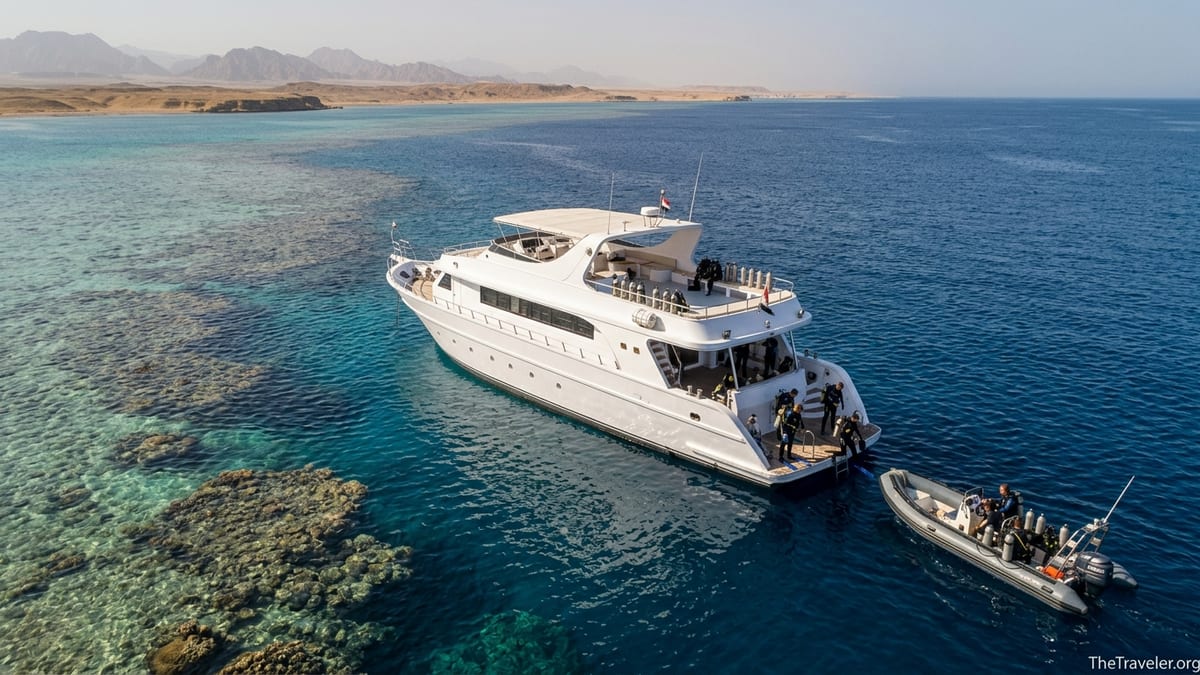
Most Egyptian liveaboards serving the Red Sea depart from four main hubs: Hurghada and Safaga on the mainland, and Sharm el Sheikh at the tip of Sinai for northern routes, plus Port Ghalib and Marsa Alam further south for remote offshore reefs such as Daedalus and St John’s. In practice, many northern “reefs and wrecks” trips start in Hurghada or Sharm el Sheikh, while Brothers, Daedalus and Elphinstone style itineraries typically sail from Port Ghalib or Marsa Alam so boats spend less time in transit and more time on signature offshore sites.
From Europe and the UK, Hurghada and Sharm el Sheikh airports have the broadest choice of direct flights and charter services, which is one reason why first-time Red Sea visitors so often begin with a northern itinerary. Marsa Alam’s airport is smaller and served by fewer international routes, but it is the practical gateway for many southern itineraries, with transfers of 10 minutes to 2 hours depending on where the boat is docked or which resort you choose. Travellers from North America often connect via Cairo and then onward to the Red Sea coast on domestic flights.
Red Sea liveaboards operate year-round, but conditions and prices shift with the seasons. Water temperatures can reach around 28–29°C in late summer and early autumn and drop to approximately 21–23°C in midwinter, when air temperatures can also feel cool on windy decks between dives. Many operators quietly discount trips from December to February, while April–June and September–November are popular for a balance of warm water and manageable air temperatures. Winter months can be ideal for wreck enthusiasts happy to wear thicker suits and for divers wanting quieter boats and less-crowded sites.
Wind and sea state matter more the further south and offshore you go. Crossings to Daedalus or the Brothers can be bumpy in strong northerlies, especially between January and March. Northern routes, which can tuck in behind Sinai and the mainland coastline, are more sheltered and usually experience shorter open-sea legs. If you are prone to seasickness and planning your first liveaboard, a summer northern itinerary from Hurghada or Sharm can be a gentler introduction than a winter crossing to remote southern reefs.
Northern Routes: Reefs, Wrecks and Easy Logistics
The classic introduction to Red Sea liveaboards is a northern “reefs and wrecks” route, often marketed as North & Ras Mohamed, North & Tiran, or Wrecks of the North. Boats leave from Hurghada, Safaga or Sharm el Sheikh and typically combine iconic sites like the SS Thistlegorm, Ras Mohamed National Park and the Straits of Tiran with smaller reef systems in the Gulf of Suez and the Straits of Gubal. A typical 7-night itinerary includes about six diving days plus a first-night embarkation and a final no-dive day for off-gassing and travel.
On these northern safaris, divers can expect 3 to 4 dives per day, with a rough pattern of an early-morning dive, a pre-lunch dive, an afternoon dive and, on some days, an optional night dive on a more sheltered reef. Specific sites vary by weather and operator, but sample weeks often include wrecks such as the SS Thistlegorm and Dunraven, reef dives at Ras Mohamed’s Shark and Yolanda Reef, and colourful pinnacles and plateaus around Sha’ab El Erg or Abu Nuhas. Many operators describe such trips as suitable for Advanced Open Water divers with around 20–30 logged dives, though Open Water divers with recent experience and a willingness to do an Adventure Deep or Advanced course onboard are commonly accepted.
One of the big appeals of northern routes is how flexible they are for mixed-experience groups. For example, a couple might include one diver with fewer than 20 dives who stays above 18–20 metres on dives at Ras Mohamed, while a more experienced buddy explores deeper sections of the wall with a guide. On wrecks such as the Thistlegorm, penetration is typically optional, with guides offering an external tour at shallower depths for newer divers and a guided swim-through of cargo holds for advanced divers comfortable with overhead environments.
In terms of cost, northern trips are usually the most budget-friendly option in the Egyptian liveaboard market. As of 2026, many standard 7-night northern safaris on mid-range boats book out at roughly 900 to 1,300 US dollars per person excluding international flights, with occasional last-minute deals lower outside peak weeks and higher rates for premium steel-hulled or small-group vessels. Because distances between sites are shorter than in the far south, fuel consumption is lower, which helps keep prices down while still delivering a dense schedule of wrecks and reefs.
Southern Routes and Brothers-style Itineraries
For experienced divers, the phrase “Red Sea liveaboard” often conjures up the southern names: Brothers, Daedalus, Elphinstone and St John’s. These offshore reefs sit far from the coast and are only realistically accessible by liveaboard. Daedalus Reef, for example, lies in the open sea and is reached by overnight or longer sailings from Marsa Alam or Hurghada. The Brothers Islands are twin pinnacles rising from deep water, with steep walls, strong currents and resident pelagic life such as hammerheads and oceanic whitetip sharks in season.
Brothers, Daedalus and Elphinstone itineraries, often abbreviated as BDE, are considered advanced routes and liveaboard operators typically set higher entry requirements. Many boats ask for Advanced Open Water or equivalent and at least 30–50 logged dives, sometimes more when currents are expected to be strong. This is because dives frequently involve negative entries, blue-water descents on drop-offs, and safety stops in open water, with limited shelter if conditions change. In return, these itineraries can deliver schooling barracuda, tuna, grey reef sharks and occasional manta rays, plus colourful soft coral walls little touched by day-boat traffic.
Further south, itineraries around Fury Shoals and St John’s tend to offer a mix of dramatic reef formations, tunnels and caverns along with relaxed drift dives and sheltered lagoons. Boats operating from Port Ghalib or Marsa Alam often structure a week to include one or two days at Abu Dabbab or local fringing reefs, followed by several days among the far-southern reef systems. Many divers report that southern routes feel quieter and more remote than northern safaris, with fewer other boats moored on the same site and night skies lit by stars instead of resort town lights.
Because of the longer distances and higher fuel use, southern and Brothers-style itineraries are generally more expensive than northern routes. Typical 7-night trips might range from around 1,200 to 1,800 US dollars per person on standard boats, with luxury vessels and smaller group charters increasing from there. It is also common for these itineraries to mandate or strongly recommend dive insurance that covers evacuation from remote locations, and some operators insist on proof of recent diving within the past year to ensure guests are current enough to manage demanding conditions safely.
Cabin Types, Boat Standards and What Is Included
Egyptian liveaboards span a wide range of comfort levels, from simple wooden-hulled boats with compact cabins to modern steel vessels that feel closer to boutique hotels. Most boats offer twin-share lower-deck cabins as the standard option, often with bunk or side-by-side beds and private or semi-private bathrooms. Upper-deck or main-deck cabins, sometimes branded as “sea view” rooms, usually command a supplement but benefit from more natural light and easier access to outdoor areas, which can make a significant difference for guests prone to motion sickness or looking for quiet spaces between dives.
At the premium end, newer boats near Hurghada, Port Ghalib and Sharm el Sheikh increasingly offer a handful of larger double or suite cabins with bigger beds, extra storage, and sometimes upgraded bathrooms. These can suit couples willing to pay more for privacy on a week-long trip. In contrast, budget-friendly liveaboards may have smaller cabins with shared bathrooms along a corridor and basic fittings that show wear but allow operators to keep prices low. When comparing options, divers should look beyond star ratings in brochures and read recent trip reports that mention water pressure, air conditioning reliability and the overall state of communal areas, as these day-to-day details can shape how comfortable a week at sea feels in practice.
Inclusions on Egyptian liveaboards tend to be broadly similar but with important small-print differences that affect the total cost. Almost all trips include accommodation, three main meals a day, snacks, drinking water, tea and coffee, and 3–4 dives per day with tanks, weights and air fills. Nitrox is commonly available for a daily or weekly fee, and some boats offer it free as a selling point, particularly on itineraries with many repetitive deep dives. Marine park fees, fuel surcharges and port fees are often charged separately, either as a per-trip supplement payable on board in cash or as part of the upfront package through an agent.
Equipment rental is rarely included in base prices. Divers who need a full gear set should budget roughly 25–40 US dollars per day as a broad indication, with higher costs for computers and lamps. Airport transfers are usually included on fixed embarkation days from the nearest airport, although some operators charge extra for out-of-hours or private transfers. Soft drinks and espresso-style coffees may be complimentary on higher-end boats and chargeable on budget options, while alcohol, if available at all, is almost always extra and may be limited to beer and wine. Clarifying these details before booking helps avoid surprises when settling the onboard bill at the end of the week.
How Many Dives, Safety Standards and Experience Requirements
Most 7-night Egyptian liveaboards advertise up to 18 to 21 dives over six diving days, which reflects three to four dives on full days plus a check dive on the first morning and occasionally a final morning dive before returning to port. Night dives are common on northern itineraries that include sheltered reefs and lagoons, but can be restricted or omitted altogether on routes where sharks are frequently encountered in shallow water or where currents make night diving unsafe. Weather can reduce the total number of dives, particularly on long crossings, so reputable operators use phrasing such as “up to” and emphasise that safety and sea state always take priority.
Onboard safety standards have become a focus for both divers and authorities in recent years after a handful of high-profile liveaboard fires and accidents in Egyptian waters since 2022. Many established fleets now publicise upgraded fire detection systems, evacuation drills and crew training. When comparing options, travellers can look for details such as clearly marked muster stations, visible lifejackets and extinguishers, briefing on emergency exits during the first safety talk, and the presence of oxygen kits and first aid supplies in both the salon and dive deck. Some insurers and national dive agencies publish general safety checklists to help guests assess whether a boat appears to meet reasonable expectations.
Certification and experience requirements vary by route. For northern reefs and wrecks, many boats are comfortable accepting Advanced Open Water divers with around 20–30 logged dives, plus capable Open Water divers planning to complete additional training onboard. Wreck penetration, deep dives beyond 30 metres and strong-current sites are normally restricted to those with the right training and experience. BDE, St John’s and other offshore itineraries often ask for 30–50 logged dives and recent experience in currents, and some may state a minimum certification of Advanced with a Deep specialty or equivalent. Liveaboards that cater to technical divers set higher entry bars and may require proof of decompression and gas-mixing training.
In practice, many Red Sea boats carry a mix of abilities on almost every trip. It is common to meet divers for whom this is a first liveaboard but who have logged 50–100 dives on day boats elsewhere. It is equally common to find local or regional divers returning to the same itineraries year after year. Honest self-assessment is crucial: if you have fewer than 20 dives and limited experience with currents, a northern trip with flexible depth and route options is generally safer and more enjoyable than a demanding Brothers itinerary. Divers with long gaps since their last trip are well-advised to schedule a refresher in a resort pool or on a day boat before embarking on a week at sea.
Liveaboards vs Resort Diving: Hurghada, Sharm, Marsa Alam and Safaga
While liveaboards are the only way to reach offshore seamounts such as Daedalus and the Brothers, Egypt’s Red Sea coastline also offers extensive resort-based diving. Choosing between the two comes down to how you like to spend your days, your budget and whether non-divers are travelling with you. In resort towns like Hurghada and Sharm el Sheikh, large all-inclusive hotels commonly price rooms from the equivalent of roughly 35–90 US dollars per night depending on season and standard, and onsite or nearby dive centres run daily boat trips to local reefs and the most famous nearby sites.
Hurghada is a practical hub for divers who want a mix of reef and wreck day trips while enjoying nightlife, promenades and family-friendly facilities. Local operators offer two-tank boat dives to sites such as Abu Ramada, Carless Reef or Sha’ab El Erg, often with prices in the range of approximately 35–60 US dollars for a day’s diving excluding equipment rental. Sharm el Sheikh, at the southern tip of Sinai, puts Ras Mohamed National Park and the Straits of Tiran within day-boat reach and has a compact, walkable dive-town feel in areas like Naama Bay, with dive centres sitting next to cafes, restaurants and small hotels.
Further south, Marsa Alam and the surrounding coastline cater more heavily to divers and snorkellers, with quieter resorts strung along the shore and many hotels built around house reefs on fringing coral. Here, shore diving and rigid inflatable boat trips visit local sites and offshore reefs such as Elphinstone, with daily packages often sitting slightly higher than Hurghada or Sharm but offering easy access to turtles, reef sharks and healthy coral gardens. Safaga, a smaller town south of Hurghada, has retained a low-key feel while giving access to well-regarded sites like Tobia Arbaa and Panorama Reef; it appeals to divers who prefer a simple town and focused diving to nightlife and shopping.
For non-diving partners or families, resort-based trips can be more flexible than liveaboards. On land, one person can dive while others relax by the pool, join snorkel trips or take excursions to Luxor or the desert. On a liveaboard, space is limited and everyone is bound to the same timetable and sea conditions. Hybrid holidays are increasingly popular: a week on a northern liveaboard out of Hurghada followed by three or four nights in a beachfront resort, or a southern BDE trip sandwiched between a few quieter days at a Marsa Alam eco-resort. This approach lets divers maximise time at signature sites without sacrificing downtime on shore.
Planning, Budgeting and Choosing the Right Option
When comparing Egyptian liveaboards, it is useful to begin with three questions: which sites matter most to you, how experienced are you with currents and repetitive deep diving, and who is travelling with you. Wreck enthusiasts who have never done a liveaboard before often find northern itineraries with the SS Thistlegorm and Ras Mohamed strike the right balance between headline dives and manageable conditions. Pelagic fans with a solid logbook may prefer BDE or southern routes for their open-ocean walls, accepting longer crossings and less predictability in exchange for higher chances of shark encounters.
Budget-wise, divers should think in terms of the total trip cost rather than headline boat prices. A northern liveaboard that appears 300 dollars cheaper than a competitor may narrow the gap once you add marine park fees, nitrox, transfers and gear rental. On the resort side, nightly accommodation costs in Hurghada or Sharm can be attractive, but daily dive boat fees and extra trips to marquee sites such as the Thistlegorm can add up over a week. For example, a diver staying at a mid-range Hurghada hotel for 7 nights and doing five 2-tank boat days plus one special wreck trip might see their total diving spend approach or exceed the cost of an entry-level northern liveaboard when all expenses are included.
Timing also affects value and crowding. Travelling in shoulder seasons such as late April or early November can secure more attractive liveaboard rates and slightly cooler air temperatures while avoiding the busiest summer weeks. Booking well in advance improves cabin choice, particularly for upper-deck rooms and double beds, while last-minute deals can work for flexible travellers who do not mind taking whichever route and cabin are available. Many Red Sea operators and specialist dive travel agencies release 12–18 month schedules, allowing divers to coordinate vacation time, airline sales and pre- or post-trip extensions such as Nile cruises or Cairo city stays.
Finally, honest communication with the booking agent or boat operator is crucial. Let them know how many dives you have, when you last dived, and which conditions you are used to. Reputable companies will steer under-experienced guests away from demanding itineraries, may suggest an onboard Advanced course or gently recommend a resort-based refresher before a liveaboard. Investing time in these conversations, reading up-to-date trip reports, and choosing routes that match your skills goes a long way to ensuring that your Red Sea holiday is memorable for the right reasons.
FAQ
Q1. Do I need to be an Advanced Open Water diver for a Red Sea liveaboard?
Many northern “reefs and wrecks” liveaboards accept Open Water divers, especially if you plan to take an Advanced or Deep course onboard, but most routes recommend at least Advanced Open Water or equivalent. Southern and Brothers itineraries almost always require Advanced certification and a minimum number of logged dives because of currents, depth and blue-water ascents.
Q2. How many dives will I typically do in a week on an Egyptian liveaboard?
On a standard 7-night itinerary with six diving days you can usually expect up to 18–21 dives, depending on weather, route and whether night dives are offered. The first and last days are often limited to a check dive and an early finish to allow for travel and no-fly time.
Q3. Are Red Sea liveaboards suitable for non-divers?
While some non-divers do join liveaboards, the schedule is built around 3–4 dives per day and space is limited, so non-divers may find days repetitive. Resorts in Hurghada, Sharm el Sheikh or Marsa Alam are generally better suited to mixed groups, with pools, beaches and excursions available while divers are on the boat.
Q4. What sort of budget should I allow for a week-long Red Sea liveaboard?
As a broad guide, mid-range 7-night northern itineraries often run in the region of 900 to 1,300 US dollars per person, while southern and Brothers routes are typically higher. You should also budget for marine park and port fees, nitrox if desired, equipment rental, tips, and international and domestic flights.
Q5. Is nitrox available on most Egyptian liveaboards?
Yes, nitrox is widely available and strongly recommended on itineraries with repetitive deep diving, such as northern wrecks or BDE routes. Some boats include nitrox in the trip price as a selling point, while others charge a daily or weekly supplement, so it is worth confirming in advance.
Q6. How do safety standards on Red Sea liveaboards compare with other regions?
Safety awareness has increased in recent years, and many established fleets publicise upgraded fire detection, life-saving equipment and crew training. Standards can still vary, so divers should look for clear safety briefings, visible emergency equipment, and up-to-date reviews mentioning drills and incident handling rather than assuming all boats operate to the same level.
Q7. Can I see big animals like sharks and dolphins on a northern itinerary, or do I need to go south?
Shark encounters are more reliably associated with offshore southern sites such as the Brothers and Daedalus, but northern routes can still deliver occasional sightings along with turtles, barracuda and large schooling fish. Dolphins are frequently seen from the boat and at certain reef systems on both northern and southern itineraries, though no operator can guarantee them.
Q8. How does resort diving from Hurghada or Sharm compare in cost to a liveaboard?
Nightly room rates in Hurghada or Sharm can look cheaper than liveaboard prices, but once you add several days of boat diving, gear rental and special trips to marquee sites, total costs may come closer than expected. Liveaboards concentrate dives into a single week at sea, while resorts spread diving across a more flexible schedule with more non-diving time.
Q9. When is the best time of year to book a Red Sea liveaboard for warm water and good visibility?
Water temperatures and visibility are generally good year-round, but many divers favour late spring and early autumn, roughly April to June and September to November, for warm water, pleasant air temperatures and relatively stable weather. Summer brings very warm conditions and winter can be cooler but quieter and often cheaper.
Q10. Should I tip the crew on an Egyptian liveaboard, and if so, how much?
Tipping is customary and constitutes an important part of crew income. Operators often suggest a guideline amount per guest for the week, typically presented at the end of the trip, and it is usually paid in cash into a communal box to be shared among crew and guides according to the boat’s policy.