

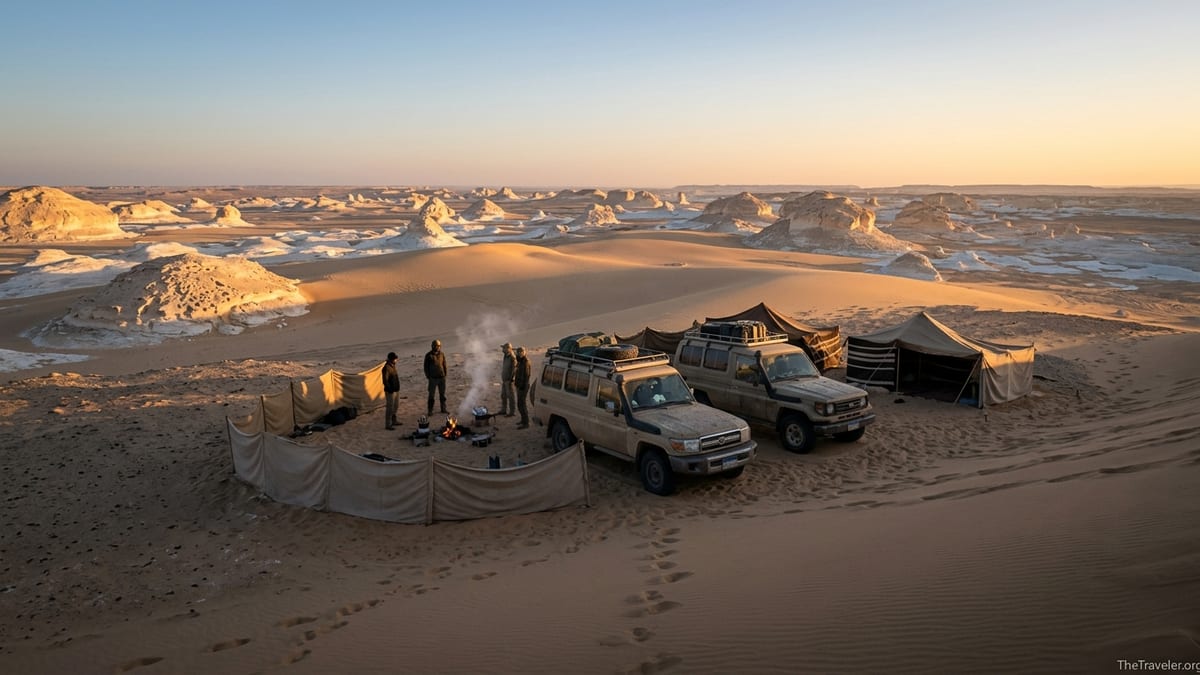
The Western Desert of Egypt is one of North Africa’s great off-road frontiers: an immense sweep of dunes, chalk plateaus and volcanic hills that begins just a few hours from Cairo. For travelers, it offers classic 4x4 expeditions across the White and Black Deserts near Bahariya and Farafra, plus deep-dune safaris in the Great Sand Sea around Siwa Oasis. This guide breaks down how trips work in reality today, from vehicle types and sandboarding to camp life, permits and how to choose a reputable operator.
Understanding Egypt’s Western Desert & Key 4x4 Areas
When Egyptians talk about the “Western Desert,” they mean the huge stretch of Sahara west of the Nile all the way to the Libyan border. For 4x4 travelers, the most practical and popular pockets are clustered around a few oases that are reachable in a day or two from Cairo: Bahariya and Farafra for the Black and White Deserts, and Siwa Oasis for the Great Sand Sea. Each has a different character and requires a slightly different style of trip.
The White Desert National Park, about five hours by road from Cairo via Bahariya, is famous for its lunar chalk formations and wide open gravel plain. Day trips visit viewpoints and short tracks, but the classic experience is an overnight or two, sleeping among wind-sculpted towers of white limestone. Nearby lies the Black Desert, a stretch of dark, volcanic-looking hills and mounds dusted with black basalt that you can climb for sweeping views.
Farther west, Siwa Oasis sits at the edge of the Great Sand Sea, a vast erg of high, soft dunes. Here, safaris focus on dune driving, swimming in desert springs and sandboarding rather than rock formations. Multi-day itineraries often combine cultural stops in the oasis with one or two afternoons charging over the dunes in Toyota Land Cruisers before sunset dinners in remote camps.
Because much of the Western Desert is a military and border-control zone, foreigners are not allowed to simply rent a 4x4 and explore independently. Permits, police notifications and in some areas military clearances are required. In practice, travelers experience the Western Desert through licensed local operators who know where they can legally go on any given season and who handle the permits in the background.
When to Go, Typical Durations and What Trips Really Look Like
The Western Desert is visitable year-round, but conditions vary sharply by season. The most comfortable months for 4x4 and camping are roughly from late October to early April, when daytime highs are usually in the low 20s to high 20s Celsius and nights can be chilly but manageable with proper layers and blankets. In midsummer, temperatures can exceed 40 degrees Celsius, and many operators either limit trips or adapt itineraries to shorter drives and less time in direct sun.
Most travelers experience the White and Black Deserts on a two day, one night or three day, two night circuit from Cairo via Bahariya. A common pattern is to leave Cairo early morning, transfer by regular car or minibus to Bahariya, then switch to 4x4s for an afternoon that takes in the Black Desert, Crystal Mountain and the dramatic limestone formations of the “New” White Desert before sunset. After a night in a simple desert camp, the second day is usually a slower drive back toward Bahariya with stops at hot or cold springs before returning to Cairo in the evening.
Longer itineraries of four to seven days link several oases and off-road areas. One established style of trip combines Bahariya and Farafra, with time in the White Desert National Park, then continues south to Dakhla and Kharga for broader desert scenery and small villages before looping back toward the Nile. At the other end of the country, Siwa focused itineraries typically run three to five days, with at least one full afternoon dedicated to dune driving and sandboarding in the Great Sand Sea, plus time to visit Siwa’s mudbrick Old Town, salt lakes and springs.
If your schedule is tight, it is possible to book a long day trip from Cairo that dips into the edge of the desert around Bahariya, but those are road heavy and offer only a glimpse of the landscapes. To really experience 4x4 driving, campfire dinners and stargazing, it is worth committing to at least one overnight. Many travelers who initially book two days and one night in the White Desert say afterward that three days would have felt more relaxed.
Vehicles, Guides and What “4x4 Safari” Means on the Ground
In the Western Desert, “4x4 safari” typically means traveling in a convoy of high clearance, four wheel drive vehicles with a professional driver and local guide, not self driving. Toyota Land Cruisers and Nissan Patrols are the workhorses, often older models that have been mechanically simplified and fitted with roof racks, extra fuel and water, sand ladders and sometimes roll bars. It is common to travel with two or more vehicles for safety, so that one can pull the other out if it becomes stuck in soft sand.
Your guide is usually a Bedouin or oasis based desert specialist who reads the dunes, keeps the group on permitted routes and handles camp setup. On a typical White Desert overnight, the crew will carry folding tables and chairs, thick mattresses, heavy blankets and windbreaks, and they will improvise a kitchen on the sand as the sun goes down. In Siwa’s Great Sand Sea, teams often travel lighter, focusing on the driving and boarding, then returning to a fixed camp or eco lodge on the edge of the dunes.
From the traveler’s perspective, days tend to follow a rhythm: morning drive to a viewpoint or new area, mid day pause in shade with a hot lunch or picnic and time to rest, then a later afternoon of more adventurous driving or short hikes. Distances in the Western Desert can be deceptive; your guide will typically keep a conservative pace to protect tires and suspension, even on tracks that appear flat. On the sand, the driving style is flowing and momentum based, with frequent stops at crests for photos.
Language skills on desert teams vary, but in the main oases there are several outfits with English speaking guides accustomed to working with international visitors. It is worth confirming language preferences in advance. Reputable operators will also brief you on safety, including how to move around camp at night, what to do if you feel unwell and how communication works if the group is out of mobile range.
White Desert, Black Desert and the Great Sand Sea: Highlights & Experiences
In the Bahariya and Farafra region, most 4x4 safaris follow a similar arc because key sights are concentrated along a well established route. The Black Desert is usually the first real off-road stop, a spread of low conical hills whose slopes are strewn with black stones from ancient volcanic activity. Many groups climb a central hill for a view over the landscape before continuing toward Crystal Mountain, a low ridge where bands of quartz and calcite catch the light.
From there, tours often push south into the so called “Old” and “New” White Desert, where the terrain changes to pale, cracked limestone and isolated chalk towers shaped by wind erosion. Guides like to time arrival at the most striking formations for late afternoon when the low sun turns the white rocks golden. This is where most overnights happen, on clearings of firm sand between the chalk structures. Evening usually means a simple grilled dinner, hot sweet tea and a long session of stargazing in some of the darkest skies accessible from Cairo.
Siwa’s Great Sand Sea delivers a different style of 4x4 day. Safaris here celebrate soft sand and steep dunes rather than rock formations. After a short drive out of town, the vehicles crest dune ridges, drop into bowls and occasionally stop at fossil sites where ancient seas left shells and coral embedded in rock. Many itineraries include swims in hot or temperate springs buried among the dunes, followed by tea brewed on an open fire. Sandboarding is a staple: guides carry boards or modified snowboards and will usually choose a dune with a gentle runout to practice before moving to steeper faces.
Beyond these headline areas, longer Western Desert expeditions can include smaller oases like Dakhla, Kharga and Farafra itself, where drivers mix short sections of off-road with long, lonely tarmac stretches. These deep-desert journeys feel more like traditional caravan routes, with fewer dramatic single landmarks but a stronger sense of scale and remoteness. They suit travelers who have several extra days and care as much about the journey between oases as specific sights.
Sandboarding, Camps and Life Overnight in the Desert
Sandboarding in Egypt is straightforward, but technique and conditions make a big difference to how enjoyable it feels. In the Great Sand Sea near Siwa, dunes are tall and relatively soft, ideal for longer rides. Boards are often basic wood or fibreglass slabs with simple bindings or straps, and guides will usually wax the base with candle wax before each run to help them glide. Standing rides feel closest to snowboarding, but many first timers prefer to sit or lie on their stomachs until they trust the surface.
Around Bahariya and Farafra, dunes are smaller but still fun for shorter sandboarding sessions, usually slotted in as a break on the way to or from the White Desert. Here, boards are sometimes shared among the group, so if sandboarding is a priority it is worth asking in advance how much time is allocated and whether equipment is included or an add on. In both regions, you should expect to get sandy from head to toe, and it helps to bring a scarf, sunglasses and a small bag to keep your camera or phone dust free between rides.
Overnight camps range from simple Bedouin style setups to semi permanent desert lodges near the tarmac. In the classic White Desert overnights, your “room” is often an open air mattress under thick blankets, sometimes sheltered by a low canvas or windbreak. There are no fixed bathrooms; instead, you walk a short distance from camp with a headlamp and follow Leave No Trace style instructions from your guide. The upside is a direct connection to the landscape: you sleep under the Milky Way with no nearby artificial light or noise.
In contrast, Siwa and some Bahariya area trips may use rustic camps that have reed huts or simple en suite rooms surrounding a central fire pit. At these, you still eat under the stars, but you can retreat to a bed with a proper mattress and bathroom facilities after dinner. Meal quality varies, but even basic outfits usually serve grilled chicken or kofta, rice or pasta and salads. More established operators sometimes include local dishes like tagines, slow cooked lamb or freshly baked bread from sand ovens, especially on multi-night trips.
Permits, Safety and the Importance of Reputable Operators
Travel in the Western Desert is tightly regulated for safety and security reasons. Foreign visitors are required to use licensed guides and, in key areas such as the White and Black Deserts, must be part of an organized trip with the correct permits. In practice, your tour company applies for the necessary paperwork and coordinates with the Tourism Police, who track convoys leaving and returning to oases and who can re-route trips if conditions change. Some border-adjacent regions remain off limits or require complex clearances that standard tourist trips do not attempt.
For travelers, the main safety decisions revolve around choosing a trustworthy operator. Look for companies based in or with long experience in the relevant oasis. In Bahariya and Farafra, that might mean local outfits that have been running White Desert overnights for years and maintain their own 4x4 fleet. In Siwa, desert-focused agencies commonly advertise Great Sand Sea safaris and can point to experienced drivers and repeat international guests. Signs of a serious operator include clear pre trip communication, realistic itineraries, an emphasis on weather and safety briefings, and willingness to explain what permits are required.
International government travel advisories highlight that you should only visit remote Western Desert areas with licensed, reputable operators and that independent off-road travel is not advised. While security incidents involving tourists in the main Western Desert safari zones have been rare in recent years, the environment is still extreme and help can be several hours away. A quality company will carry ample water and fuel, satellite or long-range communication, recovery gear and first-aid kits, and will be honest about route changes if sandstorms or heat make certain sections unsafe.
Insurance is another often overlooked piece. Many standard travel policies exclude off-road driving and adventure activities by default or require an upgrade. Before booking, it is sensible to confirm that your insurance covers guided 4x4 excursions, sandboarding and camping in remote desert areas. Reputable operators may ask for your policy details and emergency contact information as part of the booking process, which is a good sign that they are thinking about contingencies.
Pricing, What to Expect Inclusions and How to Book
Prices for Western Desert safaris vary widely depending on trip length, group size, comfort level and how you book. As a broad guide, a basic shared two day, one night White Desert trip from Cairo with transport to Bahariya, 4x4, camp equipment and meals included may start somewhere in the low to mid hundreds of US dollars per person. Private trips, longer itineraries of three days or more, or packages that link several oases often cost more, but per-day rates can drop for larger groups or longer stays.
Inclusions usually cover land transport from the starting city, 4x4 vehicles and drivers, guiding, meals during the safari days, camping gear and permit or park fees. Exclusions often include sleeping bags, personal snacks, tipping for the crew and optional extras such as additional nights in a lodge before or after the desert. In Siwa, packages might bundle in hotel nights in town plus a half day or full day Great Sand Sea safari, with sandboarding and a simple campfire dinner counted as part of the activity.
Booking can be done through Cairo based tour agencies that subcontract to oasis specialists, or directly with operators based in Bahariya, Farafra or Siwa. Direct booking with a local specialist can increase the share of your payment that reaches the desert community and sometimes offers more flexibility, but international agencies may provide stronger pre trip support, clearer cancellation policies and options to combine the desert with mainstream Nile or Red Sea itineraries. Checking recent traveler reviews and comparing two or three proposals for similar itineraries is a sensible way to understand the going rate and service differences.
Deposits are common for multi day trips, especially during peak cooler months when experienced drivers and vehicles are in high demand. Before you transfer money, you can ask for confirmation of the company’s license status, sample photos of vehicles and camps, and a breakdown of what happens in the unlikely event of weather or security related trip alterations. Operators used to international clients will have clear answers to these questions.
How to Choose a Reputable Western Desert 4x4 Operator
Selecting the right operator is the single most important decision you will make for a Western Desert safari. Start by narrowing the field to companies that specialize in the region you want to visit rather than generalist agencies that only occasionally run desert trips. For example, if your priority is the White Desert, look for Bahariya or Farafra based outfits with long track records of overnight camping, while Siwa based teams are generally better placed for the Great Sand Sea.
Once you have a shortlist, examine how each company describes safety and logistics. Serious operators talk about convoy sizes, vehicle types, maximum group numbers and staff roles. They mention the use of two vehicles for remote trips, outline what camping equipment is provided and explain how they handle dietary needs or medical concerns. A red flag is any operator that advertises aggressive dune driving as the main attraction without reference to training, safety or environmental impact.
Communication style is another revealing factor. When you email or message with questions, pay attention to how detailed and transparent the responses are. Are they willing to customize the pace of the trip, for example slowing things down for families with children or older travelers, or are they pushing a one size fits all template? Do they clearly state what is included in the price and what is not, and are they comfortable naming any limitations, such as areas they cannot currently access due to permit conditions?
Finally, try to verify that the company follows local rules and respects the environment. In protected areas like White Desert National Park, that means camping only in allowed zones, avoiding climbing fragile formations and packing out waste. Operators who emphasize low impact practices, who brief guests on cultural etiquette in oasis communities and who work with local drivers and cooks are more likely to be invested in the long term health of the region rather than short-term gains.
The Takeaway
A 4x4 safari in Egypt’s Western Desert is one of the most memorable side trips you can add to a classic Nile and Red Sea itinerary. Within a day’s journey of Cairo, you can step into landscapes that feel almost otherworldly: black volcanic hills, blinding white chalk towers and sweeping dunes that run to the horizon. Whether you choose a quick two day White Desert overnight or a longer loop that reaches Siwa’s Great Sand Sea, the experience is as much about the silence, stars and desert light as specific sights.
To get the best from the region, it pays to travel in the cooler months, give yourself at least one night under the stars and book with an operator that treats safety and environmental care as seriously as adventure. Ask detailed questions about vehicles, permits, camps and contingency plans, and be ready for simple comforts rather than luxury. In return, you will gain access to one of the last great accessible Sahara frontiers, guided by people who know its tracks, springs and winds by instinct.
For many travelers, the Western Desert ends up being the quiet highlight of a trip to Egypt, a counterpoint to the crowds at the Pyramids and the cruise ships on the Nile. If you approach it with respect for its remoteness and an open mind for long horizons and simple campfire evenings, it can feel less like an excursion and more like a short immersion in an older rhythm of travel.
FAQ
Q1. Is the Western Desert safe to visit right now?
Travel advisories generally recommend visiting the Western Desert only with licensed, reputable tour operators who follow current security rules. The main tourist zones around Bahariya, Farafra and Siwa have an established system of permits and convoy tracking, but conditions can change, so you should always check the latest official guidance and follow your operator’s advice.
Q2. Can I self drive a 4x4 in the Western Desert?
No, independent off road self driving is not permitted for foreign visitors in the core Western Desert safari areas. Regulations require that you join licensed operators who manage permits, coordinate with authorities and supply trained desert drivers familiar with the terrain, routes and emergency procedures.
Q3. How many days do I need for a White Desert safari?
The classic White Desert experience takes two days and one night, starting and ending in Cairo with an overnight camp among the chalk formations. If you have time, three days and two nights allows for a slower pace, more time for short walks and sandboarding, and a better chance to enjoy the park in different lights.
Q4. What should I pack for an overnight desert trip?
Essential items include a warm layer or lightweight down jacket for cold nights, a scarf or buff, hat and sunglasses for sun and sand, closed shoes, a headlamp, personal medications, basic toiletries, a reusable water bottle and a soft bag to keep dust off your camera or phone. Operators usually provide mattresses, blankets, main meals and drinking water, but you may wish to bring a sleeping bag and some extra snacks.
Q5. Do I need special insurance for 4x4 and sandboarding?
You should confirm that your travel insurance covers guided off road 4x4 excursions, sandboarding and camping in remote desert areas. Many basic policies classify these as adventure activities and may require an upgrade or sports add on; it is better to clarify in writing with your insurer before departure.
Q6. When is the best time of year to visit the Western Desert?
The most comfortable season for 4x4 safaris and camping is roughly from late October through early April, when daytime temperatures are milder and nights, while cool, are manageable with adequate layers. In the hottest months, trips are still possible but tend to be shorter and focused on early morning or late afternoon to avoid extreme midday heat.
Q7. Are there age or fitness limits for desert safaris?
Most standard Western Desert safaris are accessible to reasonably healthy travelers of varied ages, including older children. The days involve bumpy vehicle travel, some walking on uneven ground and basic camp facilities, so anyone with back issues, mobility challenges or serious medical conditions should discuss their needs with the operator beforehand and may opt for itineraries that use fixed camps or lodges.
Q8. What about toilets and showers in the desert?
On simple White Desert overnights, there are no built in facilities. You will typically use a designated area away from camp following Leave No Trace style instructions, and there are no showers. Semi permanent camps around Bahariya or Siwa may offer basic bathrooms and sometimes simple showers, but you should expect very limited water use compared with hotels.
Q9. Can vegetarians or people with dietary restrictions be accommodated?
Most established operators can cater to vegetarians and simple dietary needs if told in advance, and will adjust menus accordingly. For more complex allergies or strict requirements, detailed communication is essential, and bringing some backup snacks or suitable supplements is wise, given the remoteness and limited shopping options once you are in the oases.
Q10. How far in advance should I book a Western Desert safari?
For trips in the cooler high season or over popular holiday periods, booking several weeks to a few months in advance is advisable, especially if you want a private itinerary or specific dates. In shoulder seasons, some operators can arrange standard White Desert or Siwa dune trips on shorter notice, but advance planning still helps ensure you travel with your preferred company and have time to adjust insurance, flights and other logistics.