


The Western Desert of Egypt is one of North Africa’s great overland journeys, a chain of oases and surreal rock formations stretching hundreds of kilometers southwest from Cairo. Whether you have 3 days for a quick White Desert camping escape or two weeks to traverse Bahariya, Farafra, Dakhla and Kharga, smart planning around distances, road conditions and logistics will make the difference between a rushed transfer and a genuinely memorable Sahara expedition.
Understanding Egypt’s Western Desert and Oasis Chain
When travelers talk about Egypt’s Western Desert they are usually referring to the arc of inhabited oases running south of the Bahariya Depression toward Farafra, Dakhla and Kharga. Bahariya lies roughly 360 kilometers southwest of Cairo by paved highway, usually 4 to 5 hours by private car or minibus depending on checkpoints and fuel stops. From Bahariya, the road continues another 180 to 200 kilometers toward Farafra, with a turnoff into White Desert National Park where most camping itineraries take place. Farther south, Dakhla and Kharga form the tail of the route, linked by long, mostly empty asphalt strips across open desert.
Despite the remote feel, this is not pure expedition country for specialists. A web of asphalt highways, small military posts and Bedouin settlements mean that 4x4 tours and oasis guesthouses operate year-round, and it is perfectly realistic for first-time visitors to plan 3 to 14 days here. What makes the region challenging is not extreme technical terrain but the combination of long distances, limited public transport, and strict rules about overnighting in the national park. That is why the majority of travelers book at least part of their route with a licensed desert operator based in Cairo or Bahariya, who can arrange permits, fuel, food and vehicles in one package.
As a rule of thumb, think of Bahariya as the northern gateway, Farafra and the White Desert as the centerpiece, and Dakhla and Kharga as the cultural and historical tail of a longer itinerary. Many travelers combine the Western Desert either with classic Nile Valley sights such as Luxor, accessed via road from Kharga, or with Alexandria and the Mediterranean after circling back to Cairo. For planning purposes, driving times in the desert are best treated cautiously: even if mapping apps show four hours, wind, sand on the road and security stops often stretch this to five or more.
Key Logistics, Permits, Costs and When to Go
Independent travel is possible between the oases using public buses or service taxis that run from Cairo’s Western Desert bus terminal to Bahariya and sometimes on to Farafra and Dakhla. However, schedules change often and are rarely published, and services can be suspended during dust storms or security alerts. For most travelers, arranging a private car with driver or joining a small-group 4x4 tour is the most practical option, particularly for overnight camping inside White Desert National Park where a local guide is required and permits are usually handled by tour companies.
Prices for Western Desert safaris fluctuate with fuel costs and demand, but as of 2025–2026, a standard 2-night, 3-day Bahariya and White Desert trip from Cairo typically starts around 230 to 300 US dollars per person based on two to four people sharing a jeep, including transfers from Cairo, guiding, camping gear and meals. Longer 5 to 7-day Bahariya–Farafra safaris with two nights of camping and guesthouse stays in each oasis often run between 600 and 900 US dollars per person depending on group size and the level of comfort. Custom 10 to 14-day expeditions linking Bahariya, Farafra, Dakhla and Kharga, then dropping you in Luxor or Asyut for onward Nile travel, can reach 1200 to 2000 US dollars per person once permits and fuel are factored in.
Climate is critical. The best seasons are October to early December and late February to April, when daytime highs hover between the mid-20s and low 30s Celsius and nights can be cool but not freezing. In mid-winter, especially December and January, night temperatures in the White Desert can fall close to or just below freezing, which makes proper sleeping bags and windproof layers essential. From May to September, extreme heat above 40 degrees Celsius and occasional khamsin sandstorms make camping uncomfortable and dangerous for inexperienced travelers. Few reputable operators encourage overnight camping in the height of summer, and if you do travel then, focus on guesthouse stays with air conditioning and shaded courtyards rather than multi-night tent trips.
A Classic 3-Day White Desert and Bahariya Escape
The most popular Western Desert itinerary is a 3-day, 2-night loop from Cairo to Bahariya and the White Desert, ideal for travelers with limited time who still want a true Saharan camping experience. On day one, you leave Cairo early in a private minivan or 4x4, usually around 7 or 8 in the morning, arriving in Bahariya by early afternoon. After lunch in a simple local restaurant or oasis lodge, your guide typically switches to a desert-equipped jeep for an afternoon tour of Bahariya’s surroundings, from the low conical hills of the Black Desert to salt lakes and date-palm gardens. Many tours include a sunset drive up English Mountain, a low ridge used as a lookout in the early 20th century, before returning to a rustic hot-spring hotel in Bahariya for the first night.
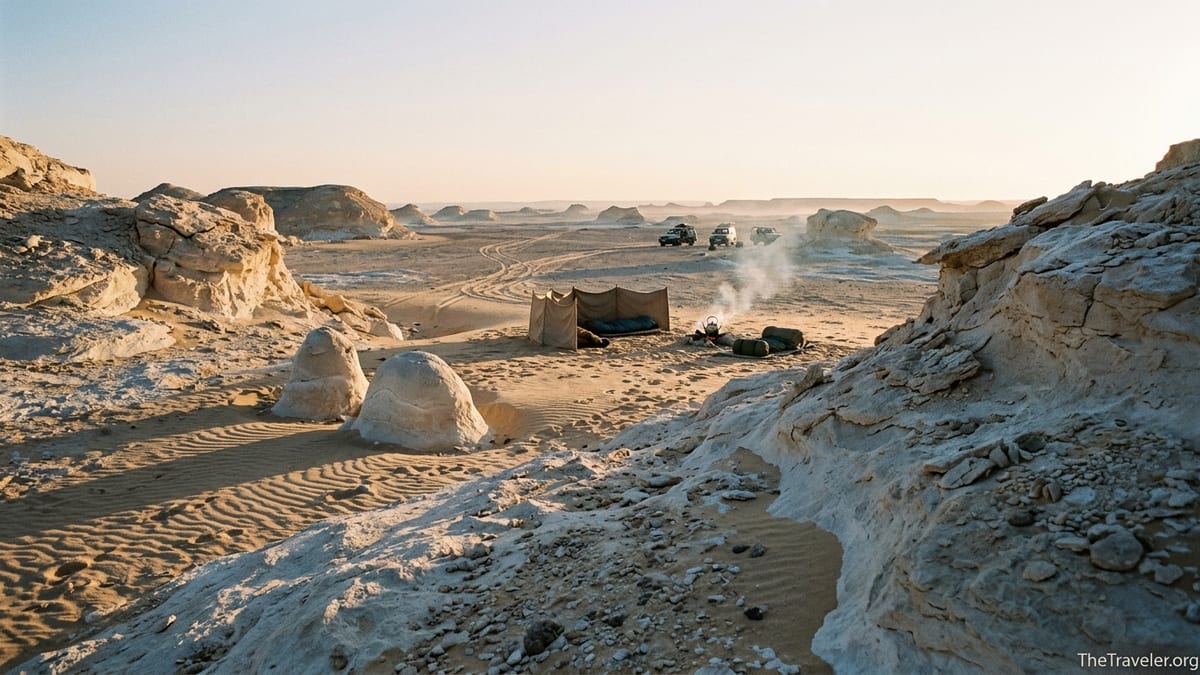
Day two is the heart of the trip. After breakfast, you load gear and food into the jeep and drive south along the asphalt highway, stopping at Crystal Mountain, a natural arch and hill streaked with sparkling calcite veins, and at the sand dunes of the Agabat area where off-road tracks thread between golden slopes. By mid-afternoon, the jeep turns off toward White Desert National Park, entering a dreamscape of chalk pinnacles, wind-carved mushrooms and white boulders that glow pink at sunset. Your crew sets up a simple wild camp among the rock formations, with low canvas windbreaks, foam mattresses and ample blankets. After a hot dinner cooked over charcoal and tea around the fire, you sleep under the stars while the drivers stay nearby in case of wind or curious foxes.
On day three, you wake amid frosted white limestone, watch sunrise over the formations, then pack camp and drive back via Agabat and the Black Desert toward Bahariya for lunch and a quick shower at the hotel. Most itineraries then continue directly back to Cairo, arriving early evening. Travel time from the White Desert back to central Cairo is typically 6 to 7 hours including stops and checkpoints, so it is wise not to book a same-night international flight. For travelers wanting a slightly slower version of this route, it is easy to add an extra night in Bahariya at the start or end to make a relaxed 4-day break instead of a tight 3-day run.
Stretching to 5 and 7 Days: Adding Farafra and Extra Camping
With 5 days to play with, you can not only see the highlights of Bahariya and White Desert National Park but also push on to Farafra Oasis for a more complete picture of oasis life. One realistic 5-day plan starts as the 3-day route, with an initial night in Bahariya, followed by a camping night in the White Desert. On day three, instead of returning directly to Bahariya, your jeep continues south through the park, stopping at less-visited formations and old caravan tracks before rejoining the asphalt road toward Farafra, a modest settlement of whitewashed houses and palm groves about 180 kilometers south of Bahariya. That night you stay in a family-run guesthouse, often with simple en-suite rooms and homemade dinners featuring pigeon, grilled chicken or vegetarian stews.
Day four can be spent exploring Farafra’s hot springs and mudbrick villages, or visiting a small local art house that displays desert-inspired paintings and sculptures. In the late afternoon, some tours offer a second, shorter camping experience in nearby desert areas outside the strict core of White Desert National Park, leaving you with one more night under the stars but closer to Farafra. On the final day, you either drive back north via Bahariya and on to Cairo, or head southeast by long desert road to the Nile Valley town of Assiut, where you can catch onward trains to Luxor and Aswan. Because this last leg is a full day’s drive, many operators structure a 5-day trip as a loop back to Cairo rather than a one-way transfer.
Seven days give you more flexibility and a much more relaxed rhythm. A typical 7-day Western Desert itinerary might spend two nights in Bahariya, with time to visit the Valley of the Golden Mummies archaeological site and local tombs if they are open, then add two nights of camping in and around the White Desert to allow for sunrise walks, sunset photography and time in more remote sectors away from day-trip groups. From there, you continue to Farafra for one or two nights in a guesthouse, using the oasis as a base for short 4x4 excursions into surrounding dunes. With a week, you can also afford an unscheduled buffer day in case of sandstorms or to simply slow down at a palm-shaded hot spring when the midday sun is at its strongest.
Epic 10 and 14-Day Bahariya–Farafra–Dakhla–Kharga Routes
Travelers with 10 to 14 days in Egypt’s Western Desert can follow the full north–south oasis arc, an overland route that feels very different from the tourist circuits along the Nile. A common 10-day version begins with the same 3-day Bahariya and White Desert section outlined earlier, then spends one night in Farafra before driving on to Dakhla Oasis, around 300 kilometers farther south. Driving time between Farafra and Dakhla is usually 5 to 6 hours with stops, and the scenery alternates between bare gravel plains and low escarpments. Dakhla itself is greener and more spread out than Bahariya, with multiple villages, fields, and low ridges rising above the palm groves.
In Dakhla, most itineraries include at least two nights in or near the main town of Mut, often at a mudbrick eco-lodge or midrange hotel with gardens and small pools. From here, day excursions reach medieval Islamic villages with narrow alleys, pharaonic-era tombs on rocky spurs and hot springs used by local families. After Dakhla, the road continues roughly 200 kilometers east to Kharga Oasis, the last major stop before the Nile. A realistic 10-day plan spends one or two nights in Kharga, allowing time to visit Roman-era forts and early Christian sites on the desert edge, then finishes with a long driving day to Luxor or Asyut for onward trains and flights.
A 14-day itinerary adds breathing space and side trips. You might spend three full days in Bahariya, mixing jeep safaris with slow exploration of the palm gardens on foot, then add three nights of camping spread across White Desert National Park and surrounding regions, including a night in quieter, less visited areas that most short tours bypass. From there, two nights each in Farafra, Dakhla and Kharga give a rhythm of long-drive day, then slow exploration day. Travelers interested in archaeology can use extra days in Dakhla and Kharga to hire local guides to lesser-known temple ruins and outlying hot springs. Others use the time to simply decompress at guesthouses, enjoying date harvests in autumn or watching stars from rooftop terraces in winter.
On both 10 and 14-day routes, logistics become more complex. Public transport is patchy between Farafra, Dakhla and Kharga, and security rules sometimes require foreign visitors to travel in convoys or file route plans with local police. This is one reason many travelers booking longer itineraries work with Cairo-based agencies or specialist Western Desert operators who can prearrange permits and check current regulations. Sharing a 4x4 and driver among two or four travelers also keeps per-person costs manageable on such extended routes, given the amount of fuel and vehicle wear involved.
Transport, Driving Times and Choosing Guided Support
For short 3 to 5-day trips centered on Bahariya and the White Desert, you will almost certainly join an organized jeep tour, even if you customize the details. Operators typically use Toyota Land Cruiser or Nissan Patrol 4x4s equipped with roof racks, jerrycans, sand ladders and basic recovery gear. A normal configuration seats four passengers plus driver and sometimes a cook, with luggage strapped on top. From Cairo to Bahariya, many packages use a separate modern minivan or sedan on the paved highway, then transfer you to the jeep for the off-road component to save wear on the expedition vehicles.
If you are an experienced overlander considering self-drive, be aware that rental agencies in Cairo rarely allow their vehicles to leave paved highways or enter the White Desert on their own insurance. Fuel stations between the oases can be far apart and occasionally short of petrol or diesel, and many desert tracks are unmarked. In addition, for safety and regulatory reasons, overnight camping inside White Desert National Park must be registered, typically through a local operator who also provides a Bedouin guide. For most visitors, it is more practical to book at least the desert sections with a guide and vehicle, while using trains or buses independently before and after.
Travel times between oasis towns are long enough that trying to cram too much into a single day is not advisable. Cairo to Bahariya is 4 to 5 hours each way. Bahariya to the central White Desert camping areas often takes 3 to 4 hours in a jeep with sightseeing stops. Bahariya to Farafra is about 4 hours by road, Farafra to Dakhla around 5 to 6, and Dakhla to Kharga 3 to 4. On top of that, you need to factor in time for sourcing food, filling fuel tanks and handling security paperwork. In practice, any itinerary that shows more than 5 to 6 hours of combined driving and intensive sightseeing in the same day will feel rushed and leave little room for breakdowns or weather delays.
Where You Will Sleep: Guesthouses, Eco-Lodges and Desert Camps
Accommodation in the Western Desert is simple but can be very atmospheric. In Bahariya, travelers often stay at oasis-style lodges and small hotels with palm-shaded courtyards, hot-spring-fed pools and mudbrick or stone guest rooms. Expect basic but comfortable rooms with private bathrooms, sometimes air conditioning or ceiling fans, and communal dining rooms serving set menus of rice, grilled meats, salads and tagines. Prices typically range from modest guesthouses used by local tour drivers up to midrange eco-lodges that appeal to small-group tours, with double rooms generally in the 30 to 70 US dollar per night range when booked separately from a package.
In Farafra and Dakhla, accommodation stock is smaller but varied, from homestay-style guesthouses with shared meals and rooftop terraces to desert eco-lodges built of traditional mudbrick. Many of these places are run by extended families who also work with local guides, so it is common that your jeep driver or tour agent will bundle stays at a preferred lodge into your overall price. Kharga, being closer to the Nile and provincial administrative centers, offers a handful of slightly larger hotels along with simpler local inns. Because options can fill quickly during Egyptian public holidays, it is wise to confirm bookings well in advance if your trip coincides with long weekends or school breaks.
Camping in the White Desert is deliberately spartan and communal. Instead of large commercial camps, most operators create a temporary wild camp each night, choosing a spot based on wind direction and proximity to interesting rock formations. Equipment usually includes foam mattresses, heavy blankets or sleeping bags, a low windbreak of canvas, cooking gear and a simple latrine area screened by a tent or dunes. There is no permanent infrastructure, which keeps the landscape pristine but means you should not expect showers or fixed toilets. Travelers wanting a little more comfort can ask about upgraded setups with thicker mattresses or private tents, though the magic of the White Desert for many is precisely the feeling of sleeping out under open skies.
What to Pack, Safety and Practical Tips
Conditions in the Western Desert can swing from hot, dry afternoons to cold, windy nights, so packing for layers is essential on any itinerary. Bring a light but sturdy pair of hiking shoes or boots for scrambling over rocks, sandals for camp, and loose long-sleeve shirts and trousers to protect from sun and blowing sand. A wide-brimmed hat, UV sunglasses and high-factor sunscreen are indispensable. Even when operators supply blankets and basic sleeping bags, a compact liner or your own 3-season sleeping bag can add warmth and comfort during winter trips. For electronics, a power bank is useful, as you may go 24 to 48 hours between charging opportunities while camping.
On the safety side, tours generally proceed only when weather conditions are acceptable, and drivers are accustomed to adjusting routes for sand drifts and visibility. Vehicle convoys are common, especially on busier weekends, which adds redundancy if one jeep has a mechanical problem. You should travel with comprehensive travel insurance that covers off-road activities, and let your operator know about any medical conditions before departure. Tap water in the oases is not recommended for visitors, so your tour should provide bottled drinking water in generous quantities. It is also wise to carry your own reusable bottle and perhaps a small water filter or purification tablets if you plan extended independent stays.
Culturally, the oases are conservative, rural communities. Modest dress is appreciated in towns and villages, with shoulders and knees covered for both men and women when away from camp. Always ask before photographing people, especially women and children. Small cash tips for drivers, cooks and guesthouse staff are customary at the end of a tour, often collected by the lead guide and distributed among the team. Mobile coverage exists in and around most oasis towns but drops away quickly once you enter the heart of White Desert National Park, so expect periods without connectivity and let friends or family know your broad route before departure.
FAQ
Q1. Can I visit the Western Desert on my own without a tour?
Independent travel between the oasis towns is possible using buses and shared taxis, but for camping inside White Desert National Park and most 4x4 off-road routes you need to join a licensed local operator who can arrange permits, guides and safety equipment.
Q2. How many days do I need for the White Desert?
The minimum realistic trip that includes camping in the White Desert is 2 nights and 3 days from Cairo, with one hotel night in Bahariya and one night under the stars. With 5 to 7 days, you can add Farafra and extra time in the park for a less rushed experience.
Q3. What is the best time of year to travel in the Western Desert?
The most comfortable months are October to early December and late February to April, when daytime temperatures are warm but not extreme and nights are cool. Mid-winter can be cold at night and summer heat can be intense, so itineraries then should focus on guesthouses rather than extended camping.
Q4. How cold does it get at night in the White Desert?
From late November through February, night temperatures in the White Desert can drop close to or slightly below freezing, especially when the wind picks up. Good sleeping bags, warm layers and windproof jackets are important, even if days feel pleasantly warm.
Q5. Are there toilets and showers while camping?
Wild camps in the White Desert are very simple, with no permanent toilets or showers. Your crew will usually set up a basic screened latrine area, and you can freshen up with wet wipes and small amounts of water. Showers are available again when you return to Bahariya or other oasis guesthouses.
Q6. How much does a typical 3-day White Desert trip cost?
Prices vary by operator and season, but many 3-day, 2-night Bahariya and White Desert packages from Cairo start around 230 to 300 US dollars per person based on small groups, including transport, guiding, camping gear and meals.
Q7. Is it safe to travel with children in the Western Desert?
Families with school-age children regularly join Western Desert safaris, and reputable operators adapt driving times and camp routines to younger travelers. However, you should be prepared for long drives, limited facilities and significant temperature swings, and keep a close eye on children around campfires and desert cliffs.
Q8. Can I combine the Western Desert with a Nile cruise?
Yes. Many longer 10 to 14-day itineraries end in Kharga, from where you can travel by road to Luxor or Asyut and connect with Nile cruises or Upper Egypt tours. Shorter trips often start and end in Cairo, allowing you to visit the Pyramids and museums before or after your desert journey.
Q9. Do I need special permits for photography or drones?
Regular cameras are generally fine in the Western Desert, though you should avoid photographing military checkpoints. Drone use is heavily restricted in Egypt and usually requires advance permits that are difficult for tourists to obtain, so most travelers leave drones at home.
Q10. What kind of fitness level do I need for these itineraries?
Most 3 to 14-day Western Desert trips involve more sitting in vehicles than strenuous hiking, so a moderate general fitness level is sufficient. You should be comfortable with climbing in and out of jeeps, walking on uneven rocky ground and coping with long days of travel in a dry, dusty environment.