


The Western Desert of Egypt stretches from the Nile Valley to the Libyan border, a vast expanse of sand seas, surreal rock formations, palm-filled oases and Bedouin communities. For first-time visitors, it can feel remote and intimidating, yet it is one of Egypt’s most rewarding regions if you come prepared. This guide focuses on the classic Western Desert arc of Siwa, Bahariya, Farafra and its White and Black Deserts, plus the deeper oases of Dakhla and Kharga, with practical advice on safaris, permits, transport, costs and how to plan a safe, memorable journey.
Understanding Egypt’s Western Desert and When to Go
The Western Desert covers roughly two thirds of Egypt and is defined by broad plateaus, dune fields and a chain of inhabited oases that run in an arc from Siwa near the Libyan border through Bahariya, Farafra, Dakhla and Kharga closer to Sudan. For travelers, this means you are not entering a featureless void but a network of small oasis towns connected by long desert highways, with basic services, guesthouses and local guides at each main stop.
Climate is the first factor in planning. Late October to April is broadly considered the best season, with daytime highs often ranging from about 18 to 28 degrees Celsius across much of the region. Nights in December and January can drop close to freezing in exposed desert camps, so you need warm layers and a proper sleeping bag if you plan to camp in the White Desert. From June to early September, temperatures frequently exceed 40 degrees, especially around Siwa and the deep oases, which makes hiking and multi-day safaris uncomfortable or even risky for the unprepared.
Weather patterns vary across the oases. Siwa and Bahariya can experience khamsin sand-laden winds in spring, which reduce visibility and make driving uncomfortable. Winter in higher plateau areas near Farafra and Dakhla can feel sharply cold after sunset because of clear skies and dry air. Always check a recent forecast for your specific oasis and build flexibility into your plans. If a strong wind event is expected, many guides will suggest delaying an overnight desert trip by a day.
First-time visitors should allow extra time for travel days and potential delays caused by road checkpoints or weather. A common mistake is to try to fit Cairo, Siwa, Bahariya and the White Desert into four or five days. In practice, each long drive can take seven to ten hours. A more realistic first-time plan is to focus on one main cluster, such as Cairo–Bahariya–White and Black Desert, or Cairo–Siwa with one or two desert excursions from the oasis.
Key Regions: Siwa, Bahariya, Farafra, Dakhla and Kharga
Siwa Oasis, about 50 kilometers from the Libyan border, is the most distinct culturally. Its population includes Siwi people with Berber roots, and you will hear the Siwi language alongside Arabic. The town is famous for the ruins of the Temple of the Oracle of Amun, where Alexander the Great reportedly consulted the oracle, and for the collapsed mud-brick citadel of Shali that still dominates the skyline. Many visitors stay in eco-lodges built from kershef, a local mix of salt and mud, such as simple palm-frond guesthouses on the outskirts of town and higher-end ecolodges in nearby date groves. From Siwa you can arrange 4x4 trips into the Great Sand Sea for dune driving, sandboarding and sunset swims in hot springs.
Bahariya Oasis is the main launch pad for the Black Desert, Crystal Mountain and the White Desert. The small town of Bawiti has a cluster of budget and midrange hotels, including simple family-run lodgings on the main street and desert camps on the outskirts. Travelers typically use Bahariya as a one-night base before heading out in 4x4 convoys for one or two nights of camping among the chalk formations of the White Desert. The nearby Black Desert, dotted with dark volcanic hills, is usually visited en route.
Farafra, south of Bahariya, is a smaller and quieter oasis closer to the heart of the White Desert protected area. Accommodation here is limited but atmospheric, with a few traditional mud-brick guesthouses and simple rooms in private homes. Some travelers prefer to base here for White Desert excursions to minimize driving times and to experience a slower, more rural oasis life, visiting small local museums and hot springs.
Further along the arc lie Dakhla and Kharga. Dakhla Oasis combines palm gardens and rock ridges with historic villages such as Al-Qasr, where narrow lanes weave between mud-brick houses and Ottoman-era door lintels still show carved owners’ names. Small hotels and ecolodges here tend to be simpler and more locally focused than in Siwa, with home-style cooking and rooftop terraces for stargazing. Kharga, the southernmost of the major oases, feels more modern and administrative, with a larger town center but fewer foreign visitors. It is often used as a transit point on longer North–South Western Desert itineraries or for visiting nearby temples and Roman-era ruins.
Desert Safaris: White Desert, Black Desert and the Great Sand Sea
For many first-time visitors, the highlight of a Western Desert trip is a night or two under the stars. The classic route from Bahariya visits the Black Desert, Crystal Mountain and the White Desert. In the Black Desert you will see low black-topped hills and scattered basalt that create a lunar feel. Guides often stop at a viewpoint where you can climb a low hill in ten to fifteen minutes to survey the valley before continuing toward the chalk plateaus.
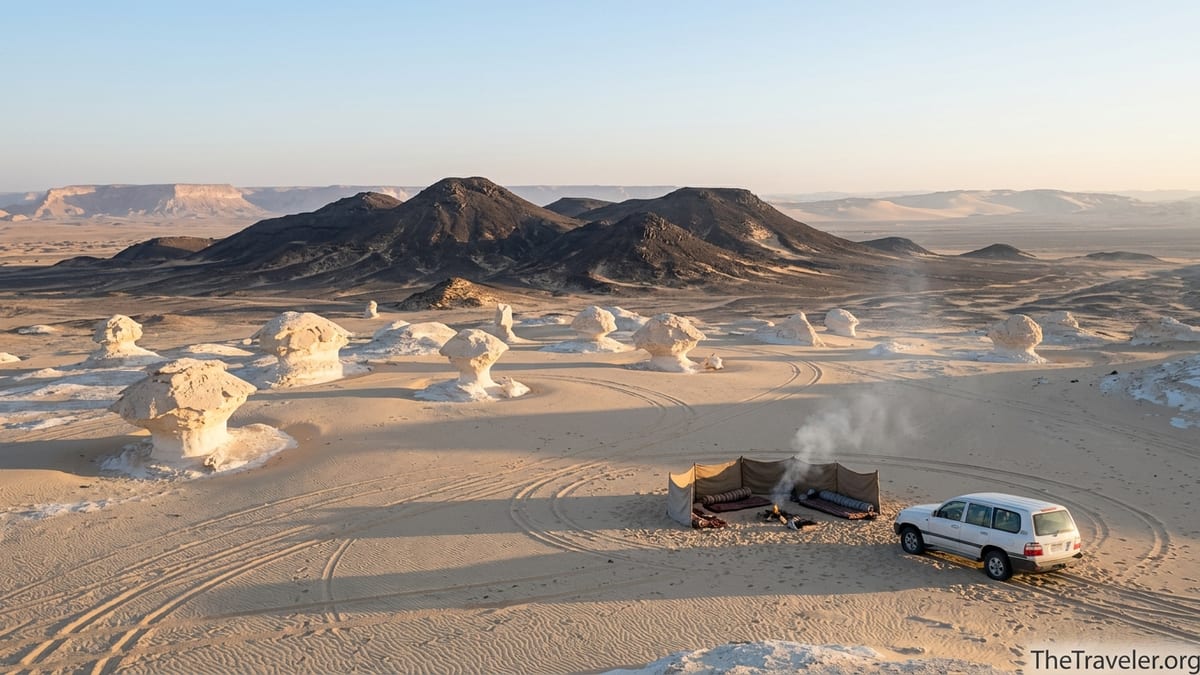
The White Desert itself lies within a protected area marked by strange chalk and limestone formations shaped by wind erosion over millennia. On a typical overnight tour, your 4x4 will leave the paved road and follow sand tracks into an area of towering mushroom-like pinnacles and white ridges. Guides set up a simple camp using mattresses, blankets and windbreaks. Dinner is usually grilled chicken or vegetables cooked over an open fire, with tea and music afterward. There are no permanent toilets or facilities in the camping zones, so operators follow basic wilderness practices and ask guests to use designated areas away from the rock formations.
Near Siwa, safaris head into the Great Sand Sea, a massive dune field along the Libyan border. These trips are more about dune driving, sandboarding and soaking in hot or cold springs than about rock formations. A half-day tour might include stops at a large dune for sandboarding, a small freshwater lake for a quick swim and a hot spring pool where visitors relax at sunset. Operators usually run these trips in older Toyota Land Cruisers fitted with sand ladders and recovery gear.
First-timers should book with established local agencies or Cairo-based operators that use licensed desert drivers. In Bahariya, for example, many visitors walk along the main street and speak directly with several safari offices to compare itineraries and vehicles before committing. A shared one-night White Desert camping tour from Bahariya, including transport, food and basic gear, often falls within a modest midrange price bracket per person, while private trips or two-night itineraries cost more. Prices may change seasonally and with fuel costs, so confirm inclusions in writing before departure.
Permits, Safety and Responsible Travel
Travel in Egypt’s Western Desert involves a mix of routine police checkpoints and, in some protected areas, park permits. For example, visits to the White Desert generally require a permit arranged by your tour operator, who submits passport copies and vehicle details to the relevant authorities. Independent self-drive visitors usually cannot enter deeper off-road sections of the White Desert or Black Desert without a local guide and the correct paperwork, so first-time travelers should plan on hiring licensed operators.
Checkpoints on roads between oases and between the oases and Cairo are standard. Buses and private cars are usually stopped briefly while officers check passports and log vehicle details. Sometimes authorities restrict night driving on certain stretches for safety reasons, in which case buses and private transfers are scheduled to depart early in the morning. When planning long jumps, such as Cairo to Siwa or Bahariya to Farafra, confirm departure times at least a day in advance and keep your passport and Egyptian visa easily accessible.
Desert safety is primarily about preparation. Even on guided trips, you should carry your own refillable water bottle, sun protection, a hat and basic medication such as rehydration salts. Nights in the White Desert can feel extremely cold due to dry air and wind exposure, so ask your operator what kind of sleeping bags and blankets are provided and consider bringing a compact liner or additional warm clothing. On Siwa dune trips, loose long sleeves and trousers protect against sunburn and allow you to sit comfortably on hot sand.
Responsible travel practices are increasingly important in fragile desert environments. In the White Desert, for example, visitors are asked not to climb delicate chalk formations or carve names into the rock. Litter is a persistent issue, especially at popular roadside viewpoints and springs. Choose operators who visibly pack out rubbish, use reusable dishware where possible and keep campfires small and controlled. When visiting oases, support small local businesses by buying dates, olive oil or crafts produced in the community rather than only in big city shops.
Accommodation, Food and Realistic Costs
Accommodation in the Western Desert ranges from simple family guesthouses and ecolodges to basic hotels built in the 1990s and 2000s. In Siwa, you will find rustic lodges made of kershef with salt-brick walls and palm trunks, often lit by candles at night or low-level electric lights. Some of these, set among olive and date groves, offer natural swimming pools fed by springs and serve set menus of home-cooked Siwan dishes. In Bahariya and Farafra, expect concrete guesthouses and a few desert camps with shared bathrooms, rooftop terraces and basic Wi-Fi, though connections can be slow and unreliable.
In Dakhla and Kharga, choices narrow. Small hotels around Dakhla’s main town might offer simple en suite rooms, air conditioning and breakfast, while ecolodges nearer old villages provide more atmosphere but limited amenities. Many establishments across the oases operate informally: you might book by messaging the owner or turning up and negotiating on the spot, especially outside peak holiday periods. Because capacity is limited, it is wise to reserve ahead for November, December and late March, when Egyptian school holidays and milder weather bring more domestic travelers.
Food is generally hearty, simple and inexpensive by international standards. In oasis towns, typical meals include grilled chicken, kofta, lentil soup, rice, salads and fresh flatbread. In Siwa you are likely to try dishes cooked in clay ovens with olives and dates, as well as local dates served in many forms. In Bahariya, many safari companies include generous meals in their tour prices, including breakfast with eggs, cheese and bread, and dinners with soups, stews and grilled meats or vegetables. Vegetarian travelers can usually be accommodated with advance notice, though vegan options may be more limited.
Costs vary with exchange rates and fuel prices, but some patterns are consistent. Budget travelers who use public buses, stay in simple guesthouses and join shared overnight safaris from Bahariya can often keep daily spending at a modest level, excluding long-distance transport to and from Cairo. Midrange travelers booking private transfers, en suite rooms and private 4x4 safaris will spend more but gain flexibility and comfort. Entrance fees for protected areas such as the White Desert are generally modest in absolute terms, collected either per person or per vehicle and usually included in safari prices. Always clarify whether national park fees, meals, camping gear and transport back to your starting point are included before paying a deposit.
Getting Around: Buses, 4x4s and Practical Routes
Reaching the Western Desert typically starts in Cairo. From there, travelers either join organized tours that include transport or use a mix of public buses and private transfers. Buses from Cairo to Bahariya usually depart from specific bus stations and take around five hours under good conditions, though checkpoints and rest stops can extend this. Tickets are affordable, but schedules may change with little notice, so check the latest departure times locally and, if possible, buy tickets a day ahead.
For Siwa, many travelers travel via the Mediterranean coastal city of Marsa Matrouh, connecting on to Siwa by bus or shared minivan. Direct overland routes between Siwa and Bahariya exist but may not always have public transport or may be open only to organized convoys, depending on current security regulations. At the time of planning, it is essential to ask local agencies, hotels or drivers whether that route is permitted and what paperwork is needed. Because information changes, it is unwise to rely on an old guidebook description of available routes.
Within the oases, local movement is easy. In Siwa, most places in town are walkable or reachable by tuk-tuk and small pickups used as shared taxis. In Bahariya, you may walk around Bawiti or hire a local driver to visit nearby springs and viewpoints. For any genuine desert excursion into the Black Desert, White Desert or Great Sand Sea, you will need a 4x4 and experienced driver. Attempting to self-drive into these areas without deep sand driving skills and recovery gear is not recommended, especially for first-time visitors.
Multi-oasis itineraries, sometimes called the “oases circuit,” link Siwa, Bahariya, Farafra, Dakhla and Kharga over one to two weeks. These trips typically rely on private 4x4s or minibuses organized through local agencies or Cairo-based operators, with permits arranged in advance. If you are short on time, consider focusing on one segment, such as Bahariya to Dakhla via Farafra, which combines the White Desert with quieter oasis life, rather than attempting the entire arc on a tight schedule.
First-Time Planning Tips for a Smooth Journey
A successful Western Desert trip begins with clear priorities. Decide whether your main goal is an overnight camping experience in the White Desert, immersion in Siwa’s oasis culture, or a longer slow journey linking several oases. Once you know your focus, allocate nights accordingly. For example, a one-week itinerary might spend two nights in Bahariya, one or two nights camping in the White Desert and two or three nights in Farafra or Dakhla, leaving transit time to and from Cairo.
Build redundancy into your transport plans. Because buses can be delayed and private transfers sometimes rescheduled around checkpoints, avoid booking tight same-day connections with flights out of Cairo. Give yourself at least one buffer day back in Cairo after leaving the desert before any international flight. Similarly, if an overnight desert safari is the centerpiece of your trip, schedule it early enough that you can shift it by a day in case of high winds or a vehicle issue.
Packing light but smart matters. In addition to standard desert clothing, pack a warm hat, gloves and thermal layer if traveling between November and February, even if daytime temperatures feel mild. A lightweight scarf or buff is useful during sandy winds and for warmth at night. Headlamps are more practical than phone flashlights around desert camps, and a small dry bag keeps electronics and documents free from fine dust. Bring a power bank, because many camps rely on limited generator power or car batteries, and charging opportunities may be limited.
Finally, manage expectations. The Western Desert is not a polished resort destination. Power cuts can happen, Wi-Fi often fails, hot water may run on irregular schedules and vehicles show their age. Approaching the trip with patience and a sense of adventure will make occasional discomforts feel like part of the experience rather than problems. In return, you gain vast star-filled skies, silent dunes and the hospitality of communities that have lived in this harsh landscape for generations.
FAQ
Q1: Do I need a special permit to visit the White Desert and Black Desert?
In most cases, yes. Permits for the White Desert protected area and surrounding desert are typically arranged by licensed tour operators or local safari offices, who submit your passport details and vehicle information to the authorities. Independent travelers cannot usually drive themselves off-road into these areas without a local guide and paperwork.
Q2: Is it safe to travel in Egypt’s Western Desert as a first-time visitor?
Most travelers who follow current advice, use licensed guides and respect police checkpoints report trouble-free trips. Routes and regulations can change, so it is important to check recent information in Cairo or at the oases, avoid restricted border zones and travel with reputable operators for off-road sections.
Q3: When is the best time of year to camp in the White Desert?
The most popular months for camping in the White Desert run from roughly late October to April, when daytime temperatures are milder. Nights can be very cold from December to February, so good sleeping bags and warm clothes are essential. Summer camping is possible but usually uncomfortable for first-timers due to high heat.
Q4: How much should I budget for an overnight White Desert safari from Bahariya?
Prices vary with fuel costs, exchange rates and group size, but a shared one-night camping trip from Bahariya that includes transport, meals, basic gear and park fees is typically in a modest midrange price bracket per person. Private tours, extra nights and upgraded equipment will increase the total. Always confirm what is included before paying.
Q5: Can I travel independently between Siwa, Bahariya, Farafra, Dakhla and Kharga?
Parts of the oases circuit can be done by public bus or shared minivan, but some segments require private vehicles and may be subject to changing security rules. At times, routes between certain oases are restricted or allowed only to organized convoys. Before committing to an independent plan, ask local agencies or hotels about current regulations.
Q6: What kind of clothing should I pack for a winter trip to the Western Desert?
Pack layers. During the day, lightweight long sleeves, trousers, a hat and sunglasses protect against sun and sand. At night, especially between November and February, you will appreciate a fleece or insulated jacket, warm hat, gloves and thermal base layer for camping or sitting outdoors.
Q7: Are there ATMs and mobile coverage in the oases?
Most larger oases such as Siwa, Bahariya, Dakhla and Kharga have at least a few ATMs, though they may occasionally be out of service. Mobile coverage is generally available in and near the main towns, but it drops quickly once you drive into the open desert. Do not rely on connectivity during safaris.
Q8: What food options can vegetarians expect in the Western Desert?
Vegetarian travelers usually find enough options, though menus are simple. Common dishes include lentil soup, salads, rice, grilled vegetables, omelettes, bean stews and plenty of bread, dates and olives. Inform your guesthouse or safari operator in advance so they can plan suitable meals.
Q9: Do I need camping gear for desert safaris, or is it provided?
On organized safaris from Bahariya, Siwa or Farafra, the operator normally provides tents or windbreaks, mattresses, blankets, cooking equipment and basic lighting. You bring personal items such as a sleeping bag liner, warm clothes, a headlamp, toiletries and any specialty gear you prefer.
Q10: How many days should a first-time visitor spend in the Western Desert?
For a first visit focused on the White and Black Deserts from Bahariya, three to four full days is a practical minimum from Cairo, including travel time. To add Siwa or the deeper oases like Dakhla and Kharga, plan at least a week, and more if you want a relaxed pace and buffer days for weather or transport changes.